• Hi all and welcome to TheWoodHaven2 brought into the 21st Century, kicking and screaming! We all have Alasdair to thank for the vast bulk of the heavy lifting to get us here, no more so than me because he's taken away a huge burden of responsibility from my shoulders and brought us to this new shiny home, with all your previous content (hopefully) still intact! Please peruse and feed back. There is still plenty to do, like changing the colour scheme, adding the banner graphic, tweaking the odd setting here and there so I have added a new thread in the 'Technical Issues, Bugs and Feature Requests' forum for you to add any issues you find, any missing settings or just anything you'd like to see added/removed from the feature set that Xenforo offers. We will get to everything over the coming weeks so please be patient, but add anything at all to the thread I mention above and we promise to get to them over the next few days/weeks/months. In the meantime, please enjoy!

Need help with table saw

bkaragoz

Seedling
Joined
Mar 2, 2022
Messages
13
Reaction score
0
Hi , I’ve recently started working as a hobby and i went through first jig saw , circular saw, mitre saw and I bought a table saw from lidl parkside brand , Fence is not accurate at all and i knew cheap saws wouldn’t have a good fence but when i wanted to make a cross cut sled I noticed table top is not level at all , not sure if that’s normal or it is faulty, would it affect accuracy? Need help whether to take it back or not .

Many thanks
 
Hi and welcome

If you're building a sled then a flat table isn't necessarily critical, but parallel guide slots, and the ability to true the slots up with the blade ARE critical.

It might be easier to show some photo's of the issues you are having, they are much more helpful in diagnosis issues and offering solutions.

You will need to make two more moderated posts before you can add pics.

Thanks
 
Everything you describe is entirely expected of these machines. The fact is that the QC is quite variable... some are quite good, some are ok, some are s--t.
You may be expecting a lot in terms of accuracy when it comes to the fence and expecting it to be accurate enough to accommodate a CS sled.
You may well be able to improve it...probably the fence could be "adjusted" but the table being out of true and or the slots being out of parallel then that's not really feasible to change.
In all honesty If I had just purchased it and had the original packaging and the receipt I would think about returning it. At least in order to check out another of the same one.
I don't want to be negative but in the long run you would be better off.
My tablesaw is an ancient affair so I'm not up with the kids on which budget buy is best although I know the little Dewalts have a good name.
 
When you buy any new inexpensive stationary machine, be it table saw, planer thicknesser, bandsaw, etc... You’ve got to ask yourself just how they can produce them so inexpensively compared to machinery of a decent quality which is typically four times the price for an entry-level machine. By the time they’ve made it and shipped it to the Lidl store there can’t be much quality in it for the £100-200 asking price, which means corners cut and a much more inaccurate machine, there will be some decent units but I imagine (by luck more than anything) the majority will be duds and only suitable for rough work which may be the intention, finer work may be nigh on impossible.

I personally would be looking for something like a secondhand small Multico saw, built well, rugged and simple.
 
We all have to start somewhere.
I doubt any that any table saw under £500 new, will have a flat table, but you can work around that.

For years I have had similar cheap ones and they work fine so long as your expectations are realistic.
Your thinking of utilising a sledge is the way to go.

Obviously I don’t have a clue about this saw but my gut feeling is you paid around £100 and have a machine comparable with something costing at least twice that from anywhere else.

We can advise you on how to fettle it into a better machine.

Be very careful about watching American y tubes. Americans like to exercise their constitutional right to saw off their fingers (and worse).
 
Hi and welcome.
I mostly show hand tool work these days, but go back a few decades and I thought I needed power tools to do accurate work. I bought a bandsaw, a router, and a basic table saw. It was the bottom of the Axminster own range at the time, with a noisy brush motor, a plastic body and an aluminium table. It's probably no better than the saw you have bought.

I still use it occasionally and have decided not to get rid of it or upgrade it. My reasoning is that I have changed my approach to making stuff. A cut surface from the table saw never needs to be the finished surface. It will always be planed afterwards, just as it would if I had cut it with a handsaw. For me, accuracy comes from the plane and marking gauge. The table saw just takes some of the labour of cutting up whole boards and lets me get on with more enjoyable stages of woodworking.
 
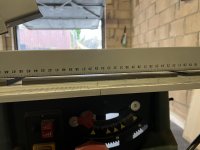
Thank you so much for all replies and i do believe each reply has priceless information for me, obviously everyone would want to get a expensive saw but at this point i am not sure how much i can get out of it i had to start from somewhere , I’ll attach some photos too as you can see on pics back of the table is ok not too bad but front one is really bad can see lights. Wanted to know how much it matters for cutting.

Many thanks
 

Attachments

  • 57111468-785C-47D0-A241-90226631AB70.jpeg
    57111468-785C-47D0-A241-90226631AB70.jpeg
    350 KB · Views: 2,801
  • ECB329BF-8591-4FDE-BC64-D65141603DA2.jpeg
    ECB329BF-8591-4FDE-BC64-D65141603DA2.jpeg
    239.5 KB · Views: 2,801
It kind of matters, but not really, if that makes sense. Yes that level of flatness isn't ideal but providing you know it's there then you can usually tweak the blade angle to account for it. As I said earlier, if you're planning on making a sled then that will give you your flatness and the consideration then is to ensure the slots in the table are parallel to each other and both parallel to the blade (there is usually minor adjustment available to the table to facilitate this).

If those all line up, then your sled runners will work and with a decent blade you will be able to get decent results. If they don't line up then it will be impossible to use a sled and you may be better off replacing it.

In terms of the bow in the table, not ideal but not the end of the world. I have a large cast iron topped table saw and even that has an amount of bow in the table, but with test cuts and a small amount of care setting up, it can cut absolutely perfect, square and smooth direct from the blade. Just takes time and care.
 
Is your straight edge just lying on the central table or the outrigger parts as well?

If those slots are parallel to the blade, that's possibly more important.
 
I would treat AndyT's post as gold-dust. Any amateur-level power tool produces a "finish" which needs finishing, and learning to sharpen, set-up, and use a number 5 or 6 plane will get you over almost any issue thrown up by a poorly made machine. I rip with a bandsaw, and that necessitates planing afterwards. The only use I would ever have for a table saw would be making large rebates, or rebates a long way from a reference edge. They'd be rough as old boots, but then I'd pick up a hand-tool and sort it out. The basic principle of this approach is to use machinery or power tools for the "grunt" work, and hand tools to achieve your desired accuracy and finish.
 
I’ve already adjusted the blade square and I believe it is fine , I’ll check slots to make sure they are parallel, and give it a last chance, I’ll add another phone and straight edge is on all table , I have a number 4 hand plane and to be honest i think i need to learn so much about them as they are amazing , simple but need experience. It’s been literally couple of months since I started working before then i did not even use any saw in my life. Many thanks
 

Attachments

  • D21543B8-9288-4E7B-95C4-65F9812354DA.jpeg
    D21543B8-9288-4E7B-95C4-65F9812354DA.jpeg
    331.1 KB · Views: 2,738
That looks to me like the central part is reasonably flat.
You added the out rigger parts and so they must be adjustable by slacking the bolts and moving a little bit
 
Mike G":3ibwmjyf said:
I would treat AndyT's post as gold-dust. Any amateur-level power tool produces a "finish" which needs finishing, and learning to sharpen, set-up, and use a number 5 or 6 plane will get you over almost any issue thrown up by a poorly made machine. I rip with a bandsaw, and that necessitates planing afterwards. The only use I would ever have for a table saw would be making large rebates, or rebates a long way from a reference edge. They'd be rough as old boots, but then I'd pick up a hand-tool and sort it out. The basic principle of this approach is to use machinery or power tools for the "grunt" work, and hand tools to achieve your desired accuracy and finish.

:text-+1:

Agree with Mike. Inexpensive equipment is going to be inaccurate whichever way you slices it and at best can only be really used for rough work. The accuracy comes from finishing with hand tools; even a decent quality p/t will leave 'ripple' marks from the cutters which will then need to be cleaned up with a No.5 or 6 so the last 0.25mm comes off by hand. I gave up using a table saw yonks ago 'cos they were not only horribly inaccurate, but took up a large 'footprint' in my 'shop - Rob
 
bkaragoz":3b1v9lyd said:
.......I have a number 4 hand plane and to be honest i think i need to learn so much about them as they are amazing , simple but need experience.......

Whereabouts in the country are you? We've members all over, so I am sure that someone would be near and give you an hour or two of advice. If you try to work it out for yourself, it could take you years of frustration before you can fully exploit a plane.

A number 4 is a really fantastically useful plane, and I think probably the first plane that anyone should buy. But maybe for your potential useage, a number 6 might be your next purchase. £40 or £50 buys you a decent second hand one off Ebay or Facebook Marketplace........and any old Stanley or Record is going to be miles better than buying a new one for the same sort of money. If you buy one with a wooden handle you know it's likely to be old enough to be top quality.
 
I agree with the advice here. If you are near me (mid Kent) I am happy to show you how to set up, sharpen and use a plane and have a number of sizes you can try. 4 or 41/2 will always be useful. 4 1/2 can be had in standard and wide forms for the old Record / Stanley. Either is good.

I agree abut the table too. I bought one of those Draper cast iron ones for next to nothing a couple of years ago when they had a silly deal. Cast iron sliding table as well. It's underpowered, fences are rudimentary and the blade was junk. I bought it as a portable table saw I could put close to a big job I was doing. OK it is not a super accurate saw, but it has proved very useful for cutting up trim pieces of oak (long strips about 8mm thick and 3m long, and is much quicker and easier than my band saw - it's the best tool for that job. Takes no time to do a couple of finish strokes with a hand plane. Also good for repetitive cutting of hundreds of MDF panel pieces.
 
AJB Temple":2tj7dyaf said:
I agree with the advice here. If you are near me (mid Kent) I am happy to show you how to set up, sharpen and use a plane and have a number of sizes you can try. 4 or 41/2 will always be useful. 4 1/2 can be had in standard and wide forms for the old Record / Stanley. Either is good.

Same here if you're anywhere near Salisbury; you can actually have a play with a real Norris A1 panel plane as well as low angle jobbies should you be so inclined. Record/Stanley's of various denominations are set up in exactly the same way as the Norris - Rob
 
I live in south Wales , in Bridgend near Cardifff, I would love to see how to use a hand plane properly and get some advice about future purchases as i have no experience, when you talk about getting accuracy from hand tools I can’t even imagine how could it be possible I’ve always been thinking accuracy would come from machinery:) , and like you said videos is full of American youtubers teaching literally nothing but advertising.

I appreciate each of your replies
 
Top right hand corner of every page on the forum is a link to the Members Map. If you have a look there you will see if anyone is near you. If you're anywhere near Bristol then one of the leading lights in UK hand-tools, AndyT, knows more about planes than most.
 
Mike G":ijr7kqac said:
Top right hand corner of every page on the forum is a link to the Members Map.

Unfortunately it’s not very comprehensive, most folks seem to have avoided being on it.
 
I’ve looked and no one seems to be near me , I’m not near Bristol but i might visit him if he accepts me .
 
Lurker":2v608zik said:
Where have you got to with the TS?

I’ve made a cross cut sled and very happy with it , as you mentioned that it could be same issue with every saw , not sure if there’s any other tests i can do [emoji2369] Fence is really bad i have to measure from slots to fence front and back every time i want to make a cut , very annoying .
Many thanks
 
Your sled sorted you out for cross cutting.
Regards ripping and you fence:
Even more expensive table saws can be a bit dodgy in this respect, as Bob says have a look for a fix on the internet.
As an aside, are you aware that for ripping, your fence should not be longer than just after the front of the saw blade?
 
Lurker":2986q277 said:
As an aside, are you aware that for ripping, your fence should not be longer than just after the front of the saw blade?


Thank you for replys , I’ve already looked online for making a fence but I found them not an easy job for me to do [emoji2357], I am not aware of that at all , are you saying the fence doesn’t need to be parallel to blade at front and back ?


Sent from my iPhone using Tapatalk
 
No, this is what they were saying:

rip fence.jpg

If you are ripping, the leading end of the fence should not go past the teeth at the front edge of the blade.
 
All you need to do is fix a piece of timber onto the original fence,(as in the previous dwg) don't make another one! The purpose is to allow the timber to spread apart slightly past the blade as it often does when ripped. Without this freedom it can jam between the fence and the blade. The only sensible reason for a TS to have a full length fence is if it tightens/fixes on the outfeed side as well. So you do need to add that piece for clearance to make it safe. You can make it a bit longer than shown above but not past the centre of the blade.
 
I think I don’t know that much about TS , I didn’t know anything about rip fence as I still think i don’t lol , so if i fix another piece of timber to the fence as shown with both pictures, what benefits will it give in terms of accuracy or what’s the point? , hope you understand I don’t know much about TS as you all do


Sent from my iPhone using Tapatalk
 
Hi Baris, once the wood has been cut it isn’t necessary to have anything next to it in fact it’s a bad idea as if the wood moves (due to being been cut) it can be thrown back at you by the blade.
Also with a short wooden fence will be easier to make it parallel to the blade. Ian
 
Cabinetman":1k48fhqs said:
Hi Baris, once the wood has been cut it isn’t necessary to have anything next to it in fact it’s a bad idea as if the wood moves (due to being been cut) it can be thrown back at you by the blade.
Also with a short wooden fence will be easier to make it parallel to the blade. Ian
i was not aware of that at all , I’ll try this as soon as possible, any ideas how can i fix it to the fence flush ?
Many thanks


Sent from my iPhone using Tapatalk
 
bkaragoz":11lz1s7z said:
.....any ideas how can i fix it to the fence flush ?

I would use counterbored 6mm coach bolts with a washer and butterfly nut on the other side of the existing fence - Rob
 
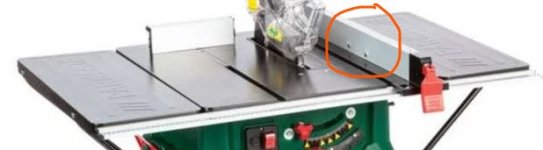
Looking at an online picture of your fence, it seems there are two round marks on the face. Are these holes that you can pass bolts through? This would seem to be an easy method if so.

Parkside fence.jpg

Otherwise a clamp or two should help certainly with sheet cutting without getting in the way

Obviously if you make yourself a decent fence, then you can design in a tee slot in the main fence to attach a sliding sub fence.

Bob
 
Thank you for reply Rob , There were 2 bolts with washers and they weren’t flush with the fence so i had to remove them , I’ll try to fix it to those holes i hope it works , thank you Bob .

7bdfa32b7e6ca112cf4d5b82a30c01a2.jpg


Sent from my iPhone using Tapatalk
 
:shock:
How on earth has that saw been sold with the fence like that, with two protruding bolt heads?
 
Andyp":ny1nivv1 said:
:shock:
How on earth has that saw been sold with the fence like that, with two protruding bolt heads?

Has it been mounted backwards, perhaps? In other words, should they be on the other side of the fence?
 
That photo is demonstrating just about THE most dangerous thing to do on a TS.
Never ever use a fence like that as a length stop. You CAN use a fence to do it but the timber must clear the stop before it goes near the blade. (So clamp a little block on)
The consequences of the timber twisting against the blade and the fence can be catastrophic.
 
Back
Top