For quite some time, I have owned one of these:
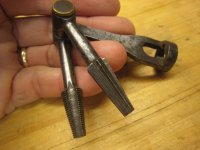
I can't remember where I got it, but it won't have cost very much - I don't think they are particularly rare.
You can see that it has, in one handy tool, a tapered reamer, die and tap, with a middle diameter of about 3/8". Who would need one of those? Well, back in the days before electricity, anyone wanting something better than oil lamps or candles. Here's an entry from a 1908 Tyzack catalogue:

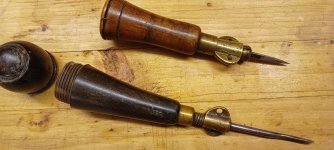
That's my one in the middle. Now, don't get me wrong. I'm not going to start fiddling about with gas pipes and fittings. Even my 1890 copy of "Every Man His Own Mechanic" warns that gas fitting "if badly and inefficiently done may involve serious consequences" and is "best left to professional artisans" (before going on to say that the householder should know how to stop a leak or swap one light fitting for another.) So what else can I do with my little multi-tool?
I thought I would have a go at making a handle with a collet on, to hold needle files. It's not always necessary to have a proper handle on a little needle file, and I seem to have managed quite well without one, but it's an excuse to have a play on my old treadle powered lathe and see what happens.
I'll let the pictures tell most of the story.
Here's a bit of 3/8" brass rod in the 3-jaw chuck. I've swivelled the top part of the cross-slide round at an angle equal to the taper on the reamer. By using the little twiddly handles on the right to advance the cutter, it will make a taper on the rod.

And so it does.
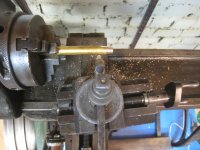
You can also see that the work isn't precisely centred, but it won't matter here.
With the taper made, it was easy to hold the die in place, pull the headstock round, and cut a matching tapered thread.
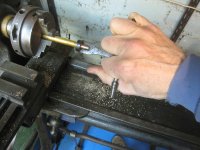
which I followed up with a bit of a neck, to make it easier for what will be the jaws of the collet to bend inwards.

To make a matching round nut, I parted off a wider bit of brass rod and tried this old single knurl tool for the first time.

drilled a 5/16" hole

reamed it
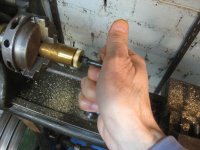
and cut it off.
Actually, I soon realised that I needed to shape the profile of the nut before trying to knurl it. Also, it needed to be smaller, and with a slightly larger hole.
Here's the central part, with a 1/8" hole drilled when it was still on the lathe, and some cuts down, hacksawed by eye.

And here it is, with the mark 2 nut

I then turned an offcut of ash to make a handle, with a 3/8" hole down the middle and the usual bit of copper pipe for a ferrule.
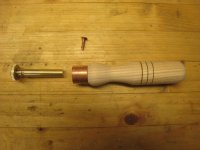
And here it all is after some epoxy resin and a wipe of oil on the handle.


So there it is. A bit rough here and there but it works. I prefer it if I manage to make use of my old tools, so this will do for me. A pleasant few hours in the workshop and a little bit of Victorian DIY that my old Grandad would have appreciated.
I can't remember where I got it, but it won't have cost very much - I don't think they are particularly rare.
You can see that it has, in one handy tool, a tapered reamer, die and tap, with a middle diameter of about 3/8". Who would need one of those? Well, back in the days before electricity, anyone wanting something better than oil lamps or candles. Here's an entry from a 1908 Tyzack catalogue:
That's my one in the middle. Now, don't get me wrong. I'm not going to start fiddling about with gas pipes and fittings. Even my 1890 copy of "Every Man His Own Mechanic" warns that gas fitting "if badly and inefficiently done may involve serious consequences" and is "best left to professional artisans" (before going on to say that the householder should know how to stop a leak or swap one light fitting for another.) So what else can I do with my little multi-tool?
I thought I would have a go at making a handle with a collet on, to hold needle files. It's not always necessary to have a proper handle on a little needle file, and I seem to have managed quite well without one, but it's an excuse to have a play on my old treadle powered lathe and see what happens.
I'll let the pictures tell most of the story.
Here's a bit of 3/8" brass rod in the 3-jaw chuck. I've swivelled the top part of the cross-slide round at an angle equal to the taper on the reamer. By using the little twiddly handles on the right to advance the cutter, it will make a taper on the rod.
And so it does.
You can also see that the work isn't precisely centred, but it won't matter here.
With the taper made, it was easy to hold the die in place, pull the headstock round, and cut a matching tapered thread.
which I followed up with a bit of a neck, to make it easier for what will be the jaws of the collet to bend inwards.
To make a matching round nut, I parted off a wider bit of brass rod and tried this old single knurl tool for the first time.
drilled a 5/16" hole
reamed it
and cut it off.
Actually, I soon realised that I needed to shape the profile of the nut before trying to knurl it. Also, it needed to be smaller, and with a slightly larger hole.
Here's the central part, with a 1/8" hole drilled when it was still on the lathe, and some cuts down, hacksawed by eye.
And here it is, with the mark 2 nut
I then turned an offcut of ash to make a handle, with a 3/8" hole down the middle and the usual bit of copper pipe for a ferrule.
And here it all is after some epoxy resin and a wipe of oil on the handle.
So there it is. A bit rough here and there but it works. I prefer it if I manage to make use of my old tools, so this will do for me. A pleasant few hours in the workshop and a little bit of Victorian DIY that my old Grandad would have appreciated.