• Hi all and welcome to TheWoodHaven2 brought into the 21st Century, kicking and screaming! We all have Alasdair to thank for the vast bulk of the heavy lifting to get us here, no more so than me because he's taken away a huge burden of responsibility from my shoulders and brought us to this new shiny home, with all your previous content (hopefully) still intact! Please peruse and feed back. There is still plenty to do, like changing the colour scheme, adding the banner graphic, tweaking the odd setting here and there so I have added a new thread in the 'Technical Issues, Bugs and Feature Requests' forum for you to add any issues you find, any missing settings or just anything you'd like to see added/removed from the feature set that Xenforo offers. We will get to everything over the coming weeks so please be patient, but add anything at all to the thread I mention above and we promise to get to them over the next few days/weeks/months. In the meantime, please enjoy!

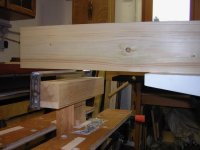
Nothing fancy, just a very useful Board Catcher

Excuse my ignorance, but why is that preferable to a roller?
The problem with a roller is that it has to be set at EXACTLY the right height for it to work. If it is even slightly too high it can get pushed over. It's fine if you can nip round to the other end to seat it properly on the roller, then all is good, but this way it 2catches" the board, even if it is not exactly, to the millimetre, in line.

I used to have the same sort of thing with the roller stand, a board with two battens underneath, which just dropped onto the roller. The board is offset a little to make sure it always flops toweards the machine, ready for collectiom, something which I don't think I made very clear on the film.
S
 
The problem with a roller is that it has to be set at EXACTLY the right height for it to work. If it is even slightly too high it can get pushed over. It's fine if you can nip round to the other end to seat it properly on the roller, then all is good, but this way it 2catches" the board, even if it is not exactly, to the millimetre, in line.

I used to have the same sort of thing with the roller stand, a board with two battens underneath, which just dropped onto the roller. The board is offset a little to make sure it always flops toweards the machine, ready for collectiom, something which I don't think I made very clear on the film.
S
Ok. Thanks for the explanation. I did get the offset/flop towards the machine thing from your film, but still couldn't really discern the advantage. Surely the whole thing could still be pushed over if the board catcher is set too low?
If the pivoted board had a stop that would prevent it going past horizontal, and the centre of gravity of the workpiece ended up sufficiently downstream of the pivot point to result in a stable support situation, I could see the point.
 
I must admit that I think exactly the same thing as John. The problem with rollers-on-stands is that some boards going through a machine aren't perfectly straight. The ones that tilt up at the nose would give the illusion that the device was working, but without actually receiving any support. The work would hover a few mm above the device, but the tilting board would pivot so as the far edge was rubbing along the underside. It would take keen observation to realise that the support was doing precisely nothing. The ones that tilt down at the nose can bash into a roller and push it over, and for those, I can see Steve's design working really well. The flipping board would gently lift the nose sufficiently for it to sit flat on the apparatus. The lesson.............set Steve's device a few mm high, above the level of the table.

Did we see you wielding a hand plane Steve? Or did you get a body double in for that bit...... ;) :p
 
I've never found a need for a support for use with a thicknesser. I just support the workpiece by hand as enters the machine and when it reaches its mid-point I transfer my self propelled, infinitely variable height adjustable support system to the outfeed. The same system is then available to transport the workpiece to the next operation.
Brian
 
Great idea Steve!!! you should patent it.
You could also add another attachment and it could double up as music stand.
 
Very good Steve, well worth a 'copy'.
I also dismantled the roller-ball stand made many years ago as it was more of a hassle lining up especially when ripping long boards off the TS (2500mm ++)
Made two others to not waste the roller balls, they clamp onto my trestles and are set at the TS height.
Cost to do yours is negligible and worth a try.
Very long boards through the thicknesser are also an issue when wide.
 
Brian, one of the issues about just nipping round to the other end is that I am not as nimble as I used to be and the way things are arranged at the moment I have to negotiate my way over the 4" extractor hose. This just helps.
To the doubters, I can only say that I have been using this (well, its predecessor which had two battens underneath and just slipped over the roller) for over 20 years and have never had the problems you seem to imagine.
It just works.
Your mileage may differ.
 
Last edited:
I like that idea Steve.
Is a 4” extractor hose all you have to get round?:)
Last time I needed to plane a long piece of timber this was the setup.
DSCN7670.jpeg
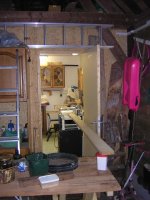
In the far distance you can just see my out feed support. There is a 6” step between the barn area where I started and the workshop. IIRC the plank was 3m long.


DSCN7648.jpeg
 
Steve, I had 2 roiier supports and used them frequently feeding long/heavy timbers onto (or away from) the planer, table saw or bandsaw, but never the thicknesser.
I agree your don't want to be nipping around with a 4" tripping hazard on the floor.

Mileage may differ but not in the direction you may assume. Tomorrow we're picking up a nice shiny 5 year old car with under 10k on the clock. I wish I could trade in my rusty old body.

I came across this song a few days. Made me quite reflective.

Brian

PS
Why did you turn a cylinder to mount the plate on?
 
Back
Top