Dr.Al
Old Oak
I'm going to be taking my travel tool chest for a little jaunt in the fairly near future and I've started thinking about which sort of glue to take with me. Most of the glue I have is rather old and I thought it would be quite interesting try to compare their efficacy. I've seen quite a few comparisons on-line trying to compare all sorts of different brands and types of glue but in every case they start with brand new bottles.
Since I started gluing dovetails in the David Charlesworth manner, I get through tiny amounts of glue on each box I make and hence a small bottle will last me a very long time.
I know there are things you can do to extend shelf life (like keeping the PVA glue in the fridge or superglue in the freezer) but there comes a point when the glue is just really really old and probably won't work that well.
To get at least a modicum of consistency in the process, I'm going to be gluing lollipop sticks together using spring clamps to hold the joint while the glue dries. The first batch includes, first of all, some modern glues:
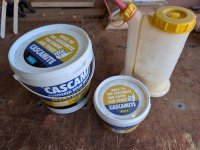
The Glubot thing has some Titebond 1 in it that I bought in 2020. Surprisingly, it still flows out of the bottle. My bottle of Titebond 3 from the same year got thrown away a year or two ago as it had solidified in the bottle. I've got a bottle of Titebond 3 from April 2025 so I may include that in the test as well. None of the glue has ever been in the fridge.
Both of the Cascamite tubs claim "Back to the Cascamite you know and trust" but one is labelled Polyvine and the other Ureka. As I understand it, Polyvine messed with the formula at some point and lost a lot of customers as a result. I don't know whether they went back to the original formula before Ureka took over the glue brand or whether it only happened after Ureka took over - the labelling on the tubs implies it was before but I have no idea: these two tubs are the only ones I've ever owned. The Polyvine one was bought in May 2021 and was used for an end grain chopping board that is still going strong so I have no reason to think there's a problem with its formulation. The Ureka one was a free sample sent to me in late 2023 (and was opened for the first time today).
I'm also going to try some protein glues:
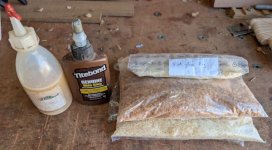
The bottle on the left is some liquid fish glue that I bought in late 2022. Annoyingly I can't find a record of when I bought the Titebond Liquid Hide Glue but I used it on the tool chest project in April 2023 so I'd guess it was bought at a similar time to the fish glue. The small bag of fish glue flakes was bought on ebay in April 2024. The paler coloured bag of hide glue flakes (which is still unopened ) at the bottom was bought on ebay in October 2024; I'm not sure when I bought the darker hide glue flakes (from Axminster I think, but in person hence not having a record of the date). I've not really done much in the way of experimenting with the flaked protein glues so this is also an opportunity for me to learn a bit more about them.
This is the what I'm using for the hide glue flakes:
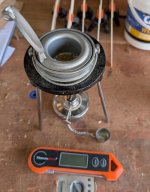
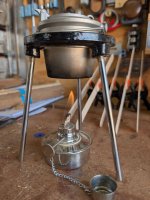
The glue pot is the Lee Valley one, which is a nice size for the sort of jobs I do. It's sitting in an ebay tripod with an aluminium sleeve that I turned on the lathe to match the inside diameter (and taper) of the glue pot. The probe thermometer is used to check the temperature of the hide glue as I haven't used it enough to gain a feel for it. For this first go, I weighed out equal portions (about 10 g each) of water and hide glue and left it to soak for 30 minutes. I then heated it in the water bath to about 60 degrees with this little bioethanol/meths burner with an adjustable wick (I'm using bioethanol as it's less smelly):
After gluing two pairs of lollipop sticks with the hide glue I'll leave the glue overnight and glue some more tomorrow (or the day after) to see how it lasts post-mix.
I haven't done the fish glue flakes yet but that process will be similar I think, just more soaking time and a lower temperature.
The next photo shows everything together and you can see the first five prepared joints (this photo was taken before I did the hide glue ones):
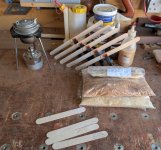
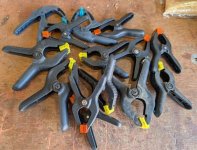
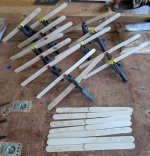
I bought two packs of 100 lollipop sticks from amazon. On each one I mark a pencil line 40 mm from the end so that all the glue joints have the same amount of overlap. I then apply glue to both sticks using a paint brush and hold them together with a spring clamp. I've got six identical spring clamps so can prepare six pieces at a time (although I glued an extra hide glue joint and held it with a different clamp as I wanted to do more trials with that as I'm unfamiliar with it).
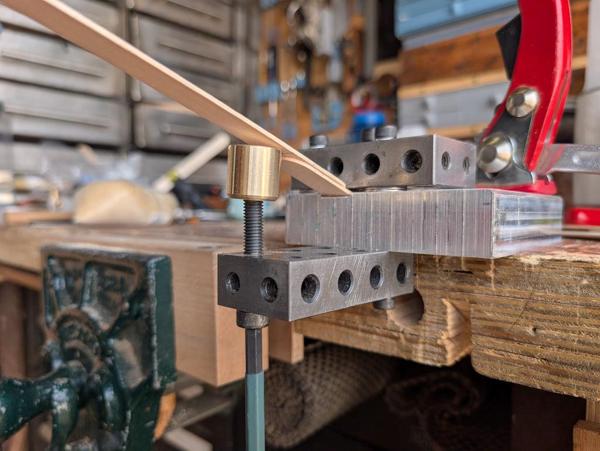
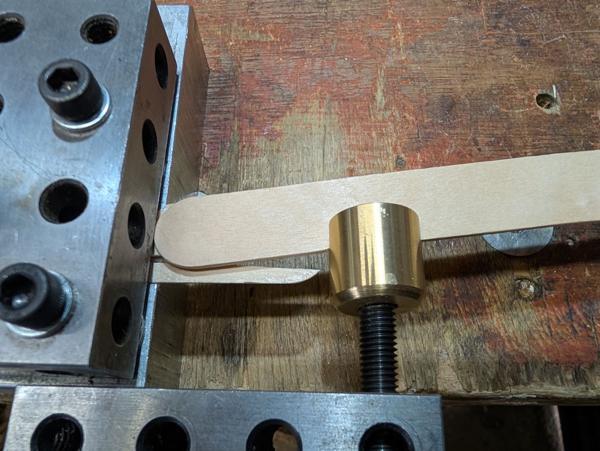
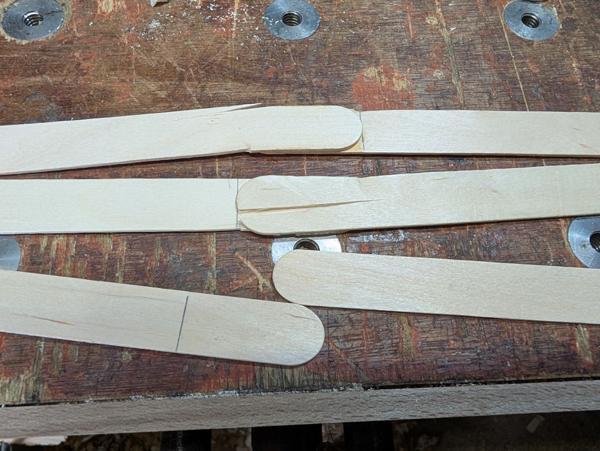
I haven't quite decided how to test the joint, although it'll probably involve a simple metal jig with a screw bearing on the wood. The main thing to decide is whether to test in shear (twisting the lollipop sticks in the plane of the glue joint) or to apply a peeling stress. Either way I probably won't worry too much about a calibrated force: I'll just see if the glue joint fails first or if the wood breaks.
It'll be interesting to see how the various glues compare. I'm particularly hoping the liquid fish glue works well: as you can see I've got a lot of the bottle left. I really like the long working time you get with fish glue: for me I think the ideal glue would be one with an infinite shelf life and a very long working time. Obviously a bit of strength is important to but most of the joint strength hopefully comes from geometry rather than glue function.
Fish glue doesn't seem to be a very easy thing to get hold of (especially in flake form) so I'm extra keen that the bottle I've got keeps going for as long as possible. Cascamite seems to be quite a promising option for the long shelf life (given that it's supplied dry) and long working time, although mixing it up is a bit of a faff so I think I still prefer the fish glue.
Since I started gluing dovetails in the David Charlesworth manner, I get through tiny amounts of glue on each box I make and hence a small bottle will last me a very long time.
I know there are things you can do to extend shelf life (like keeping the PVA glue in the fridge or superglue in the freezer) but there comes a point when the glue is just really really old and probably won't work that well.
To get at least a modicum of consistency in the process, I'm going to be gluing lollipop sticks together using spring clamps to hold the joint while the glue dries. The first batch includes, first of all, some modern glues:
The Glubot thing has some Titebond 1 in it that I bought in 2020. Surprisingly, it still flows out of the bottle. My bottle of Titebond 3 from the same year got thrown away a year or two ago as it had solidified in the bottle. I've got a bottle of Titebond 3 from April 2025 so I may include that in the test as well. None of the glue has ever been in the fridge.
Both of the Cascamite tubs claim "Back to the Cascamite you know and trust" but one is labelled Polyvine and the other Ureka. As I understand it, Polyvine messed with the formula at some point and lost a lot of customers as a result. I don't know whether they went back to the original formula before Ureka took over the glue brand or whether it only happened after Ureka took over - the labelling on the tubs implies it was before but I have no idea: these two tubs are the only ones I've ever owned. The Polyvine one was bought in May 2021 and was used for an end grain chopping board that is still going strong so I have no reason to think there's a problem with its formulation. The Ureka one was a free sample sent to me in late 2023 (and was opened for the first time today).
I'm also going to try some protein glues:
The bottle on the left is some liquid fish glue that I bought in late 2022. Annoyingly I can't find a record of when I bought the Titebond Liquid Hide Glue but I used it on the tool chest project in April 2023 so I'd guess it was bought at a similar time to the fish glue. The small bag of fish glue flakes was bought on ebay in April 2024. The paler coloured bag of hide glue flakes (which is still unopened
) at the bottom was bought on ebay in October 2024; I'm not sure when I bought the darker hide glue flakes (from Axminster I think, but in person hence not having a record of the date). I've not really done much in the way of experimenting with the flaked protein glues so this is also an opportunity for me to learn a bit more about them.This is the what I'm using for the hide glue flakes:
The glue pot is the Lee Valley one, which is a nice size for the sort of jobs I do. It's sitting in an ebay tripod with an aluminium sleeve that I turned on the lathe to match the inside diameter (and taper) of the glue pot. The probe thermometer is used to check the temperature of the hide glue as I haven't used it enough to gain a feel for it. For this first go, I weighed out equal portions (about 10 g each) of water and hide glue and left it to soak for 30 minutes. I then heated it in the water bath to about 60 degrees with this little bioethanol/meths burner with an adjustable wick (I'm using bioethanol as it's less smelly):
After gluing two pairs of lollipop sticks with the hide glue I'll leave the glue overnight and glue some more tomorrow (or the day after) to see how it lasts post-mix.
I haven't done the fish glue flakes yet but that process will be similar I think, just more soaking time and a lower temperature.
The next photo shows everything together and you can see the first five prepared joints (this photo was taken before I did the hide glue ones):
I bought two packs of 100 lollipop sticks from amazon. On each one I mark a pencil line 40 mm from the end so that all the glue joints have the same amount of overlap. I then apply glue to both sticks using a paint brush and hold them together with a spring clamp. I've got six identical spring clamps so can prepare six pieces at a time (although I glued an extra hide glue joint and held it with a different clamp as I wanted to do more trials with that as I'm unfamiliar with it).
I haven't quite decided how to test the joint, although it'll probably involve a simple metal jig with a screw bearing on the wood. The main thing to decide is whether to test in shear (twisting the lollipop sticks in the plane of the glue joint) or to apply a peeling stress. Either way I probably won't worry too much about a calibrated force: I'll just see if the glue joint fails first or if the wood breaks.
It'll be interesting to see how the various glues compare. I'm particularly hoping the liquid fish glue works well: as you can see I've got a lot of the bottle left. I really like the long working time you get with fish glue: for me I think the ideal glue would be one with an infinite shelf life and a very long working time. Obviously a bit of strength is important to but most of the joint strength hopefully comes from geometry rather than glue function.
Fish glue doesn't seem to be a very easy thing to get hold of (especially in flake form) so I'm extra keen that the bottle I've got keeps going for as long as possible. Cascamite seems to be quite a promising option for the long shelf life (given that it's supplied dry) and long working time, although mixing it up is a bit of a faff so I think I still prefer the fish glue.
Last edited:


 I haven't tried it with ketchup bottles as we don't use the stuff but plenty of other containers including paint tins.



 ).
).
 Excellent stuff