• Hi all and welcome to TheWoodHaven2 brought into the 21st Century, kicking and screaming! We all have Alasdair to thank for the vast bulk of the heavy lifting to get us here, no more so than me because he's taken away a huge burden of responsibility from my shoulders and brought us to this new shiny home, with all your previous content (hopefully) still intact! Please peruse and feed back. There is still plenty to do, like changing the colour scheme, adding the banner graphic, tweaking the odd setting here and there so I have added a new thread in the 'Technical Issues, Bugs and Feature Requests' forum for you to add any issues you find, any missing settings or just anything you'd like to see added/removed from the feature set that Xenforo offers. We will get to everything over the coming weeks so please be patient, but add anything at all to the thread I mention above and we promise to get to them over the next few days/weeks/months. In the meantime, please enjoy!

Overflow bookshelves.....DUN

Woodbloke

Sequoia
Joined
Jul 22, 2014
Messages
7,221
Reaction score
1,133
Location
Salisbury, UK
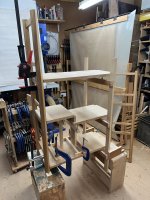
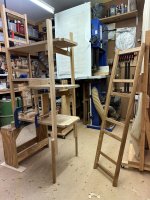
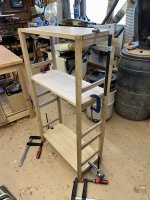
We have a bookcase in the lounge (made a few years ago) which is groaning so we have a need of an overflow bookshelf to go into the spare bedroom. It looks fairly straight forward but it ain't, principally 'cos the second shelf up from the bottom (not installed) has a 'step' in it so is on two levels, with a vertical panel to support it. This is the first 'dry run' to see the eventual form:

IMG_5973.jpeg

IMG_5974.jpeg

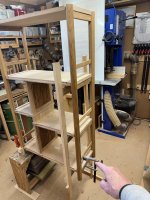
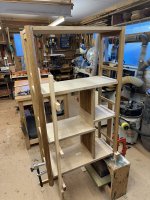
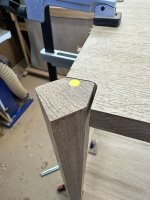
The job is further complicated as each of the legs is offset by 45 degrees which made for some tricky work with the Domino to machine the mortices. Second and foremost, the shelves (bandsaw oak veneer over a solid quarter sawn pine laminate substrate) have a 3mm shadow gap round the legs, so won't actually be in contact:

IMG_5975.jpeg

IMG_5976.jpeg

The offset legs are a Krenov feature and can be seen in a couple of his pieces; easy enough to make on the router table but awkward in other respects such as gluing up the 'ladder' frameworks. With careful detail drawings (twice full scale) this is relatively easy to make; the tricky bit will be working out the correct sequence to assemble the finished project....probably a use for 'old skool' proper Araldite epoxy?? - Rob
 
Generally, the reason for choosing to veneer is obvious. For the life of me I can't see the advantage of doing this in veneer rather than just solid oak boards.

There must be some complication in the absent 2nd shelf which somehow complicates the glue-up, because otherwise it looks just a question of gluing up the 2 ladders separately, cleaning them up, then gluing in the shelves.

If there isn't a back, what prevents the whole thing from racking?
 
Generally, the reason for choosing to veneer is obvious. For the life of me I can't see the advantage of doing this in veneer rather than just solid oak boards.

There must be some complication in the absent 2nd shelf which somehow complicates the glue-up, because otherwise it looks just a question of gluing up the 2 ladders separately, cleaning them up, then gluing in the shelves.

If there isn't a back, what prevents the whole thing from racking?
As mentioned Mike, the second shelf doesn't go all the way across, but has a 'step' in it with a vertical panel in three sections joining it to the shelf above and the one below. The shelves will be glued onto their respective cross rails with a very substantial 6mm ply tongue so there's unlikely to be any racking and as to veneering, I can get all the veneers out of one thickish board of Oak whereas to do it in the solid would take three times as much timber. Solid shelf boards would then have to be fixed to the framework to allow for movement and would thus not be integral with it, if say buttons were to be used. In addition, buttons, if used would be always on view which would ruin the aesthetic of the whole piece. They have their obvious place, but not on this job - Rob
 
I really like the angled legs.
Thanks...I've been pondering on this one all evening. The lower and middle shelves as shown have narrower 'rungs' (12mm thick) each that will eventually prevent the books from falling out sideways, but it means that the shelves can't be manipulated into position on their respective rails as there isn't enough room to twist them flat. The conclusion is that I'll have to come up a very 'cunning plan' to support the entire construction in order to fit the shelves to the frame...I think. Or possibly the final ladder framework to the shelves once they're all in position... - Rob
 
Last edited:
This is getting very complicated!

IMG_6057.jpeg

IMG_6058.jpeg

IMG_6059.jpeg

Vertical panels from a small board of Brown Oak kindly donated to the cause by 'Cabinetman' a couple of years ago - Rob
 
Haha, I saw those and thought that looks very much like Brown Oak, I had forgotten I’d donated it to the cause. I like it - a lot!
Lovely stuff Ian, beautiful to work with unlike the awful kiln dried Oak I used for the frame. The last photo won't work but by removing the:

IMG_6060 2.jpeg

...sawing stool and screwing on a couple of leg extensions, it ought to be much 'easier to glue the right hand side ladder in place - Rob
 
A wee update on this one. Although the component parts were relatively straight forward to build, the actual assembly has proved insanely difficult as I've had to construct all sorts of cunning jigs to ensure, as best I can, that verticals are plumb vertical:

IMG_6127.jpeg

...and horizontals are more or less horizontal. Vertical panels in Brown Oak:

IMG_6128.jpeg

...as are the 'upstands' to fit into the stopped rebates. If I were to take off the cramp indicated....

IMG_6129.jpeg

...the whole of that 'ladder' would come crashing to the floor, as I discovered the other day. A view from the front giving some idea:

IMG_6131.jpeg

...of what it'll eventually look like, if you can image dispensing with that softwood concoction that's supporting the assembly. Much fitting, fettling and faffing yet to do but I'm getting there....slowly. As mentioned earlier, it had to be assembled this way (shelves go in sideways) as it's impossible to drop them in from above - Rob
 
As ever with your builds Rob, I find this fascinating to watch, but somehow I don't think there will be a rash of imitations any time soon!

I've made quite a few bookcases, some crudely made of softwood joined with nails, others with hardwoods, dovetails and housings, but I wouldn't have the patience for following Krenov on this one.
 
As ever with your builds Rob, I find this fascinating to watch, but somehow I don't think there will be a rash of imitations any time soon!

I've made quite a few bookcases, some crudely made of softwood joined with nails, others with hardwoods, dovetails and housings, but I wouldn't have the patience for following Krenov on this one.
The thread title doesn’t do this build justice.
Thanks chaps. This isn't really a JK build though the legs design is, but as far as I'm aware he didn't ever make anything remotely like this. I think it's probably more of a Scandi thing as opposed to another JK 'interpretation' but I really didn't have a Scoobies as to actually how difficult this would be to put together until I tried to fit the shelves and then the proverbial euro dropped. The next stage is to fit the 'upstands' after which it will be polished bit by bit and then glued together a section at a time, starting from the bottom up. I think..... - Rob
 
Now dun but a few pics to illustrate just how complicated this thing was to put together and some of the completed bookshelf:

IMG_6177.jpeg

IMG_6181.jpeg

Panelled frames glued in place with convex ash cauls that straighten out to give pressure in the middle. End 'ladder' being glued:

72FFA4A3-8A9A-4F21-B23C-CE97DAE750C8.jpg

I made the almost fatal mistake of working when ill(ish) prior to Christmas and planed down the top of the legs too far, so I did a proper Alan Peters and made a feature of the Brown Oak end caps, glued on with 'old skool' Araldite overnight and planed flush yesterday using the top as a runway for the plane:

IMG_6187.jpeg

From being a horrendous cock up, the finished legs look acceptable:

IMG_6197.jpeg

Finished with a couple of coats of thinned down Odie's Oil. Great stuff but it's far too bloody expensive and really hard work to apply neat:

IMG_6190.jpeg

Once dry in about an hour, a coat of thinned wax was applied with a grey Webrax pad and buffed off with a clean towel. An old scissor jack from one of our cars was used to support:

IMG_6185.jpeg

...the framework as the pine concoction was dismantled. Not the first time I've used this scissor jack but a very, very handy bit of kit for the workshop. Finally a couple of glamour shots:

IMG_6195.jpeg

IMG_6198.jpeg

...of the finished project with some of the larger books it was initially designed for; I think the next project will be a simple JK cabinet with double concave panelled doors! - Rob
 
Last edited:
Well done again Rob. A standard for the rest of us to aspire to.
 
Simple lol
Very nice Rob, those end caps are a clever get out! Bet the air was a bit blue when you realised what you had done.
There is some beautiful grain on that 1/4 sawn Oak.
I'd been definitely under the weather and decided to do a 'bit' (unwisely) in the 'shop. Consequently I really didn't think about what I was doing when I picked up the plane and it was only afterwards when checking did I realise that one corner was about 2mm or so lower than it should be! There was a bit of 'oh goodness, gracious me, what have I done?' (or similar:LOL:) going on before I came up with the cunning Alan Peters 'fix'...which didn't turn out too shabbily - Rob
 
That's a complicated bit of shovetailing there Ian! As I understand it, JK founded that school during the late 70s, early 80's in California with a view to promoting fine woodworking, not necessarily adapting or interpreting his pieces. Whether or nae he would have made something like that is a moot point as for moi, personally, it doesn't 'floateth the bateau' :ROFLMAO: - Rob
 
That's a complicated bit of shovetailing there Ian! As I understand it, JK founded that school during the late 70s, early 80's in California with a view to promoting fine woodworking, not necessarily adapting or interpreting his pieces. Whether or nae he would have made something like that is a moot point as for moi, personally, it doesn't 'floateth the bateau' :ROFLMAO: - Rob
Yes I must agree, not my favourite. And maybe nothing at all to do with him or his designs.
Thanks for explaining.
 
As a brief addendum to this project, it still was still 'racking' slightly in freestanding mode, so a few days ago I made some aluminium brackets:

IMG_6335.jpeg

...which I cut from some extruded stuff that once belonged to a long discarded project. The brackets were screwed onto the underside of the third shelf as shown above, so even when standing or sitting in front off the unit, the brackets are virtually invisible. It's now as solid as a solid thing! - Rob

Edit - the ancient script is the slip cover for the Folio edition of The Domesday Book
 
Back
Top