• Hi all and welcome to TheWoodHaven2 brought into the 21st Century, kicking and screaming! We all have Alasdair to thank for the vast bulk of the heavy lifting to get us here, no more so than me because he's taken away a huge burden of responsibility from my shoulders and brought us to this new shiny home, with all your previous content (hopefully) still intact! Please peruse and feed back. There is still plenty to do, like changing the colour scheme, adding the banner graphic, tweaking the odd setting here and there so I have added a new thread in the 'Technical Issues, Bugs and Feature Requests' forum for you to add any issues you find, any missing settings or just anything you'd like to see added/removed from the feature set that Xenforo offers. We will get to everything over the coming weeks so please be patient, but add anything at all to the thread I mention above and we promise to get to them over the next few days/weeks/months. In the meantime, please enjoy!

Pizza Pin

Woodbloke

Sequoia
Joined
Jul 22, 2014
Messages
7,357
Reaction score
1,323
Location
Salisbury, UK
Following on from the recent threads on pizzas, Woodster (if I recollect) of this parish requested details on a 'pizza pin' I was about to make from an initial Boxwood parallel rolling pin made a while back:
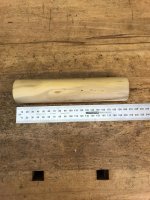
IMG_6817.jpeg

The object of the exercise was to produce a smaller, tapered pin so that the thicker crust of a traditional Neapolitan pizza was easier to obtain, so after faffing around on the lathe a few days ago, this:
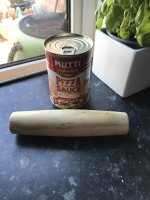
IMG_6834.jpeg

...is what I came up with; tapered at each end and a bit shorter by about 20mm. The pizza dough (Ooni recipe) had been prepared a few days ago, then frozen and had been thawing out all afternoon. Once rolled with the pizza pin, the base looked thus:
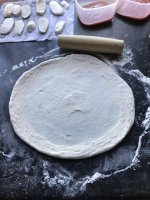
IMG_6835.jpeg

...and slid onto the peel without sticking. I used the semolina 'ball bearing' trick and made two pizzas this time as we'd purchased two peels; absolutely no issues with the pizzas sticking.

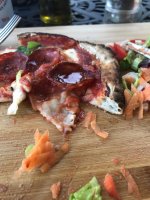
After blitzing in the oven at about 400deg C for a minute or thereabouts, the pizzas were respectable:

IMG_6836.jpeg

...with a nicely done, crispy crust:

IMG_6837.jpeg

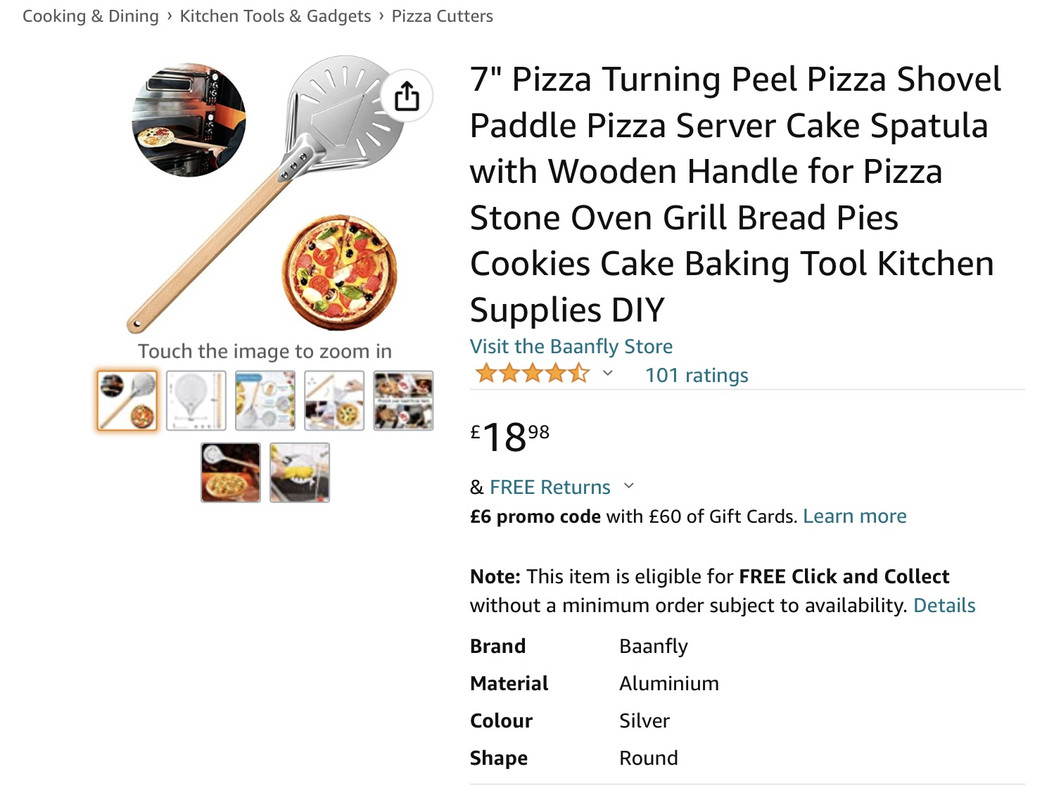
Both the pizzas were too 'wet'; I think that one of those Mutti tins will do eight pizzas but the biggest problem I encountered this evening was turning them in the oven as I couldn't get them back onto the peel, so after tea SWIMBO ordered one of these which ought to make life considerably easier.

The pizza pin was a definite winner and made it much easier to produce the desired pizza base. The Tesco Finest peperami though was a bit 'tingly' :D - Rob
 
The Pin looks good and so do the Pizza’s. I normally pass the tomato through a sieve as it can be a bit watery sometimes. The Mozzarella can also be a bit wet so I sometimes dry it off a bit with some paper towel.
You’re doing well though by the look of it. One of Vito’s tips was to sprinkle grated Parmesan onto the sauce before putting the Mozzarella on and that works well for us.

Edit: to help stop the middle being a bit wet, turn the temperature down a bit and cook it slightly longer.
 
Woodster":2d1bsnpl said:
The Pin looks good and so do the Pizza’s. I normally pass the tomato through a sieve as it can be a bit watery sometimes. The Mozzarella can also be a bit wet so I sometimes dry it off a bit with some paper towel.
You’re doing well though by the look of it. One of Vito’s tips was to sprinkle grated Parmesan onto the sauce before putting the Mozzarella on and that works well for us.

Edit: to help stop the middle being a bit wet, turn the temperature down a bit and cook it slightly longer.

I'll use half the quantity of sauce next time; I'd also frozen the mozzarella and expected it to be crumbly when it was thawed and sliced but it turned out to be perfect. I also extracted a lot of water from it by drying on a kitchen towel. It's quite a knack to juggle cooking the pizza and attending to the fire at the same time so that you get the temp about right in the middle of the stone; the infrared thermometer helps a lot.
Still a very tasty outcome though, even if I struggled to turn the pizzas - Rob
 
Yes I struggle to turn them as well. I should get one of the round turning peels really.

34247114-9-FEB-4222-A816-A696-AE213958.jpg
 
Apologies for resurrecting another old thread. But this one drives me wild whenever I see it.
The implement that one uses to get a pizza out of the pizza oven is not a "pizza peel".*
It is a pizza pelle .."pelle" being the french word for shovel.
I owned a pizzeria ( mine was a "take away", we also did "Tex-Mex" ) in the south of France for a couple of years, I still have some of my equipment, including an electric pizza oven ( can do 4 full size pizza (s)** at once in it ) and my "pelle à pizza". Thin stainless steel disc about 40 cm diametre attached to a stainless steel tube ( about 3 cm diametre ) handle about 1 metre long.I cut mine down as it was too long when bought, to be easily maneuverable between the oven and the counter when behind the counter.
It has never been a "peel".

Pelle in french rhymes with sell. In Italian it is a pala ( which also translates to English as "shovel" ) In Italy the "pelle" ( FR) or "pala" ( IT ) not peel , has other variants, as detailed in this article
( which nevertheless gets it wrong , again, with "peel" )

It is another of those "misheard" words that gets used in place of the correct term.
French has a few of them which drive me mad, for example.
Expresso ..instead of the correct Espresso.
and
"parler français comme une vache espagnole" ( speaking french like a spanish cow )
should be
"parler français comme un basque espagnole" or "parler français comme un vasque espagnole" or "parler comme un gabach espagnol"
each of which means approximately speaking french clumsily like someone from the Basque region of Spain, where most Basque can speak their own language and some heavily accented french.

Lidl France often has terrible misspellings in the french language on their products.

*Hilda Baker would turn in her grave..She Knows Y' Know!
** I have been told ( by Italians ) that pizza is like sheep the plural is the same as the singular.

 
Last edited:
Peel is a better word though. The tools "peels" it off the oven floor. :cool:

A shovel, as we all know, has curved sides so that it can hold plenty of sand for chucking in the mixer, or coal for shovelling into the fire box. Otherwise it would be a spade. (vanga, piche perhaps according to my wife) :censored:
 
Some would differ -
 
Peel is a better word though. The tools "peels" it off the oven floor. :cool:

A shovel, as we all know, has curved sides so that it can hold plenty of sand for chucking in the mixer, or coal for shovelling into the fire box. Otherwise is would be a spade. :censored:
Coal shovels have upturned sides, proper shovels don't. I've never seen anything other than these used for shovelling sand. Incidentally, Cornish shovels were traditionally larger than Devonshire shovels, as Cornish men were presumed to be stronger.
 
Various sources indicate that up to 60% of English words have their origins in French, if they were all spelt the way they currently are in french the English lexicon would be in a helluva mess.
 
Ah, but it isn't just the spelling in English that has changed ( although an awful lot of English words are derived from Norman french* but with a different pronunciation** )..How do you pronounce peel ? I'm presuming it is like reel.
When I left the UK ( back in 87 ) I knew a few pizza makers , mainly in the London area. All were Italian ( like the Ice cream makers ) , all called the instrument a pala .Pele ( with no accents anywhere and only one L ) isn't even a word in french despite what the Chambers dictionary says.
pelé is the verb peler conjugated
The garden version ..spade... is bêche.
Peel seems to me to be a recent addition to English based upon mishearing the Italian word, Chambers appear to be hallucinating a word that does not exist in the french language.

*Yes the Normans were actually vikings anyway.
** French ( at least modern "metropolitan french" is rarely pronounced how it is written.Which is what makes it so hard for foreigners to learn.You don't speak what you read, a large part of written french is silent when spoken. Quebecois french is much closer to to original pronunciation as was used in the 18th century in France.The Académie Française decides what words are "official" and how the language in France is written, but says nothing about pronunciation.Parisian "fashions" in speaking gradually take over the way the rest of France speaks. This is accelerated by the media, and especially "social media".leading to the moronic use of "en fait" ( in fact ), which is used by french in the same way as "like" or "innit" or "anat" is used by some anglophones.The french have taken it to extremes and so "en fait" is used like punctuation, some even break a word in the middle to insert "en fait" and then follow the word with "en fait", end the sentence with "en fait", and often begin their sentence with "en fait".They then go on to use it every other word. This is not just the "yoof" but their parents and even newsreaders and politicians who are old enough to know better. Strangely they rarely use "en fait" when writing, if they write, semi-illiteracy is growing rapidly as a problem here. Many teachers are just quietly giving up, others unfortunately use "en fait" and similar linguistic "tics" and mannerisms as often in their own speech as those they teach.

Even a spade is often slightly curved, what is the current English word ( not peel , you peel an orange, peel is not an object ) for a flat spade or shovel. I don't remember ever hearing or reading the word "peel" used for it when in England.I grew up In England, Ireland and various RAF bases across the world during the 50's and 60s. Never heard "peel" once..did hear "paddle" though, in many places in England.

Btw..I would have linked to the Larousse website as the Larousse is considered to be the definitive source in french.But the Larousse on line has decided to do something that is totally illegal under GDPR. Either one accepts the hundreds of trackers that they place on behalf of their commercial partners, or one has to pay.Totally illegal under the GDPR and french law.But as the CNIL ( the french body for policing GDPR ) has decided unofficially to not "go after" certain french companies who break the law, but prefers to chase foreign companies. Many french websites ( especially those with "connections" ) ignore the law.
 
Last edited:
Ah, but it isn't just the spelling in English that has changed ( although an awful lot of English words are derived from Norman french* but with a different pronunciation** )..How do you pronounce peel ? I'm presuming it is like reel.
When I left the UK ( back in 87 ) I knew a few pizza makers , mainly in the London area. All were Italian ( like the Ice cream makers ) , all called the instrument a pala .Pele ( with no accents anywhere and only one L ) isn't even a word in french despite what the Chambers dictionary says.
pelé is the verb peler conjugated
The garden version ..spade... is bêche.
Peel seems to me to be a recent addition to English based upon mishearing the Italian word, Chambers appear to be hallucinating a word that does not exist in the french language.

*Yes the Normans were actually vikings anyway.
** French ( at least modern "metropolitan french" is rarely pronounced how it is written.Which is what makes it so hard for foreigners to learn.You don't speak what you read, a large part of written french is silent when spoken. Quebecois french is much closer to to original pronunciation as was used in the 18th century in France.The Académie Française decides what words are "official" and how the language in France is written, but says nothing about pronunciation.Parisian "fashions" in speaking gradually take over the way the rest of France speaks. This is accelerated by the media, and especially "social media".leading to the moronic use of "en fait" ( in fact ), which is used by french in the same way as "like" or "innit" or "anat" is used by some anglophones.The french have taken it to extremes and so "en fait" is used like punctuation, some even break a word in the middle to insert "en fait" and then follow the word with "en fait", end the sentence with "en fait", and often begin their sentence with "en fait".They then go on to use it every other word. This is not just the "yoof" but their parents and even newsreaders and politicians who are old enough to know better. Strangely they rarely use "en fait" when writing, if they write, semi-illiteracy is growing rapidly as a problem here. Many teachers are just quietly giving up, others unfortunately use "en fait" and similar linguistic "tics" and mannerisms as often in their own speech as those they teach.

Even a spade is often slightly curved, what is the current English word ( not peel , you peel an orange, peel is not an object ) for a flat spade or shovel. I don't remember ever hearing or reading the word "peel" used for it when in England.I grew up In England, Ireland and various RAF bases across the world during the 50's and 60s. Never heard "peel" once..did hear "paddle" though, in many places in England.

Btw..I would have linked to the Larousse website as the Larousse is considered to be the definitive source in french.But the Larousse on line has decided to do something that is totally illegal under GDPR. Either one accepts the hundreds of trackers that they place on behalf of their commercial partners, or one has to pay.Totally illegal under the GDPR and french law.But as the CNIL ( the french body for policing GDPR ) has decided unofficially to not "go after" certain french companies who break the law, but prefers to chase foreign companies. Many french websites ( especially those with "connections" ) ignore the law.

MW, please dont start another thread fight (UKW Scrolling) over the peel/piel/pele or whatever anybody wants to call it.
It makes absolutely no difference to the Pizza or the person cooking or eating.
 
:) not intending to, don't worry Phil, ( didn't start one over there, just stated a fact and then got jumped on by a few who then posted what they think that they know about something I've worked with professionally for over 3 decades ).

What intrigues me though is where Chambers got their spelling of "pele" from, that Dr.Al posted, dictionaries aren't supposed to invent words, or mis( pelle ) them. Scrabble would be impossible.
 
dictionaries aren't supposed to invent words, or mis( pelle ) them. Scrabble would be impossible.

Dictionaries document words as they're used. There are lots of words that irritate me but have made their way into the dictionary as a result of being in common use (although I'm happy to say that "action" as a verb - as in "to action something" when you mean "to do something", has managed to stay out of Chambers for now at least!).

If you do a web search for "pizza peel", you'll get lots of (relevant) hits suggesting that it is in fairly common use, so I'm not at all surprised that it's made it into a dictionary. It's certainly been around a while: I just checked my "dead tree" dictionary (published in 2006) and the same definition is in there too.

I don't have access to the full Oxford English Dictionary; that tends to give a lot more information on origins / history of words.
 
I was going to refrain from adding to this friendly discussion but couldn't help myself.
The OED states the word PEEL has been used to describe a pole with a flat disc on one end used to place loaves in an oven since at least the late 14th century. Perhaps Chambers used the OED as their source and did not invent the word after all.

I think further discussion on this subject should be left to the etymology experts, does Suzie Dent have a website?

Nice pizza by the way Rob, apologies for the diversion.

Lets get back on topic.
Why can’t a normal rolling pin be used? Why does a pizza pin need to be convex along it’s length?
 
Nice pizza by the way Rob, apologies for the diversion.

Lets get back on topic.
Why can’t a normal rolling pin be used? Why does a pizza pin need to be convex along it’s length?
Of course you can Andy, but in my hitherto very limited experience of producing the base I I found it very 'ard to make it circular with just hands as the pros do, so I tried a conventional, parallel sided rolling pin. This worked fine, but the periphery of the base needs to be slightly thicker, which is where the convex pin scores as it rolls out the middle super dooper thin but leaves a nice, slightly thicker rim, whereas the parallel pin didn't - Rob
 
Ah I see, so that’s how the thick crust is made. When I’ve seen pizzas made traditionally on the box there was a lot of twirling and throwing them up in the air.
Have you found a way of stuffing cheese inside the crust yet, my favourite.
 
Made Oi larf Sam :-)
Probably turn out that the OED was right and that the Brits have been saying and spelling it weird since Norman days, ( like mutton and mouton ) and that I just never heard it, nor saw it. Embuggerance for scrabble though, all these words with spell it how you feel.

Pizza crust ( thick, thin, crispy, browned etc ) in Europe ( mainland ) is like sharpening, wars have been started for less.
Took me a while to learn to throw pizza, once I "got it" , never did it again , always used a rolling pin. spinny show offy things going on in a commercial kitchen is dangerous IMO. I've only seen it done once in Italy, in a very touristy place.

To get the thicker edge for crustiness , I just pulled / pushed the pâte towards the circumference. But, I think the idea of a convex rolling pin is a good one. I've seen people tear their pizza pâte when trying to get the edge thicker by pulling / pushing it.

If you just want the cheese inside the crust edges, you could just put some around the edge and roll the pâte back over it towards the middle.

I made all the classic pizza ( still have a menu board somewhere ) ..and some exotics, with chili and dark chocolate sprinkled over,.That was amazingly popular once people had tried the free slice, the women especially loved it.

That and the Hawaiian, yes made with pineapple. :)
 
Back
Top