• Hi all and welcome to TheWoodHaven2 brought into the 21st Century, kicking and screaming! We all have Alasdair to thank for the vast bulk of the heavy lifting to get us here, no more so than me because he's taken away a huge burden of responsibility from my shoulders and brought us to this new shiny home, with all your previous content (hopefully) still intact! Please peruse and feed back. There is still plenty to do, like changing the colour scheme, adding the banner graphic, tweaking the odd setting here and there so I have added a new thread in the 'Technical Issues, Bugs and Feature Requests' forum for you to add any issues you find, any missing settings or just anything you'd like to see added/removed from the feature set that Xenforo offers. We will get to everything over the coming weeks so please be patient, but add anything at all to the thread I mention above and we promise to get to them over the next few days/weeks/months. In the meantime, please enjoy!

Pork scratchings theory

Guineafowl21

Nordic Pine
Joined
Dec 15, 2020
Messages
537
Reaction score
153
Location
Nairn
Two parts to this:

For crackling, I usually slow roast the pork belly, cut the skin off, then stick it in the air fryer. Some areas are perfect, expanded almost like a hard, crispy foam, other areas go hard and tough like plastic. I haven’t been able to work out why, but the method is more successful than others. Salting, pricking, slashing don’t seem to make a consistent difference. Any thoughts? (Looking at you, @AJB Temple …)

I’d like to try making my own scratchings from raw skin, aiming for ones like Mr Porky’s. I can’t find a proper guide to this - most are American, making pork rinds, which aren’t quite the same thing. I think you’re meant to boil the skin, then dry it out, then into the deep fryer. Again, any guidance appreciated.

Cheers.
 
I don't know about scratchings, but my method for crackling (which always seems to work very well) is to dry the skin thoroughly (with kitchen towel), then rubbing with oil and sprinkling a little salt on it. The joint then goes in the oven for roasting. When the joint comes out of the oven, I cut the skin off and, while the joint is resting, stick the skin back in the oven, lying flat on the grid of the roasting tray. That makes sure that the whole surface is nicely crackled. The joints from our butchers come pre-slashed, otherwise I'd probably do that before any of the above.
 
Well, I have slow cooked pork belly on our menu right now, with crispy crackling squares.

There are multiple ways of getting reliably crisp crackling. I nearly always buy a whole pork belly and take the skin off prior to cooking. Ron my butcher (and farmer of the cattle) is very skilled at doing this with an even thin layer of fat. This gives me a big sheet of skin and I scald that and dehydrate it uncovered in the chiller for 24 hours.

Let's assume you are doing skin on. Score the skin deeply with a Stanley knife. Put the belly in the clean sink and pour boiling water over it liberally. Dry the whole thing thoroughly with a paper towel. Salt the skin quite liberally with table salt. Put it on a tray and then into the fridge uncovered, for ideally 24 hours. This dehydrates it and is a key step for top results.

Get your oven hot. I put ours on 250 - 260C fan (yours may not go that hot, if not max it out) and when it is up to temperature, put the joint in for 20 minutes on a grid in your pan. This shocks it. Then turn down to 160 fan (or 180 no fan) and cook until the pork is meltingly soft - depends on joint size. There is a lot of fat in belly and you don't want the joint sitting in it.

Rest for 20 mins, but do not having anything touching the skin. If you have used this method you will have superb cracking that is really bubbled and crisp.

The skin off method that I use in the restaurant is much faster as basically after dehydration I just blast it in a very hot oven (maybe 280) until I have crackling. I cook the belly slowly in a different and much cooler oven. But I have three ovens.
 
This gives me a big sheet of skin and I scald that and dehydrate it uncovered in the chiller for 24 hours.
Scald, as in, dip briefly into boiling water?
There is a lot of fat in belly and you don't want the joint sitting in it.
I do, rightly or wrongly! The meat side gets rubbed with 5-spice, salt and pepper, then I make a custom tinfoil bath for it, so during the slow cook, it sort of ‘confits’ in its own fat. Perhaps only appealing to primitive carnivores like me, not restaurant customers.
Score the skin deeply with a Stanley knife
Good for depth control, I take it? I read somewhere that slashing too deep, into the meat, lets the juices come to the top and ruin the crackling. Wife is from HK, so we have a Chinese-style needle pricker. Might try your way.

The other thing you say about pouring boiling water over it makes sense - we do the same when making crispy duck (duck inflated with my compressor blow gun).

I don't know about scratchings, but my method for crackling (which always seems to work very well) is to dry the skin thoroughly (with kitchen towel), then rubbing with oil and sprinkling a little salt on it. The joint then goes in the oven for roasting. When the joint comes out of the oven, I cut the skin off and, while the joint is resting, stick the skin back in the oven, lying flat on the grid of the roasting tray. That makes sure that the whole surface is nicely crackled. The joints from our butchers come pre-slashed, otherwise I'd probably do that before any of the above.
Yes, that’s pretty much what I’ve read, but don’t always get consistency. The pork we use isn’t always the same, sometimes supermarket, sometimes farm shop or our own pigs. Maybe the inconsistent age/breed is disrupting things. We did an older sow once, and the crackling was always as tough as b*ggery whatever I did to it.

Anyway, thanks both. Will have a go tonight and report back.
 
Tonight’s pork belly* obviously had to skip the drying step, but the other half is drying away in the fridge.

After the 160 long cook, then 20 min rest, the skin was still quite soft so it went into the air fryer (its only earthly use, as far as I can see) and came out nice and crackly after 10 minutes. A partial success! My oven has the option of combining rear fan with top heat, so perhaps I should try that next time (tomorrow)?

For some reason, the ceramic Le Creuset oven dish cracked in half during the hot sizzle. My fault, I assume, but the bloody thing’s been in a kiln, so I can’t see why a 260 degC oven was a problem.

*
Wife is away for another two weeks, and there’s loads of pork belly in the freezer. I might be having it most nights until I’ve crack(l)ed this.
 
Scald by pouring boiling water over the skin side. Tightens the skin and opens the score cuts
Dehydration uncovered in fridge is your friend.
Cut through the skin and no deeper. It is not essential but makes the crackling easier to handle later.
Air fryer is useless to me. Too small, not hot enough.

Personally I think sitting the meat in a bath of its own fat produces a much worse product than letting it render out. Then use the reserved fat to cook potatoes in some fashion. I filter the lard and reserve it. You don't have to filter through a fine sieve, but I do as I am charging for my product. Plus, particles in the fat burn. Not good.

Home cooks do everything in one piece, and tend to omit the time consuming bits (24 hours in chiller).
Home cooks tend not to use very high temps. Restaurant cooks will use the technique I suggest. They will also use an oven probe or thermopen in the meat and cook to internal temperature (taking account of resting time in absolutely everything, including fish) not time elapsed.

In my opinion, seasoning the skin results in seasoned crackling but has no effect on the meat. This is partly why for paying guests I take the skin off and season the meat separately. It's two components for me. Restaurant cooks want consistency: I do not want overcooked pork because the crackling is not ready, and I can crisp the skin perfectly as a separate thing in 20 minutes. Salt on the skin prior to dehydration draws out moisture. Which is what you want. If it looks wet, dry it! Paper towels are cheap and they can go in the compost.

Using fan and top heat is basically fan + grill in a domestic oven. This is less than ideal. Stop it. The crackling is actually the easy part for a chef who knows what they are doing. Pork belly cooked well needs slow cooking. I treat the crackling as a garnish. And to be frank, if the subcutaneous layer (between skin and first layer of flesh) is too thick, I trim it and render it before it goes in the oven.

But in the end - dehydrate. And don't smear everything in oil when you stick it in the oven! You've dried the skin so don't wet it again.
 
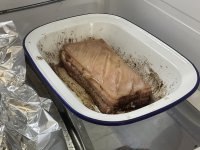
This bit for tonight was scored, scalded, dried and salted yesterday evening, and is sitting open in the fridge. Metal dish this time :pDark stuff is 5-spice on the meat.

There’s quite a bit of brine forming. Should I rinse this off at some point?

Adrian’s comment about temperatures makes me think my oven, although it appears to go to 260degC, may not be achieving that.

My diet (and demeanour) is palaeolithic (not in any official way) so I’d consider this a portion for one.
image.jpg

For the next piece, I’ll try the skin-off method.
 
Last edited:
Do not rinse. Pat dry with paper all over and get rid of the liquid. Always put it on a wire rack in the tray - you are trying to dry it in the fridge.
 
Since we got our air fryer we have had perfect crackling. Remove from joint (this gets wrapped in foil and slow cooked at around 160), pat dry, score in diamond pattern and dehydrate in fridge for at least 6 hours. Then salt liberally and cook in air fryer at 200 for around 30 minutes. Never had a failure yet.
 
Since we got our air fryer we have had perfect crackling. Remove from joint (this gets wrapped in foil and slow cooked at around 160), pat dry, score in diamond pattern and dehydrate in fridge for at least 6 hours. Then salt liberally and cook in air fryer at 200 for around 30 minutes. Never had a failure yet.
That sounds like a good technique, too. Only problems are:

A) I’ve banged on so much about how it’s a gimmick that burns the top and undercooks the rest it’s hard to backtrack
B) it’s a bit small
C) we may not always have it

So, I’m aiming to nail it using a conventional oven.
 
I can't comment on air fryers as I don't have one as they are much too small to be useful for how we operate. But it is worth remembering that an air fryer is just a small volume fan oven that tends to use a top element.

If I was working in a larger restaurant, then the alternative approach, frequently used, is to stick the dry and ideally dehydrated skin (or the whole joint if it is a pork roast) under the salamander (think industrial grill) - flash the fat side then the skin. You can also blow torch it, best done with a proper plumbers blow torch rather than the toys they sell in kitchen shops.
 
Skin should bubble like this and be very evenly crispy and not burnt. This was just a pork joint done for a group last Thursday event - exactly the same method.
 

Attachments

  • IMG_0346.jpeg
    IMG_0346.jpeg
    235.9 KB · Views: 7
Skin should bubble like this and be very evenly crispy and not burnt. This was just a pork joint done for a group last Thursday event - exactly the same method.
That looks nice. I’ve tried a MAPP gas torch but found it very easy to overdo. Skin wasn’t properly dried, though.
 
Yes don't go mad with it. And the surface needs to be dry and not oily. I use a Rothenburger (sp?) Mapp gas torch for very lightly charred (pre-steamed) hispi for example. It creates a delicate tracery effect.
 
You can clearly see that you are hotter at the back of the oven. So next time turn the dish through 180 degrees half way through.
 
Will do.

I’m not there yet - although that joint looked the part, after cooking and resting the skin was quite soft. A blast in the air fryer both sides crisped it up, but it was still very chewy in the middle, like crisps laminated to a piece of leather.

Meat was nicer cooked on the trivet, not ‘confit’.

I might have slashed the skin too deep, so I think I’ll stop doing it. I’ve made crap crackling with slashes, and great crackling with none. Not to say it’s the wrong thing to do, but it seems to be a source of inconsistencies. If the meat juices come up, they’ll reduce the surrounding cooking temperature and produce leather, it seems. For Chinese crispy pork belly, you prick the skin, but this might be to help the top layer of fat render out, as the pieces are served whole in cross-section, so it can’t be trimmed away.

I’m going to try a hybrid of Adrian’s and the Chinese method:
1. Scald
2. Prick with this, which we have somewhere, easier after scalding has softened the skin. Doesn’t go too deep. Has been involved in the successes:
IMG_1285.jpeg

3. 24hr dry in fridge.
4. Before cooking as above, brush on vinegar or Shaoxing wine then sprinkle salt. Level the joint. Spin 180 during sizzle.

Although it seems wrong to add the vinegar, it appears to have a drying effect and helps to stick the salt down. I’ve also seen vodka used. I’ve got a vague notion that many of my successful cracklings have involved this step.
 
The tool you show is a meat tenderiser. Used on schnitzel etc. Needs quite a bit of force to get through skin and a bit of a pain to clean.

I think being a "slasher" is not helping your cause as it is evident from the photo that you cut very deep. I just lightly score to relax the surface during cooking. As I think I said above, when I am doing a side or half a side of pork belly, I do it skin off and cook the crackling separately, often whilst the pork belly is resting and then I don't really care about scoring the sheet of skin. Anyway, best of luck with it. Whatever works for you is good.

PS - oven thermometers are cheap and might be worth it for you. I am lucky to have an accurate oven but most domestic ones are uneven and inaccurate. You need to know what temps your oven is actually delivering.
 
The tool you show is a meat tenderiser. Used on schnitzel etc. Needs quite a bit of force to get through skin
Now, my wife’s late uncle was a chef in HK, and it’s coming back to me that for siu yuk he would ‘shallow parboil’ the belly piece, skin down, in a wok for just a minute or so. He could then prick the holes with just a bunch of toothpicks. He told us to get one of those needle tools for extra speed. The more holes, the better, apparently.

The skin was salted for 5 mins, then scraped clean, dried, then the vinegar before fridge drying.

I guess a decent scald will have a similar effect of softening the skin. The problem, for me, with scoring first off is that the pork is variable in origin, the skin is therefore variable in thickness/toughness, and dryer areas are much tougher than wetter ones, so it’s hard to be consistent. Starting off with softened skin should help with all that, I hope.
 
Last edited:
Some progress. This one was finished with a minute or two under the grill on max, and flavoured with sweet pimenton:
IMG_1292.jpeg
 
Back
Top