Alf
Sapling
Actually, despite the subject line, this is probably for anyone who knows more about metal than I do - which is likely everyone.
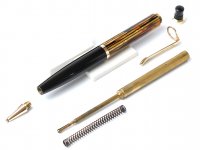
So, I have this Pelikan mechanical pencil which is not working. The pen repair people are no use because they say "Buy a cheap one in bad condition for spare parts" and this is the cheap one in bad condition! Anyway, here it is exploded:
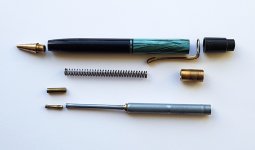
Not many pictures of their innards online, but usually they seem to be all brass, so I suspect this might be wartime manufacture - could be any time from 1937 to 1951 though. Whatever it is, it's very broken. If the brass collet is not held firmly in the end of the tube, the lead cannot be held at all, never mind extended.
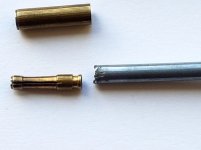
Vital statistics are:
Tube: 3mm diameter, 2mm bore (as far as I can judge in that a 2mm HHS bit just went in)
Collet larger diameter: 2.5mm
Collet groove diameter: 2.1mm
Lead diameter: 1.18mm
Anyway, I would like to find a way to fix it. The existing tube is sufficiently mauled that I don't think it's long enough to work properly any more. I was thinking total replacement of the thin tube, which opens up a potential can of worms at the other end. Or possibly amputation and extension? The lead obviously needs to be able to get through, but I see there is such stuff as thin walled brass tube, and I wondered if some sort of inner sleeve could work and may be more doable with my (lack of) skill set. But then that's another place for joint failure.
But fundamentally, how is the collet held? I'm guessing it's a matter of heat, expansion of tube, insertion of collet, allow natural contraction do the job. In which case, what's the best heat source for such a task? In use this connection is held under pretty strong tension by that spring all the time, so it's got to be good. But equally I can't add any external bulk because the collet sleeve needs to slide over it all. Oh, and is it, as I assume, aluminium? And should I "upgrade" to brass, or will that make my life more difficult?
Ack, I have rambled, sorry. But a lot of ideas in my nut, and not the knowledge to know how best to progress. Any help most gratefully received.
Perplexed and pencil-less*, Al
*Not strictly true...
So, I have this Pelikan mechanical pencil which is not working. The pen repair people are no use because they say "Buy a cheap one in bad condition for spare parts" and this is the cheap one in bad condition! Anyway, here it is exploded:
Not many pictures of their innards online, but usually they seem to be all brass, so I suspect this might be wartime manufacture - could be any time from 1937 to 1951 though. Whatever it is, it's very broken. If the brass collet is not held firmly in the end of the tube, the lead cannot be held at all, never mind extended.
Vital statistics are:
Tube: 3mm diameter, 2mm bore (as far as I can judge in that a 2mm HHS bit just went in)
Collet larger diameter: 2.5mm
Collet groove diameter: 2.1mm
Lead diameter: 1.18mm
Anyway, I would like to find a way to fix it. The existing tube is sufficiently mauled that I don't think it's long enough to work properly any more. I was thinking total replacement of the thin tube, which opens up a potential can of worms at the other end. Or possibly amputation and extension? The lead obviously needs to be able to get through, but I see there is such stuff as thin walled brass tube, and I wondered if some sort of inner sleeve could work and may be more doable with my (lack of) skill set. But then that's another place for joint failure.
But fundamentally, how is the collet held? I'm guessing it's a matter of heat, expansion of tube, insertion of collet, allow natural contraction do the job. In which case, what's the best heat source for such a task? In use this connection is held under pretty strong tension by that spring all the time, so it's got to be good. But equally I can't add any external bulk because the collet sleeve needs to slide over it all. Oh, and is it, as I assume, aluminium? And should I "upgrade" to brass, or will that make my life more difficult?
Ack, I have rambled, sorry. But a lot of ideas in my nut, and not the knowledge to know how best to progress. Any help most gratefully received.
Perplexed and pencil-less*, Al
*Not strictly true...
 ) it will be a friction fit (possibly shrunk) at the other end, but something like loktite 638 would help with the joint.