

Phil
Old Oak
Rainwater harvesting tanks
We periodically suffer from no water supply by the council.
Reservoirs not maintained, pumps not maintained, bulk piping not maintained and so the sad story carries on.
The water supply to the main dam (Vaal) is rain in the mountains, except winter there is not much rain. So the level of the dam gets low. Water is also then supplied from Lesotho dams, underground tunnels to the feed rivers.
https://www.lhda.org.ls
When we run out of water now, wife buys 5L bottles for cooking and drinking.
Washing is a face only wash. Toilets a problem and I get from neighbours’ tanks or the clubhouse swimming pools.
Pot plants also need water in this hellish heat.
A management decision was taken to install rainwater tanks. The water will be used for the toilets, stand-in-the-shower-basin-wash and the garden.
As we are sectional title, the outside does not belong to us but is common property in the estate. As such we need to apply for permission to install tank/s and comply with the laid down specs.
The tank/s must not be visible by the neighbours or they must provide written permission. If visible from the street suitable screening to be used (big joke!)
A 1000L tank is too high to fit under the gutters, so we decided on 2 x 750L tanks coupled together.
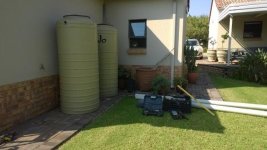
The tanks ready for installation, plumber on site. (if I was 5 years younger I would have done it myself.) The plumber lives on the estate with his mother and is part of the estate maintenance crew. A Sunday installation in his own time.
The tanks are joined at the bottom with 30mm pipe, connected to ball valves and click on fittings.
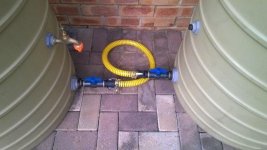
If I decide to use a pump, close the taps, release one clip-on and use similar fitting to the pump.
The gutter downpipe is cut off and a leaf catcher installed.
The leaf catcher then connects to a series of 90 degree bends and 100mm pipe.

{leaf catcher}
Looking at the completed setup:
The pipe running down the wall is the ‘first flush” diverter. The first lot of water could have sand, stones etc. which will go down this pipe. There is a drain tap at the bottom of the pipe.
When the water reaches the T-piece, there is a shutoff valve, and the water then runs into tank #1 and feeds tank #2.
Tank #1 also gets the overflow pipe. I still need to fit the brackets to anchor the pipe to the paving.
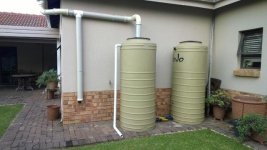
There are covers on top of the tanks and below that a mesh unit for dirt.
They are fairly well sealed, hopefully no mozzie can get in.
Now we wait for some rain.
Part of the estate spec is that all pipe work to be painted the same colour as the outside walls. I think I can manage that!
We periodically suffer from no water supply by the council.
Reservoirs not maintained, pumps not maintained, bulk piping not maintained and so the sad story carries on.
The water supply to the main dam (Vaal) is rain in the mountains, except winter there is not much rain. So the level of the dam gets low. Water is also then supplied from Lesotho dams, underground tunnels to the feed rivers.
https://www.lhda.org.ls
When we run out of water now, wife buys 5L bottles for cooking and drinking.
Washing is a face only wash. Toilets a problem and I get from neighbours’ tanks or the clubhouse swimming pools.
Pot plants also need water in this hellish heat.
A management decision was taken to install rainwater tanks. The water will be used for the toilets, stand-in-the-shower-basin-wash and the garden.
As we are sectional title, the outside does not belong to us but is common property in the estate. As such we need to apply for permission to install tank/s and comply with the laid down specs.
The tank/s must not be visible by the neighbours or they must provide written permission. If visible from the street suitable screening to be used (big joke!)
A 1000L tank is too high to fit under the gutters, so we decided on 2 x 750L tanks coupled together.
The tanks ready for installation, plumber on site. (if I was 5 years younger I would have done it myself.) The plumber lives on the estate with his mother and is part of the estate maintenance crew. A Sunday installation in his own time.
The tanks are joined at the bottom with 30mm pipe, connected to ball valves and click on fittings.
If I decide to use a pump, close the taps, release one clip-on and use similar fitting to the pump.
The gutter downpipe is cut off and a leaf catcher installed.
The leaf catcher then connects to a series of 90 degree bends and 100mm pipe.
{leaf catcher}
Looking at the completed setup:
The pipe running down the wall is the ‘first flush” diverter. The first lot of water could have sand, stones etc. which will go down this pipe. There is a drain tap at the bottom of the pipe.
When the water reaches the T-piece, there is a shutoff valve, and the water then runs into tank #1 and feeds tank #2.
Tank #1 also gets the overflow pipe. I still need to fit the brackets to anchor the pipe to the paving.
There are covers on top of the tanks and below that a mesh unit for dirt.
They are fairly well sealed, hopefully no mozzie can get in.
Now we wait for some rain.
Part of the estate spec is that all pipe work to be painted the same colour as the outside walls. I think I can manage that!


 )
)

