I've been a bit quiet on actually doing any woodwork lately. But today, several things have lined up together.
The obvious one is that it's far too hot to expose my pasty body to the outdoor sun, with the record-breaking temperatures across Europe, the Red Alert from the Met Office, etc.
Another is that I know someone who needs a bookcase.
And another is that I have squirreled away lots of bits of useful wood which really ought to be made into useful things, which isn't going to happen if I just watch other people on YouTube and on the forum having fun in their own workshops.
And the real big one (with commiserations to anyone whose workshop is an uninsulated garden shed, and I promise not to bang on about it too much) is that my basement workshop is the coolest room in the house and therefore the best place to be. It was 24° in there when I started this morning and it's 25° now, which is 10 degrees less than the Met Office says it is outside. That's hotter than it normally is and hotter than I'd like, but I'm just thankful that I don't have to work outside or in overheated spaces like so many millions of people do.
So, with all that rambling aside, what have I been up to?
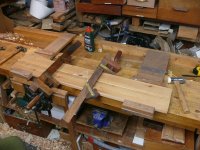
The first job was to gather together all the bits that I will need and make sure of their sizes.

Some of these have been waiting a long time. From the left: a piece of ash-veneered blockboard from back when you could get blockboard, maybe 25-30 years ago, with a remnant of iron-on ash edge veneer. A bit of old floorboard (1890s). Two "pineboard" shelves chucked out by a neighbour. Some little bits of ash from my bed making project (2022). Some bookcase strips from an old office bookcase I used up in my bedside chest of drawers build (2015). A big bit of pine board, stained orange. I think I got this from a skip and used it as a table top in my first house, about 40 years ago. Some longer ash trimmings from the bed. Two bits of ash veneered MDF from a wardrobe I built about the time MDF displaced blockboard, some time in the 90s.
So you can tell, this project will be very basic when it comes to construction. Most of the fun will be in reducing this mixed kit of parts to nicer-looking, straighter, cleaner materials. I do have a plan, literally on the back of an envelope, so the overall design is clear enough to begin.
Regular readers will know that although I do have a (cheap, basic) table saw, I don't like the noise and dust it creates, so rarely bother clearing the clutter enough to use it. Also, with other people nearby working from home, I didn't want to make a lot of noise. So today was all hand work instead, not even using my tiny bandsaw.
The big bit of orange pine board will make a pair of uprights, with an overall shelf depth of about 7" which is enough in this case. That's big enough for most hardback books but also ok for many boxes, papers etc without taking up too much floor space. They are about 51" tall but I'll cut them down to about 41", which I reckon is ok for a base board just off the floor and three adjustable shelves. So my first job, after moving most of the wood out again. was to saw the board in half.
Actually, my first job was to sharpen the irons in my most-used planes, in readiness. Here's a badly focussed shot of the planes:

which should serve to show that in general, the commonest designs and sizes are common because they really are the most useful.
And I'm really sorry, but I failed to take any photos of how I did the sharpening so it will have to remain a mystery lost to time. I hope you can bear the anguish without getting too emotional...
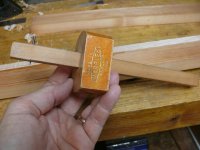
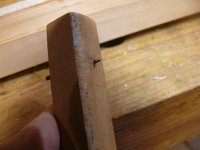
I marked a pair of lines with a panel gauge, with enough room to saw between them and plane back to the line.

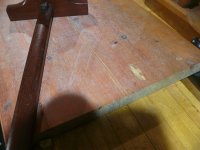
You may have noticed that the lighting has got a bit more dramatic than usual. The reason is simple - when I last updated the workshop lights, I added some LED panels but left the existing fluorescents in place. Today, with it being so hot already, having four 6ft 70 watt tubes rather close to my head was no fun, so I turned them off and got by with an LED floodlight and a couple of Anglepoises with LED lamps in them. I really ought to swap over to LED battens soon.
My preferred, comfortable way to rip a big bit of wood is to use my nice old Workmate like this:

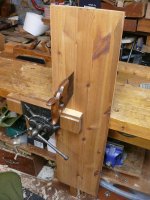
moving the board ahead, then reversing it. To complete the cut, I put it vertical in the vice:


which is ok for anyone wanting a giggle about how untidy it all looks and how little space is left.
But really, I just wanted to remind anyone who's not got round to it, to make an adjustable stack of thin stuff, to go at the opposite end of the vice jaws when gripping big things. Mine is some squares of thick card and a bit of wood, but just use whatever you have. It really helps get a good grip. (I think this was a tip from @Alf, years ago. Thanks Alf!)

Having made the cut, I carefully planed both edges straightish and squareish. They won't need to connect to anything, but they ought to at least match.

Good enough for now.
Next, I planed off both faces to get rid of all the old stain and get reasonable surfaces. This was really enjoyable and satisfying. Although I have a few more exotic and valuable planes, my favourite smoother is this Stanley 4½. Just to be sentimental for a moment, I was given this plane quite a long time ago, when I was getting back into woodworking. When removed from its previous owner's shed it looked like this:

but I made it look like this

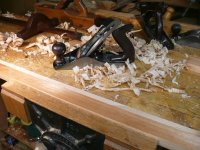
which is so easy to do and so worthwhile and was a step along the way of my appreciation of old tools. Here's an action shot of it taking away the wispy minimum of material, quietly and efficiently:

I now use it fitted with a Record iron and a Stay-set cap iron, which I know some people dislike intensely but seems rather good to me. It powers through knots without a murmur:

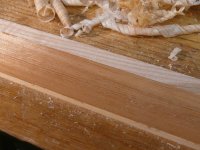
and soon the bits look almost respectable:

After lunch, I also ripped two narrowish pieces off the fragment of old floorboard. I'll use these to make a pair of stretchers across the tops of the sides, then fix the top on with screws going up through the stretchers. The front one will be faced with ash.
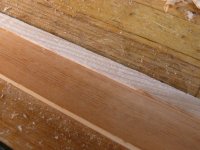
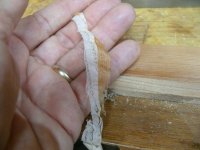
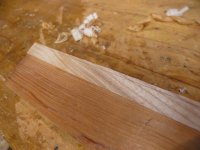
Maybe I needn't bother facing it though - after some more sawing and planing the wood hidden under the old dirt and paint revealed itself to be absolutely lovely to work, with clear, straight, even grain. Taking a full-width shaving was easy:

But by this time, even in the relative cool of the workshop, I was glad to go and clean up and have a shower. I know that someone with a bigger space and a planer-thicknesser would have finished before I'd started, but as I've said many times before, I only do this for the pleasure of doing it, not for any sort of economic advantage, so I don't mind.
I don't know how long the rest of this project will take - but I'm hoping it's weeks not months. I'll try to remember to stop and take photos as I go and bring you another instalment as soon as there's something else to see.
The obvious one is that it's far too hot to expose my pasty body to the outdoor sun, with the record-breaking temperatures across Europe, the Red Alert from the Met Office, etc.
Another is that I know someone who needs a bookcase.
And another is that I have squirreled away lots of bits of useful wood which really ought to be made into useful things, which isn't going to happen if I just watch other people on YouTube and on the forum having fun in their own workshops.
And the real big one (with commiserations to anyone whose workshop is an uninsulated garden shed, and I promise not to bang on about it too much) is that my basement workshop is the coolest room in the house and therefore the best place to be. It was 24° in there when I started this morning and it's 25° now, which is 10 degrees less than the Met Office says it is outside. That's hotter than it normally is and hotter than I'd like, but I'm just thankful that I don't have to work outside or in overheated spaces like so many millions of people do.
So, with all that rambling aside, what have I been up to?
The first job was to gather together all the bits that I will need and make sure of their sizes.
Some of these have been waiting a long time. From the left: a piece of ash-veneered blockboard from back when you could get blockboard, maybe 25-30 years ago, with a remnant of iron-on ash edge veneer. A bit of old floorboard (1890s). Two "pineboard" shelves chucked out by a neighbour. Some little bits of ash from my bed making project (2022). Some bookcase strips from an old office bookcase I used up in my bedside chest of drawers build (2015). A big bit of pine board, stained orange. I think I got this from a skip and used it as a table top in my first house, about 40 years ago. Some longer ash trimmings from the bed. Two bits of ash veneered MDF from a wardrobe I built about the time MDF displaced blockboard, some time in the 90s.
So you can tell, this project will be very basic when it comes to construction. Most of the fun will be in reducing this mixed kit of parts to nicer-looking, straighter, cleaner materials. I do have a plan, literally on the back of an envelope, so the overall design is clear enough to begin.
Regular readers will know that although I do have a (cheap, basic) table saw, I don't like the noise and dust it creates, so rarely bother clearing the clutter enough to use it. Also, with other people nearby working from home, I didn't want to make a lot of noise. So today was all hand work instead, not even using my tiny bandsaw.
The big bit of orange pine board will make a pair of uprights, with an overall shelf depth of about 7" which is enough in this case. That's big enough for most hardback books but also ok for many boxes, papers etc without taking up too much floor space. They are about 51" tall but I'll cut them down to about 41", which I reckon is ok for a base board just off the floor and three adjustable shelves. So my first job, after moving most of the wood out again. was to saw the board in half.
Actually, my first job was to sharpen the irons in my most-used planes, in readiness. Here's a badly focussed shot of the planes:
which should serve to show that in general, the commonest designs and sizes are common because they really are the most useful.
And I'm really sorry, but I failed to take any photos of how I did the sharpening so it will have to remain a mystery lost to time. I hope you can bear the anguish without getting too emotional...
I marked a pair of lines with a panel gauge, with enough room to saw between them and plane back to the line.
You may have noticed that the lighting has got a bit more dramatic than usual. The reason is simple - when I last updated the workshop lights, I added some LED panels but left the existing fluorescents in place. Today, with it being so hot already, having four 6ft 70 watt tubes rather close to my head was no fun, so I turned them off and got by with an LED floodlight and a couple of Anglepoises with LED lamps in them. I really ought to swap over to LED battens soon.
My preferred, comfortable way to rip a big bit of wood is to use my nice old Workmate like this:
moving the board ahead, then reversing it. To complete the cut, I put it vertical in the vice:
which is ok for anyone wanting a giggle about how untidy it all looks and how little space is left.
But really, I just wanted to remind anyone who's not got round to it, to make an adjustable stack of thin stuff, to go at the opposite end of the vice jaws when gripping big things. Mine is some squares of thick card and a bit of wood, but just use whatever you have. It really helps get a good grip. (I think this was a tip from @Alf, years ago. Thanks Alf!)
Having made the cut, I carefully planed both edges straightish and squareish. They won't need to connect to anything, but they ought to at least match.
Good enough for now.
Next, I planed off both faces to get rid of all the old stain and get reasonable surfaces. This was really enjoyable and satisfying. Although I have a few more exotic and valuable planes, my favourite smoother is this Stanley 4½. Just to be sentimental for a moment, I was given this plane quite a long time ago, when I was getting back into woodworking. When removed from its previous owner's shed it looked like this:
but I made it look like this
which is so easy to do and so worthwhile and was a step along the way of my appreciation of old tools. Here's an action shot of it taking away the wispy minimum of material, quietly and efficiently:
I now use it fitted with a Record iron and a Stay-set cap iron, which I know some people dislike intensely but seems rather good to me. It powers through knots without a murmur:
and soon the bits look almost respectable:
After lunch, I also ripped two narrowish pieces off the fragment of old floorboard. I'll use these to make a pair of stretchers across the tops of the sides, then fix the top on with screws going up through the stretchers. The front one will be faced with ash.
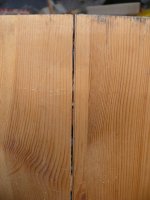
Maybe I needn't bother facing it though - after some more sawing and planing the wood hidden under the old dirt and paint revealed itself to be absolutely lovely to work, with clear, straight, even grain. Taking a full-width shaving was easy:
But by this time, even in the relative cool of the workshop, I was glad to go and clean up and have a shower. I know that someone with a bigger space and a planer-thicknesser would have finished before I'd started, but as I've said many times before, I only do this for the pleasure of doing it, not for any sort of economic advantage, so I don't mind.
I don't know how long the rest of this project will take - but I'm hoping it's weeks not months. I'll try to remember to stop and take photos as I go and bring you another instalment as soon as there's something else to see.