• Hi all and welcome to TheWoodHaven2 brought into the 21st Century, kicking and screaming! We all have Alasdair to thank for the vast bulk of the heavy lifting to get us here, no more so than me because he's taken away a huge burden of responsibility from my shoulders and brought us to this new shiny home, with all your previous content (hopefully) still intact! Please peruse and feed back. There is still plenty to do, like changing the colour scheme, adding the banner graphic, tweaking the odd setting here and there so I have added a new thread in the 'Technical Issues, Bugs and Feature Requests' forum for you to add any issues you find, any missing settings or just anything you'd like to see added/removed from the feature set that Xenforo offers. We will get to everything over the coming weeks so please be patient, but add anything at all to the thread I mention above and we promise to get to them over the next few days/weeks/months. In the meantime, please enjoy!

Removing warpage?

Stuart

Sapling
Joined
May 21, 2021
Messages
401
Reaction score
133
Next project is to make a new box for a mahjong set. The lid has original characters and we want to incorporate it into the new box but it’s so badly warped it basically destroyed the old lid.
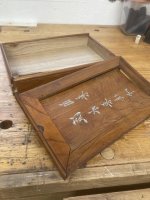
1D04097C-57C7-479E-9DD4-64D039CE6793.jpeg
Gentle disassembly left me with what I originally thought was a single panel
65B0276B-05F6-4565-873F-B4C41B10A3E9.jpeg
Further examination showed it to be two panels (approximately 3.5mm each)
9D64F61E-11C9-4D3C-9B20-A91A792B11F4.jpeg
I’ve managed to separate them and scraped most of the glue off
B08BEAEF-7C9F-442A-BB89-EA1F31AEB02A.jpeg
I am of course still left with a badly warped panel that I want to flatten.

I wonder of the initial warping was caused by only having two panels glued together and the surface tension lead to this issue? Separation has shown any reduction of the warping.

Any ideas how I might get round this? I was initially thinking of creating a sort of plywood by using a cross grain panel between the two existing and re gluing. Looking to keep the overall thickness to no more than 10mm if I can.
 
I personally would try the get that piece with the lettering on much thinner by means of careful hand planing and then glue it like a veneer to a more stable substrate like a decent quality piece of 9mm plywood or even MDF.
 
Yep, Dan has it right, I reckon. Otherwise they'll just end up back where they started.
 
It will need a balancing veneer as well
 
I'd run that through the drum sander. The rollers should keep it flat during the process and end up with a thinner more flexible skin to add to your "plywood".
I would happily sand it for you if you like? I can take it down in 0.1 mm steps watching how it is behaving.
Bob
 
Trevanion":gmjo1q1y said:
I personally would try the get that piece with the lettering on much thinner by means of careful hand planing and then glue it like a veneer to a more stable substrate like a decent quality piece of 9mm plywood or even MDF.

Trouble is those curved bits are so far warped that there's not enough 'meat' to get them anywhere near flat.

9fingers":gmjo1q1y said:
I'd run that through the drum sander. The rollers should keep it flat during the process and end up with a thinner more flexible skin to add to your "plywood".
I would happily sand it for you if you like? I can take it down in 0.1 mm steps watching how it is behaving.
Bob

I'd go with Bob's approach and run them carefully through a drum sander to end up with two thinner, more flexible pieces which can then be stuck to a flat, ply core to finish up with the required final thickness - Rob
 
Woodbloke":12dw0utx said:
Trouble is those curved bits are so far warped that there's not enough 'meat' to get them anywhere near flat.

Ah, I wasn't suggesting flattening them as you're thinking Rob. I was suggesting just making them thinner with a hand plane with the warp still in the piece, once stuck to a flat and stable substrate it would then become flat.
 
I'm not convinced that a drum sander will get them flat. If it is thin enough then the roller pressure is sufficient to flatten the piece as it goes through but when it comes out, it will bow again.

It will work if you make it thin enough to be fixed to a flat substrate as has been suggested.
 
RogerS":23x8cejw said:
I'm not convinced that a drum sander will get them flat. If it is thin enough then the roller pressure is sufficient to flatten the piece as it goes through but when it comes out, it will bow again.

It will work if you make it thin enough to be fixed to a flat substrate as has been suggested.
Yes it will Roger, I agree, but these now much thinner but still bowed pieces can then be glued to a flat ply core as Bob & I suggested - Rob
 
9fingers":3bejahh5 said:
I'd run that through the drum sander. The rollers should keep it flat during the process and end up with a thinner more flexible skin to add to your "plywood".
I would happily sand it for you if you like? I can take it down in 0.1 mm steps watching how it is behaving.
Bob
Knowing nothing about drum sanders I would worry that this process would crack the panel. Is that not an issue?

The suggestion of hand planing down to thinner panels and treating them like veneers seems like a good idea and I would probably take that route. Another possibility I might consider is steaming the panels to try an bend them flatter, and possibly planing them a little afterwards.
 
Thank you for all the comments and Bob for your very kind offer (I’ll contact you separately).

I have to admit I was hoping for a simpler solution but thinning it does make sense and for longer term stability I would be foolish just to clean it up and re-adhere.

Minimum thickness is 3.2 mm with an average of 3.5 mm. Deepest bit of the carved characters is 0.6 mm so I reckon it could be safely taken to 1.6 mm without too many issues? Would this be too thick for veneering to a 6mm substrate with similar balancing veneer on the back?
 
Stuart":3e35ld46 said:
Minimum thickness is 3.2 mm with an average of 3.5 mm. Deepest bit of the carved characters is 0.6 mm so I reckon it could be safely taken to 1.6 mm without too many issues? Would this be too thick for veneering to a 6mm substrate with similar balancing veneer on the back?
If my sums is correct (always a moot point :D ) and assuming an average thickness of 3.3mm, removing 1.6mm would leave an overall thickness of 1.7mm. I regularly veneer 2mm thick and up so 1.7mm would be a trifling on the thin side for me, but to answer the question, no, it would present no difficulties whatsoever - Rob
 
Unfortunately we can’t see the grain on the end of those two pieces that were stuck together, I suspect that they were both likely to cup in the same direction, it’s worth checking that as then one piece could be turned over and the whole thing glued back together which should keep them flat and in equilibrium, but after all this time maybe go with thinning them and gluing to a ply substrate. Ian
 
A visit has been arranged to the wonderfully kind Mr 9fingers to reduce the thickness. I will then make up a new panel with ply or mdf as the core of the 'ply' to hopefully provide a flat, stable box top.
 
Back
Top