• Hi all and welcome to TheWoodHaven2 brought into the 21st Century, kicking and screaming! We all have Alasdair to thank for the vast bulk of the heavy lifting to get us here, no more so than me because he's taken away a huge burden of responsibility from my shoulders and brought us to this new shiny home, with all your previous content (hopefully) still intact! Please peruse and feed back. There is still plenty to do, like changing the colour scheme, adding the banner graphic, tweaking the odd setting here and there so I have added a new thread in the 'Technical Issues, Bugs and Feature Requests' forum for you to add any issues you find, any missing settings or just anything you'd like to see added/removed from the feature set that Xenforo offers. We will get to everything over the coming weeks so please be patient, but add anything at all to the thread I mention above and we promise to get to them over the next few days/weeks/months. In the meantime, please enjoy!

Sawhorses

The story of the sawhorses is fascinating. The were used in building a timber framed pavilion in a nature reserve in Suriname, to be used as part of an eco-tourism development. Here is a bit of the challenge they faced getting materials to the site:


THE building site is only accessible during Suriname’s two wet seasons, when motorized canoes can manage the eight-
hour journey upriver to Foengoe Island with cargo on board (Fig. 3). Given that none of our timber species would float,
each of the 657 pieces would have to be individually loaded into canoes for the 120-mile journey and then lifted out of the boats
and carried up to the building site that lay 20 ft. above and some distance from the boat-landing area. The central area of the pavilion called for 12 principal posts, 10x10s up to 34 ft. long and weighing up to 1800 lbs apiece: these timbers posed a particular challenge. To solve this and other logistical problems, we flew to Suriname to study the problem.
After much discussion, we decided to span the Coppename River with a 400-ft. highline and shotgun carriage that would
enable a small crew of locals to lift the timbers from the canoes with a 1½-ton chainfall and then hoist and trolley them up to the
building site (Fig. 3).....

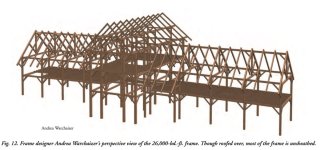
The frame was cut from over 26,000 bd. ft. of kope, brownheart and purpleheart timbers, all species selected for rot-resistance...

And the frame was raised entirely by hand. No machinery could reach the remote location.
Screenshot 2025-09-25 at 2.18.02 PM.jpg

Here is drawing of the frame that was built.

Screenshot 2025-09-25 at 2.24.58 PM.jpg

And as built:

 
Back
Top