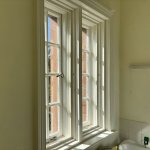
It’s almost the season for window making as I continue the secondary glazing project, so this thread is getting revived. Next up is a pair almost identical to the ones I put in the shower room.
First a few notes to remind myself of things I questioned during the last build.
1. The mullion between the windows was created using a flat front piece butted and nailed from the front on to the sides. No mitres or anything fancy. I was slightly concerned that I would see the fixings or that the line between the front and sides would become more visible as wood moved. Neither happened so I’m happy with this approach to the construction and will repeat for the new windows. With this construction, the join between front and sides is hidden by the windows when closed so even if it were to become visible, it’s not a disaster.
Also there’s no back to the mullions in the secondary glazing, just front and sides. The existing mullions act as the back and it works just fine. No change necessary there.
2. The next window set is going in the living room, so I’m going to take more care with the finishing to ensure a smooth result. The wood I’m using is supposedly pre-planed, but it became apparent during the last build that one of the four sides is usually rougher than the others. For this window, I’m going to take more time sanding, filling, and painting since this set is on display in the living room.
3. Last time I used tight tolerances on my measurements so that when it came time to fitting the frame in to the opening, it was a real squeeze and it ended up pushing the new frame slightly out of square. This time I’m going to make sure that there is room to slide the frame in easily and take my time using caulk or shims as necessary for gap filling and levelling to keep everything absolutely square.
4. Attaching the secondary stops was a pain last time. I think I’d decided to attach primary stop to secondary stop before attaching to the frame this time.
5. On the previous build, I created the frame and flyscreen and installed before building the casements and attaching the hardware. This was a PITA. Much easier to do everything at the bench so that’s what’s happening this time.
Parts list calculator: