
TBH Malc it never occurred to me to use micromesh wet.. Wet n’ dry paper is for metal only in my world.


When I first acquired it a few years ago, all its blurb recommended wet on lacquer. And I'd always used w'n'd with cellulose paint on car and bike.TBH Malc it never occurred to me to use micromesh wet.. Wet n’ dry paper is for metal only in my world.

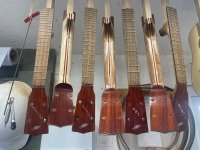


Thanks, Al.You've got way more patience than I have Malc. They look lovely.
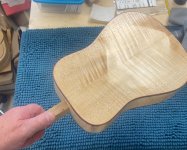
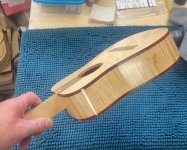

Today, I had one of Paul Gambaccini's programmes playing. It was quite laid back so I was somewhat less aggressive.I have visions of you doing a backwards and forwards CPR type sanding motion to Staying Alive.


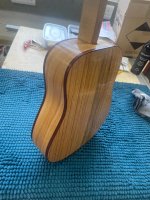


I'm not sure, @Andy P. I've not got a studio set up, either acoustically or with equipment. I will try subjectively using my ears. I am more interested in hearing the difference between the Sycamore and Monterey Pine bodies, if there is any difference at all. Likewise, the difference between the Spruce soundboard and the Cedar.When you come to tuning them will you be able to compare how the same note sounds on each instrument?


As Manuel is famed for saying, "I know nothing" especially when it comes to luthier type stuff, but I did recollect reading ages ago that it's the varnish, especially on very high end violins that goes a long way to determining the eventual sound. I also remember back in the day when Nigel Kennedy was interviewed by Wogan, he asked to hold Kennedy's Strad (or similar) and was point blank refused, maybe 'cos he was going to get his grubby mitts all over the varnish?? - RobI'm not sure, @Andy P. I've not got a studio set up, either acoustically or with equipment. I will try subjectively using my ears. I am more interested in hearing the difference between the Sycamore and Monterey Pine bodies, if there is any difference at all. Likewise, the difference between the Spruce soundboard and the Cedar.
I don't really know, Rob, that's above my pay grade. But sound is all about vibrations and how the timber moves. I can imagine that a modern two pack finish could cure so hard that it might affect how much the wood can vibrate.As Manuel is famed for saying, "I know nothing" especially when it comes to luthier type stuff, but I did recollect reading ages ago that it's the varnish, especially on very high end violins that goes a long way to determining the eventual sound. I also remember back in the day that when Nigel Kennedy was interviewed by Wogan, he asked to hold Kennedy's Strad and was point blank refused, maybe 'cos he was going to get his grubby mitts all over the varnish?? - Rob
I recollect also that the varnish recipe used on top endy 18th century violins was a closely guarded secret, each maker having his own concoction and method of application. I guess that whatever is used, there has to be some degree (or a lot) of flexibility to allow the timber to vibrate - RobI know french Polish is a finish used on many classical and some western guitars. Although I learned a bit of doing that during my A Level, I choose to use nitrocellulose lacquer which has been traditional with some manufacturers. I believe it is flexible and moves with the wood vibrations. I realise it's nasty stuff and some people avoid it, but I've learned a bit about how to apply it and and how to get it to a high gloss. It takes time, and I wonder if modern two pack finishes are just time and finance saving for the manufacturer.
