I'm definitely not qualified to be offering "how to" tips but here is something that I stumbled on at the weekend and the reason I'm posting this is because it works. I'll be amazed if nobody else does it but a quick trawl of books and the internet did not turn up this method of how to get the shoulders on dovetail pin boards and tenons just right. So please regard it as a start point for discussion rather than me trying to tell you how things should be done.
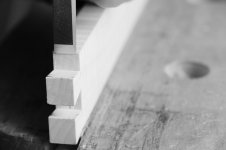
The problem: the shoulder cut, being such a short one seems to be generally expected to fit "straight from the saw" while a final trim with a paring chisel is usually recommended. That's where the problems start for me as I occasionally pare a bit down towards the first tail/tenon and so the final result can be a bit of gappiness at the shoulder.
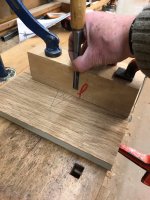
This is my counter to that and assuming that you've got your marking out right, it can hardly go wrong. The first thing is to saw the shoulder a fraction above the line, say one millimetre, so any inaccuracy is unimportant. Then place the tail board flat on the bench and with a chisel that is slightly broader than the shoulder is long, tap in the marked line and and angle the cut a degree or two upwards. Repeat from the other side (the cuts should meet more or less in the middle). Now with a chisel that is slightly narrower than the shoulder is wide and with the board held/clamped on its edge, tap bang on vertically or even a degree downwards (you can because the chisel is narrower and its only end grain) to remove the slight hump or tent (to use the Charlesworthian term), usually in one go.
The result is shoulders which consistently conform bang on to the marked line on their edges and are either flat or a fraction undercut.
Any thoughts/disagreement/outrage?
The problem: the shoulder cut, being such a short one seems to be generally expected to fit "straight from the saw" while a final trim with a paring chisel is usually recommended. That's where the problems start for me as I occasionally pare a bit down towards the first tail/tenon and so the final result can be a bit of gappiness at the shoulder.
This is my counter to that and assuming that you've got your marking out right, it can hardly go wrong. The first thing is to saw the shoulder a fraction above the line, say one millimetre, so any inaccuracy is unimportant. Then place the tail board flat on the bench and with a chisel that is slightly broader than the shoulder is long, tap in the marked line and and angle the cut a degree or two upwards. Repeat from the other side (the cuts should meet more or less in the middle). Now with a chisel that is slightly narrower than the shoulder is wide and with the board held/clamped on its edge, tap bang on vertically or even a degree downwards (you can because the chisel is narrower and its only end grain) to remove the slight hump or tent (to use the Charlesworthian term), usually in one go.
The result is shoulders which consistently conform bang on to the marked line on their edges and are either flat or a fraction undercut.
Any thoughts/disagreement/outrage?