

Woodbloke
Sequoia
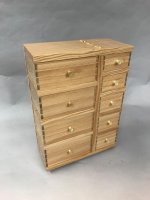
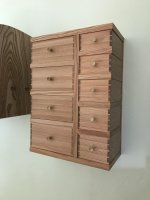
For the last few weeks (whilst some London Plane is further conditioning in the 'shop) I've been mostly faffing around with very small bits of wood making this little 'skeletal' wall hung cabinet which measures about 400mm tall and 300mm wide and within that area are nine drawers.
Many years ago when the kids were tiny, we had a day out at Kimmeridge Bay in Dorset, wherupon we chanced on some planks of Douglas Fir that had been washed ashore as flotsam from a ship in the Channel that had lost it's deck cargo. We then collected a load of 25mm thick boards (illegal I since found out), got them home and I spent some time drying them out and I then made a blanket chest from the wood which served us well for about thirty years.
Over the last couple of years, I've made a couple of blanket chests (one for me and another for SWIMBO) but rather than break up the original, I decided to make something from it rather than fritter the timber away in the 'shop as rough stuff for jig making etc, so the idea of a little cabinet came about.
I didn't though, have a great deal as the boards in the original blanket chest had been doweled together (I didn't have a biscuit jointer till much later) so I had to cut round them and use what remained. I decided to stack laminate the bits I had available, re-saw the block and then re-join to form boards which are straight grained with no knots and also quarter sawn. It's a hell of faff to do but you end up with pristine, clean material which won't warp or twist.
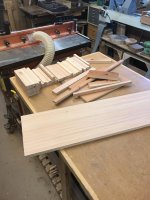
There was just enough to make a 'skeletal' framework with seven horizontal partitions and a pair of vertical rails at the back for support. The shelves were glued into place using 6mm ply tongues and the main jointing was with through wedged tenons, left proud and later rounded over. In the pic below you can see two of the Holly drawer runners as well as the grooves for the ply tongues:

The 'female' part of the drawer runner assembly, which eventually fits into the drawer was made in three sections, shown below glued up with an orange Carver cramp, a pair of 'C' cramps from old furniture springs and a pair of small spring clamps:
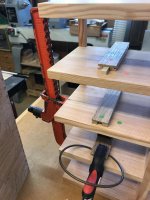
Doing it this way again is real faff but it ensures that each part of the drawer runner runs 'one on one' with no slack anywhere. As the build progressed, all the drawers were made and fitted:

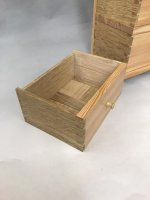
...and the pic below shows a finished drawer, with the 6mm 'show' sides of each drawer cut from the same piece of quarter sawn oak. Each drawer has a pair of slips fitted and a quarter sawn oak base; the width of each slat in the smaller drawers is around 25mm...fun to machine the tongue on the router table.
The back is a bit of a 'dog's dinner' and has been left entirely open. It doesn't really matter as it's going up against a wall and will never under normal circumstances be seen. The method of hanging is by the 'french cleat' system as detailed in an earlier thread. Works very well btw!
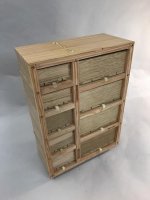
The final two pics show it in the 'shop and hung on the wall next to the Krenov style bookshelf I made a few weeks ago:
The other timber used for the drawer pulls and through tenon wedges was Holly which IMO is as pleasant to work with as Boxwood and much underrated, though it's exceptionally difficult to season. This little job has been finished with a couple of coats of satin Polyvine acrylic wax jollop followed by a single matt coat of the same, after which came a goodly slathering of decent Swedish wax polish from CHT - Rob
Many years ago when the kids were tiny, we had a day out at Kimmeridge Bay in Dorset, wherupon we chanced on some planks of Douglas Fir that had been washed ashore as flotsam from a ship in the Channel that had lost it's deck cargo. We then collected a load of 25mm thick boards (illegal I since found out), got them home and I spent some time drying them out and I then made a blanket chest from the wood which served us well for about thirty years.
Over the last couple of years, I've made a couple of blanket chests (one for me and another for SWIMBO) but rather than break up the original, I decided to make something from it rather than fritter the timber away in the 'shop as rough stuff for jig making etc, so the idea of a little cabinet came about.
I didn't though, have a great deal as the boards in the original blanket chest had been doweled together (I didn't have a biscuit jointer till much later) so I had to cut round them and use what remained. I decided to stack laminate the bits I had available, re-saw the block and then re-join to form boards which are straight grained with no knots and also quarter sawn. It's a hell of faff to do but you end up with pristine, clean material which won't warp or twist.
There was just enough to make a 'skeletal' framework with seven horizontal partitions and a pair of vertical rails at the back for support. The shelves were glued into place using 6mm ply tongues and the main jointing was with through wedged tenons, left proud and later rounded over. In the pic below you can see two of the Holly drawer runners as well as the grooves for the ply tongues:
The 'female' part of the drawer runner assembly, which eventually fits into the drawer was made in three sections, shown below glued up with an orange Carver cramp, a pair of 'C' cramps from old furniture springs and a pair of small spring clamps:
Doing it this way again is real faff but it ensures that each part of the drawer runner runs 'one on one' with no slack anywhere. As the build progressed, all the drawers were made and fitted:
...and the pic below shows a finished drawer, with the 6mm 'show' sides of each drawer cut from the same piece of quarter sawn oak. Each drawer has a pair of slips fitted and a quarter sawn oak base; the width of each slat in the smaller drawers is around 25mm...fun to machine the tongue on the router table.
The back is a bit of a 'dog's dinner' and has been left entirely open. It doesn't really matter as it's going up against a wall and will never under normal circumstances be seen. The method of hanging is by the 'french cleat' system as detailed in an earlier thread. Works very well btw!
The final two pics show it in the 'shop and hung on the wall next to the Krenov style bookshelf I made a few weeks ago:
The other timber used for the drawer pulls and through tenon wedges was Holly which IMO is as pleasant to work with as Boxwood and much underrated, though it's exceptionally difficult to season. This little job has been finished with a couple of coats of satin Polyvine acrylic wax jollop followed by a single matt coat of the same, after which came a goodly slathering of decent Swedish wax polish from CHT - Rob


 My two kids (aged about 5 or so) had to manhandle a bit up the cliffs to the car park, so it has a 'sentimental' attachment although they probably wouldn't think so.