

Ok, last lap!
With the box beginning to look like a box, I thought the lid was a bit too thick. It's too late to thin the whole thing down, so I just planed a bevel around the rim to make it look a bit lighter.
Before
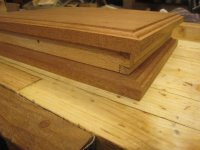
During

After

This is a trad box out of mahogany so it's getting trad stains and finishes. I did some tests anyway, just to be sure. To darken the mahogany, I used potassium permanganate. I've used it before, on a library chair/steps, but looking it up online now, it seems I may have got myself confused, thinking it was the same thing as bichromate of potash, which certainly does have a history of use as a stain on mahogany.
I'm no chemist, but in my limited experience the pp works just fine and it's too late to tell me that the box will spontaneously combust or be reduced to powder in a week.
It goes on purple, which you need to be quick to catch in a photo, as it soon turns brown.


It's fairly easy to get the colour even. As it's water based, I left it overnight to dry. Here the scrap has got a first coat of shellac on as well.

I'd decided on shellac because I bought a lifetime supply of flakes and 99.9% ethanol to dissolve them in. It's not quite as easy as Osmo Poly-X but you can do several coats in an evening and it's pretty forgiving in use.
Here's the base turning a deeper shade of brown

For the sides, which are oak, I know from before that the pp doesn't work so well, but I also have some vandyke crystals, already dissolved from before, which are good on oak, so I used that. (I guess I could have used them on the top and bottom too.)
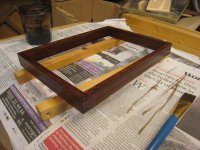
And here's the whole kit of parts having had somewhere around 8 coats of shellac and an overnight drying session.

With that all done, it was time to put all the screws in and see if it worked. Here's a posed shot for anyone wondering if I used an impact driver on the screws

Most of the screws in that piano hinge are the same screws that were in there when it was holding this mahogany in place originally. The piano probably dated to the 1920s but was completely unplayable when it was chucked out and the wood was rescued for me.
As I expected, a round hole in a catch won't close over a stud of the same diameter:

But a few strokes of a file make it just long enough - phew!


The bottom needed something to stop it sliding, so I cut some little circles of leather

and glued them on

And with that done, I gave the whole box a quick once-over with some Alfie Shine polish that I was given. Here it is:


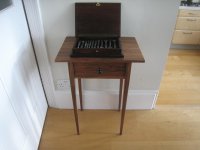
And purely for the sake of showing it in daylight, here it is in its temporary place on top of a table I made a few years ago.

Of course, as anyone who has ever made anything will know, there are improvements that could be made and some of them will be, but I'll call this finished and decide that it's good enough. My immediate problem is to find a place to squeeze it onto a shelf in the workshop - it's handy but it takes up a lot more space than just tipping all the bits into an old biscuit tin! Any way, it's kept me out of mischief for a few weeks while we have all had to stay in more than we would have wanted and I have enjoyed making it, so that's ok by me. I hope you like it too.
With the box beginning to look like a box, I thought the lid was a bit too thick. It's too late to thin the whole thing down, so I just planed a bevel around the rim to make it look a bit lighter.
Before
During
After
This is a trad box out of mahogany so it's getting trad stains and finishes. I did some tests anyway, just to be sure. To darken the mahogany, I used potassium permanganate. I've used it before, on a library chair/steps, but looking it up online now, it seems I may have got myself confused, thinking it was the same thing as bichromate of potash, which certainly does have a history of use as a stain on mahogany.
I'm no chemist, but in my limited experience the pp works just fine and it's too late to tell me that the box will spontaneously combust or be reduced to powder in a week.
It goes on purple, which you need to be quick to catch in a photo, as it soon turns brown.
It's fairly easy to get the colour even. As it's water based, I left it overnight to dry. Here the scrap has got a first coat of shellac on as well.
I'd decided on shellac because I bought a lifetime supply of flakes and 99.9% ethanol to dissolve them in. It's not quite as easy as Osmo Poly-X but you can do several coats in an evening and it's pretty forgiving in use.
Here's the base turning a deeper shade of brown
For the sides, which are oak, I know from before that the pp doesn't work so well, but I also have some vandyke crystals, already dissolved from before, which are good on oak, so I used that. (I guess I could have used them on the top and bottom too.)
And here's the whole kit of parts having had somewhere around 8 coats of shellac and an overnight drying session.
With that all done, it was time to put all the screws in and see if it worked. Here's a posed shot for anyone wondering if I used an impact driver on the screws
Most of the screws in that piano hinge are the same screws that were in there when it was holding this mahogany in place originally. The piano probably dated to the 1920s but was completely unplayable when it was chucked out and the wood was rescued for me.
As I expected, a round hole in a catch won't close over a stud of the same diameter:
But a few strokes of a file make it just long enough - phew!
The bottom needed something to stop it sliding, so I cut some little circles of leather
and glued them on
And with that done, I gave the whole box a quick once-over with some Alfie Shine polish that I was given. Here it is:
And purely for the sake of showing it in daylight, here it is in its temporary place on top of a table I made a few years ago.
Of course, as anyone who has ever made anything will know, there are improvements that could be made and some of them will be, but I'll call this finished and decide that it's good enough. My immediate problem is to find a place to squeeze it onto a shelf in the workshop - it's handy but it takes up a lot more space than just tipping all the bits into an old biscuit tin! Any way, it's kept me out of mischief for a few weeks while we have all had to stay in more than we would have wanted and I have enjoyed making it, so that's ok by me. I hope you like it too.


