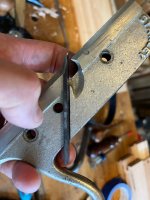
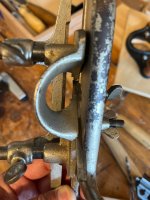
I used to have a 50, long ago sold, but I don't remember that amount of slop.
Is it an original Stanley blade? Later 50s had a blade adjuster which worked on notches in the bottom of the blade, I can't see any notches in the bottom of the blade but that might just mean you have an early model.
Original blades would have been 1/8" thick, you may have a replacement made by an owner from 3mm steel.
Or it may just have been rusted and suffered some enthusiastic sanding.
On the other hand a second look at your picture made me pause. The blade isn't protruding much out of the slot, doesn't look as if there's a lot for the sliding section to butt against. Do you have the same problem with wider blades. The 50 had a different method for holding smaller blades. Blood and gore explains it better than I can.
Quote "There is one slight problem with this design of sandwiching the cutter between two castings to hold the cutter in place, and that is that the narrowest two ploughing cutters (1/8" and 3/16") aren't wide enough to be secured in this manner. A holding screw was added when these two cutters were provided starting ca. 1936. The holding screw has a head that measures 3/4" in diameter, and it's this wide head that holds the cutter in place; the sliding section is removed, and the holding screw is substituted. The same wing nut that pulls the sliding section up against the left edge of the cutter also pulls the holding screw's head against the left edge of the cutter. The holding screw is normally MIA."