• Hi all and welcome to TheWoodHaven2 brought into the 21st Century, kicking and screaming! We all have Alasdair to thank for the vast bulk of the heavy lifting to get us here, no more so than me because he's taken away a huge burden of responsibility from my shoulders and brought us to this new shiny home, with all your previous content (hopefully) still intact! Please peruse and feed back. There is still plenty to do, like changing the colour scheme, adding the banner graphic, tweaking the odd setting here and there so I have added a new thread in the 'Technical Issues, Bugs and Feature Requests' forum for you to add any issues you find, any missing settings or just anything you'd like to see added/removed from the feature set that Xenforo offers. We will get to everything over the coming weeks so please be patient, but add anything at all to the thread I mention above and we promise to get to them over the next few days/weeks/months. In the meantime, please enjoy!

Tail vice location.

Mike G

Petrified Pine
Joined
Jul 30, 2014
Messages
12,585
Reaction score
3,217
Location
Suffolk
Name
Mike
I know, I know....it's at the end of the bench.

For those of you with a tail vice of the type which works within the bench, rather than just being a face vice on the end of the bench, could you please let me know how far in from the front edge of the bench it is set. Or, how far in is the line of bench dog holes?

I've got an old car jack and am thinking about the implications of turning it into a tail vice.
 
Hi Mike, I’ve just been following an enormously long thread on an American site about benches and vises (sic), yes I know, and the consensus is coming that they’re not using them very much at all once they have them, but if you have a need to use one for planing my thought is that you stand at your bench, plane in hand as if to plane a plank (and most are less than 8” wide) where your plane hits the middle of the plank is the centre line of the dog holes.
Personally I think if you can use a plane correctly you just plane up against a stop, any movement in the wood denotes a bad planing action, and also always having the wood held firm can foster bad planing habits.
Ian
 
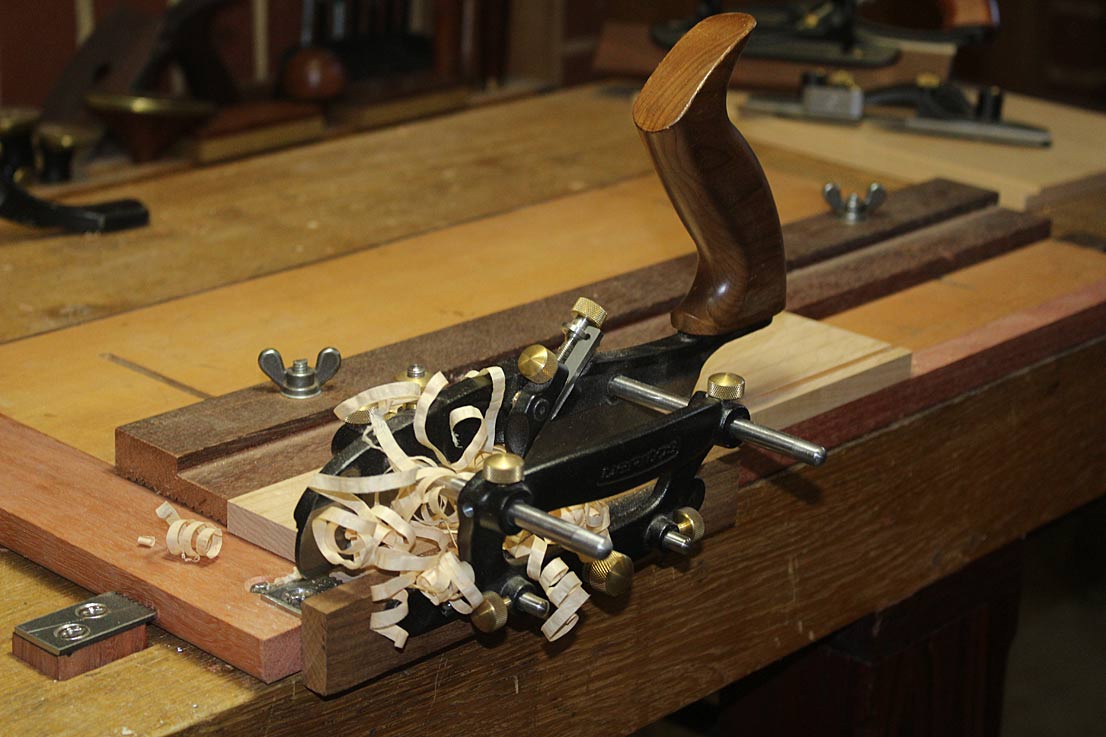
Ian, I'm guessing you've never used a fenced plane.

I'd have to look, Mike, can't remember. But perhaps you may not wish to know, it being commercially made. :eusa-shifty:
 
Alf":b0ttcn40 said:
Ian, I'm guessing you've never used a fenced plane.

I'd have to look, Mike, can't remember. But perhaps you may not wish to know, it being commercially made. :eusa-shifty:

Not for a while I must say, but a Doe's foot and holdfast would work against a stop, or a centre planing stick and a stop, it’s all doable without any vice at all.
 
Cabinetman":1iteeaej said:
...... a Doe's foot and holdfast would work against a stop, or a centre planing stick and a stop, it’s all doable without any vice at all.

Indeed. The thing is, my bench has square dog holes, and so my hold-fasts are square, so they don't rotate and work with a doe's foot.

This whole subject arose in my mind when I screwed a doe's foot onto my bench to use a (fenced) rebate plane a few days ago. I've done it many times before, but it isn't a proper long-term solution. However, my dog holes are too far inboard to be of any use with a tail vice and a fenced plane.......so..........a doe's foot doesn't work properly for me, and a tail vice doesn't either. My bench is too low and gives me neck ache doing various tasks, and is a bit short, too (it's a school bench that I raised some 6 inches). The tool well is in the wrong place, and it isn't anywhere near flat. You can see where this is going.
 
Andyp":1nfoshzd said:
Here you go Mike....

Thanks Andy. That's brilliant. That really would work for the issues I have. It's the closest I've ever noticed to the edge.
 
Trevanion":2e6kw3nc said:
Build the bench! Build the bench! :D

It's always been the long term plan, Dan, but it's creeping up the list of priorities. The thing is, my bench has getting on for 40 years of my history scarred onto it's surface. There are reminders everywhere of projects and fun, cut and planed and drilled and painted and varnished into the surface. I'm not sentimental about these things, but.......
 
It sounds like you’re working yourself up to a new bench Mike, but till then how about a long substantial piece of wood cramped the full length of the bench to push the piece to be worked on up against and have it’s end up to a planing stop. This is assuming you don’t have s split top to cramp through, my next bench will definitely be split with a planing stick, though it is possible to fit a stick to the back of the front work surface in the toolwell. I did a wip on just this a while ago.
Ian
 
Cabinetman":fz6f1wjo said:
.....a long substantial piece of wood cramped the full length of the bench to push the piece to be worked on up against and have it’s end up to a planing stop.......

That's sort-of what I do generally. I put a couple of dogs in the bench, and put a batten up against them, running longitudinally along the bench. With a stop at the end in the usual way, this can work. However, there are too many moving parts, and you tend to end up re-locating everything after every single stroke of the plane.
 
Mike G":bejjck9q said:
Andyp":bejjck9q said:
Here you go Mike....

Thanks Andy. That's brilliant. That really would work for the issues I have. It's the closest I've ever noticed to the edge.

Wow. i just dug this out of the archive. Proof I actually used it.

C6936962-91C8-4876-B986-9C39B1BA8787.jpeg
 
Cabinetman":16gwdo12 said:
......I have just found this again, it’s the lift up stick in the toolwell I did, in case anyone hasn’t seen it.

https://www.thewoodhaven2.co.uk/viewtop ... ck#p101392

Yes, I remember that well. My current tool-well is lined with a huge quadrant, for some reason, which leaves nowhere near enough upstand against which to fix a stop (or anything).

I hadn't intended this to turn into a "my new bench" thread, but this is what I am currently thinking:

new benchl.jpg

The shaded area on the plan is a tool well, but you'll note the shelf behind, which is something I have always done, and is a tidier alternative or addition to a tool well.
 
Andyp":3n03lewv said:
....i just dug this out of the archive. Proof I actually used it....

That's precisely the circumstance we've been talking about. It looks to me that you might have the vice closed and the edge of the board overhanging enough to clear it. On narrow boards I often end up with the vice open to its maximum, and the plane and fence passing inside it.
 
Square dog holes a mile from the edge of the bench:

Fxq0ytG.png

Note the shelf behind. Note also the white board occupying the left hand half of the tool well, with a stop running along it. This is normally the other way up in the well to give me a larger working area, but I flip it over if it suits my work-holding. Here is the normal set-up:

QNWJ0lH.png
 
Cabinetman":36ccbjwf said:
Alf":36ccbjwf said:
Ian, I'm guessing you've never used a fenced plane.

I'd have to look, Mike, can't remember. But perhaps you may not wish to know, it being commercially made. :eusa-shifty:

Not for a while I must say, but a Doe's foot and holdfast would work against a stop, or a centre planing stick and a stop, it’s all doable without any vice at all.
Quite so. But you might as well argue against every tool and holding fixture in the book, because woodwork's doable with a piece of flint while sitting on the floor. ;)
 
Mike G":3fnhq2ap said:
Andyp":3fnhq2ap said:
Here you go Mike....

Thanks Andy. That's brilliant. That really would work for the issues I have. It's the closest I've ever noticed to the edge.
Mine is almost the same as Andy's with three dog holes instead of four. It uses a 25mm dia steel 'acme' screw thread (pinched from a carvers vice) and was built when I constructed the bench (I have the plans somewhere). To build this type of 'L' shaped tail vice into an existing bench would be a trifle difficult! - Rob
 
No, just offering viable alternative ways of doing it depending on equipment available. Mike Siemsen has a brill vid showing all methods and ways of holding wood even if you don’t have a vise.
Ian
 
Mike G":1wbq6od0 said:
I know, I know....it's at the end of the bench.

For those of you with a tail vice of the type which works within the bench, rather than just being a face vice on the end of the bench, could you please let me know how far in from the front edge of the bench it is set. Or, how far in is the line of bench dog holes?

I've got an old car jack and am thinking about the implications of turning it into a tail vice.


Mike, the BenchCrafted end vise and dogs is situated 3" in from the apron ..

Tailvisea-zpsvnal6yby.jpg


If I placed a long board against a far dog, one can either use the end vise or a Doe's Foot ...

6a.jpg


In any event, there is a planing stop at the end of the bench ...

End-stop1.jpg


For narrow boards, when ploughing grooves or mouldings, use a sticking board (this one has an adjustable fence) ...

AdjustableStickingBoard2_html_m32531582.jpg


AdjustableStickingBoard2_html_m6d3441d5.jpg


Even wide boards can be used on the dog positioning. Just move the board as needed ...

ApothecaryChestWeekendOne_html_m3f130627.jpg


Regards from Perth

Derek
 
Mike G":3jql9uzo said:
..... My bench is too low and gives me neck ache doing various tasks, and is a bit short, too (it's a school bench that I raised some 6 inches). The tool well is in the wrong place, and it isn't anywhere near flat. You can see where this is going.

Slight digression, but bench height is an issue I'd like to hear people's opinions on... (yes, I know, a preposition is not a suitable word to end a sentence with)

Seriously - for hand planing and big sawing tasks you need downward pressure so not too high. For most other tasks you need good upright posture to avoid back pain. Think ergonomics of kitchen worktops - forearms horizontal, fingers pointing down indicate the optimum height. These two criteria are incompatible. I don't hand plane a huge amount, so I have a high bench and a small portable platform to stand on when I need to get above the work. What do others do ?
 
Saw horses. I cannot imagine a workshop without.

The height issues for me are when chiseling or carving, where my elbow rests on the work on the bench, bending me over.
 
Mike G":nyrhvgmm said:
Saw horses. I cannot imagine a workshop without.

The height issues for me are when chiseling or carving, where my elbow rests on the work on the bench, bending me over.

Fine for sawing, agreed, but you still need a lowish bench for planing and then you have the problem you mentioned above.
 
As I said I’ve been reading up on benches and one book has heights based on you the individual,
Saw bench, knee height. Assembly bench, tip of finger at your side ht. planing, wrist ht when at your side. Joinery/joint cutting elbow ht.
Interesting idea, but doesn’t work for me, people say planing needs a lot of top pressure so a lower bench ht, but I prefer it higher so as to be able to push more easily. From memory my bench is 37” High and I’m 5’9”.
It’s all subjective I suppose.
Ian
 
Cabinetman":3ol0tkhm said:
As I said I’ve been reading up on benches and one book has heights based on you the individual,
Saw bench, knee height. Assembly bench, tip of finger at your side ht. planing, wrist ht when at your side. Joinery/joint cutting elbow ht.
Interesting idea, but doesn’t work for me, people say planing needs a lot of top pressure so a lower bench ht, but I prefer it higher so as to be able to push more easily. From memory my bench is 37” High and I’m 5’9”.
It’s all subjective I suppose.
Ian

That's pretty much the problem, different jobs need different heights. My choice was 110cm (43") a couple of cm below my elbow height (I'm 6' 2"). That height suits for most jobs, but I find it too high for planing and hence the platform. I've also seen (ancient edition of fine Woodworking) a bench top bench with it's own vice etc that clamps to the main bench to raise the work height for detail jobs.

https://www.finewoodworking.com/project-guides/shop-projects/mini-workbench-works-wonders
 
I have a lot of back issues (one of the many curses of being tall) and hence am very sensitive to bench height. It's also part of the reason I built my portable workbench. That allows me to have "low" workbench (about 1 metre high, although the floor isn't level, so the actual height varies a bit along the length) and also a high workbench by plonking the portable workbench in top, which raises the top to about 1.2 metres.

I'm 6'6" (1.98 m) tall, so I'm sure those workbench heights would be far too high for most people. As I prefer Japanese saws, I'm more likely to have the wood higher up with me pulling down than use a saw horse (the Japanese saws would try to lift the wood off the saw horse and it would just be a pain). I know the Japanese way is to have the wood very low down and pull up (with your weight on the wood to hold it in place), but my back didn't like that very much so I've found other ways.
 
chataigner":5zvm6lxr said:
Cabinetman":5zvm6lxr said:
As I said I’ve been reading up on benches and one book has heights based on you the individual,
Saw bench, knee height. Assembly bench, tip of finger at your side ht. planing, wrist ht when at your side. Joinery/joint cutting elbow ht.
Interesting idea, but doesn’t work for me, people say planing needs a lot of top pressure so a lower bench ht, but I prefer it higher so as to be able to push more easily. From memory my bench is 37” High and I’m 5’9”.
It’s all subjective I suppose.
Ian

That's pretty much the problem, different jobs need different heights. My choice was 110cm (43") a couple of cm below my elbow height (I'm 6' 2"). That height suits for most jobs, but I find it too high for planing and hence the platform. I've also seen (ancient edition of fine Woodworking) a bench top bench with it's own vice etc that clamps to the main bench to raise the work height for detail jobs.

https://www.finewoodworking.com/project-guides/shop-projects/mini-workbench-works-wonders
Now that’s interesting! At first I thought you were going to be showing us a Moxon vice but no, it’s a little bench which cramps to the top of a proper bench to save bending over, I think it would be especially good for joint cutting, definitely something I shall be looking into. I particularly liked the adaptation for cramping tapered parts in the vice, brilliant, suggest you all have a look boys and girls.
This could be just what you need Mike.
 
Cabinetman":2q1q1ktv said:
chataigner":2q1q1ktv said:
Cabinetman":2q1q1ktv said:
As I said I’ve been reading up on benches and one book has heights based on you the individual,
Saw bench, knee height. Assembly bench, tip of finger at your side ht. planing, wrist ht when at your side. Joinery/joint cutting elbow ht.
Interesting idea, but doesn’t work for me, people say planing needs a lot of top pressure so a lower bench ht, but I prefer it higher so as to be able to push more easily. From memory my bench is 37” High and I’m 5’9”.
It’s all subjective I suppose.
Ian

That's pretty much the problem, different jobs need different heights. My choice was 110cm (43") a couple of cm below my elbow height (I'm 6' 2"). That height suits for most jobs, but I find it too high for planing and hence the platform. I've also seen (ancient edition of fine Woodworking) a bench top bench with it's own vice etc that clamps to the main bench to raise the work height for detail jobs.

https://www.finewoodworking.com/project-guides/shop-projects/mini-workbench-works-wonders
Now that’s interesting! At first I thought you were going to be showing us a Moxon vice but no, it’s a little bench which cramps to the top of a proper bench to save bending over, I think it would be especially good for joint cutting, definitely something I shall be looking into. I particularly liked the adaptation for cramping tapered parts in the vice, brilliant, suggest you all have a look boys and girls.
This could be just what you need Mike.

That's a similar idea to my portable workbench & I love it for joint cutting
 
Hi Al, that’s good, you say it raises yours to 1200mm high, the one on the vid is about 11.5” High which would bring it up to about there on my bench so that makes sense, but then I like a higher surface than most.
Ian
 
My solution is to have the bench at the right height for planing and sawing joinery, and when doing detailed chisel work I sit on a chair. It doesn't seem to be a popular approach, but I'm honestly not sure why - I sit down, lean forward slightly, rest my elbows on the bench and/or work, and everything is right at the ideal height for visibility and fine control.
 
spb":3r2i7jcx said:
My solution is to have the bench at the right height for planing and sawing joinery, and when doing detailed chisel work I sit on a chair. It doesn't seem to be a popular approach, but I'm honestly not sure why - I sit down, lean forward slightly, rest my elbows on the bench and/or work, and everything is right at the ideal height for visibility and fine control.

The other option as they do in the Barnsley 'shop is to jack up a standard bench (if it's too low) by putting blocks under the feet. Rob Ingham was big on sitting down for chiseling etc but I believe he had back problems so it made sense - Rob
 
Cor! this hand tool business doesn't half cause lots of knock on issues Mike.

From back in another thread when you were having difficulty thinking about my shop without hand planes, let your imagination run riot by visualising,
no saw horses,
no vices mounted on benches,
nothing with dog holes to lose small items down and just an assembly table that doubles as a saw outfeed table and trebles as a router table and quadruples as an outfeed for the thicknesser allowing about 4m to be run through.
Oh yes and no tool well either as erm..I've nowt to put in it!

Hope this does not give you nightmares but maybe hints that there are other ways of working :lol:

Bob
 
Cabinetman":igcvdu6k said:
Get thee behind me Satan! Oh and wash your mouth out with carbolic whilst you’re at it, dear heaven, what’s the World coming to, it’ll be sanding to 1000 grit next. :lol:

Norm has a lot to answer for including giving me the confidence to move from metal engineering towards wood!

To be fair I normally stop at 320 grit before slathering on my equivalent of Mike's Magic Mix and cut the last coat with 0000 wirewool/wax :lol:

Bob
 
9fingers":1kwcyrb1 said:
.....Hope this does not give you nightmares but maybe hints that there are other ways of working :lol:

Oh I know, I know. I've hung around woodworking fora long enough to have come to terms with that.....and of course I was heading in that direction myself 20 or 30 years ago. Whilst it's not for me, I still find the processes interesting. I hope you machine-only guys also find the alternatives interesting. As an illustration of the differences, how about this. I got a few strips of sandpaper torn off the edges of some thickness sander belts from a local joinery firm in about 1990, and I've just moved them, again. I've never, ever bought sandpaper in my life, other than belts for my belt sander.
 
Back
Top