• Hi all and welcome to TheWoodHaven2 brought into the 21st Century, kicking and screaming! We all have Alasdair to thank for the vast bulk of the heavy lifting to get us here, no more so than me because he's taken away a huge burden of responsibility from my shoulders and brought us to this new shiny home, with all your previous content (hopefully) still intact! Please peruse and feed back. There is still plenty to do, like changing the colour scheme, adding the banner graphic, tweaking the odd setting here and there so I have added a new thread in the 'Technical Issues, Bugs and Feature Requests' forum for you to add any issues you find, any missing settings or just anything you'd like to see added/removed from the feature set that Xenforo offers. We will get to everything over the coming weeks so please be patient, but add anything at all to the thread I mention above and we promise to get to them over the next few days/weeks/months. In the meantime, please enjoy!

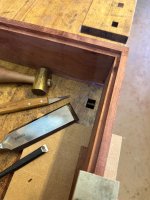
The Niff-Naff Cabinet; back panel rebate

Very nice Rob. Why so many holes? Obviously for shelf pins but that allows for an awful lot of adjustment
There's going to be six 4 or 5mm Bubinga shelves Andy (already cut) which gives SWIMBO plenty of room for all her nick-nacks, but they're all of varying sizes, so she's got plenty of different options for arranging the distance between the shelves.
That was a fairly risky fix there Rob, but I reckon you could have gone nearer the ends.
No I wouldn’t have either lol.
Have I missed how you got those nicely polished chamfers around the pin holes?
You're telling me it was risky! I had to plan out what I had to do very carefully so the 'set up' took ages before I even switched on the router. The job was deliberately equidistant from the ends of the plank, so I stuck a piece(s) of masking tape on the ci surface so that when the end of the pine was level with them after a pass, the cutter was approx 10mm away from the top or bottom. You can see the two pieces of tape on the second pic.
Chamfers around the holes were made by using a countersink bit as a way of disguising the tear out on the edges as I stupidly used a 'James Blunt' drill bit - Rob
 
Nice work as always Rob.
Tear out on shelf pin holes has caught me out a few times, especially in the old days before Brad point bits where a thing. Now I keep a stock of Festool Brad points that get there first run on shelf pins then used for months after on general stuff.
Also after years of using the 5mm shelf pins I switched to the 3mm Hafele pins, less tear out and less noticeable.
 
Well I for one was mystified, looked it up and here it is for anyone else as ill educated as me. Still not a lot wiser tbh.
IMG_0319.png
But the chamfers around the holes aren’t just polished as I said before, they look burnished, must be the nature of that blinking hard wood!
 
Last edited:
But the chamfers around the holes aren’t just polished as I said before, they look burnished, must be the nature of that blinking hard wood!
I suppose in a way they are burnished Ian. What I actually did was to put the countersink cutter into the pillar drill chuck and then bring it down as far as it would go and no further. Then I positioned the job on the table and raised it so that a small chamfer was cut, but the cutter couldn't go any deeper and so burnished the cut. If you look at the 'oles, they're all identical with exactly the same chamfer on each hole, so doing as described is the only way to achieve exactly the same degree of countersinking on each hole.

I started the back panel yesterday and made some progress. From another block of Bubinga, I cut several strips for the back panel, drum sanded to about 2mm thick and arranged thus:

IMG_7772.jpeg

I appreciate this isn't the most wonderful arrangement but it's the best I could do, bearing in mind that I've got limited quantities of Bubinga. Each bit was shot in on my veneer shoot:

IMG_7773.jpeg

....which is simply two bits of Melamine faced chipboard screwed together. Simple but it works! Once the first joint has been shot in:

IMG_7774.jpeg

....they can be placed on the table as shown and tested for a 'watertight' fit, adjusting with a shaving here and there until it's perfick along the entire length. The joint is then pulled tight with a really good quality, stretchy tape (Scotch here but Tesa is equally as good) and pressure rolled with a heavy duty steel roller:

IMG_7775.jpeg

Rinse and repeat for all the bits until the Bubinga 'lay up' is done n'dusted. I then found a lump of decent, knot free (almost) pine for the balancer on the back:

IMG_7779.jpeg

....and the jointing process was repeated. The last thing to do was to use some genuine, proper paper veneer tape:

IMG_7780.jpeg

....over the joints. As the paper tape is applied wet, once dry it will further pull the joint together as it drys and shrinks slightly. Having sorted out a bit of 3mm ply, both sides will be glued in one hit tomorrow morning in the AirPress vacuum bag - Rob
 
The back panel went into the AirPress vacuum bag at 8am this morning and wasn't retrieved until after coffee at 11.30. It came out, as they always do, looking like the proverbial 'dogs dinner':

IMG_7784 2.jpeg

....and worse, had taken on a distinct and unwelcome bow, clearly seen above! I clamped it down severialy to the bench top:

IMG_7785 2.jpeg

...and attacked each half with the Metabo ROS, starting at 60g and working through 80, 120 and finishing (for today at least) at 240g. What was really surprising is that by the time I'd done the sanding at 240g, the panel was almost flat. I can only assume that the friction from the sanding bled through to the glue underneath (I did use a 'tad' too much...open to interpretatioin:ROFLMAO:) and somehow straightened it out. The back was treated similarly:

IMG_7786 2.jpeg

...so that by the time I'd finished sanding, the Bubinga show face had turned from a 'dogs dinner' into something a bit more respectable:

IMG_7788 2.jpeg

...with no glue lines between the individual pieces. When offered up against the cabinet:

IMG_7789 2.jpeg

...you can see now what it'll eventually look like - Rob
 
...........I suppose in a way they are burnished Ian. What I actually did was to put the countersink cutter into the pillar drill chuck and then bring it down as far as it would go and no further. Then I positioned the job on the table and raised it so that a small chamfer was cut, but the cutter couldn't go any deeper and so burnished the cut. If you look at the 'oles, they're all identical with exactly the same chamfer on each hole, so doing as described is the only way to achieve exactly the same degree of countersinking on each hole...........

It seems to work very well.
What I do is countersink holes then run the drill in reverse briefly. I didn't concentrate once and created a bit of smoke and lovely blackened finish. :rolleyes: :ROFLMAO:
 
It seems to work very well.
What I do is countersink holes then run the drill in reverse briefly. I didn't concentrate once and created a bit of smoke and lovely blackened finish. :rolleyes: :ROFLMAO:
I bet you said quietly 'oh deary me, what a silly billy'....or similar:ROFLMAO: - Rob
 
I bet you said quietly 'oh deary me, what a silly billy'....or similar:ROFLMAO: - Rob
Crikey Rob did you hear me from all the way doon sooth? My exact words. :ROFLMAO: You must be wearing earplugs at the minute as there's a lot of swearing going on while trying to fix my ride on mower. Probably audible in outer space. :whistle:

I was using a cordless Ian, matching depths weren't critical but I was getting minor tearout and reversing the countersink worked a treat at least until I was distracted. Something that happens rather too frequently. :unsure:
 
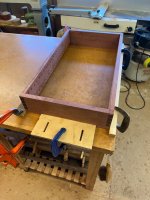
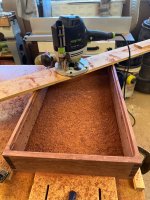
The back panel rebate is pretty straight forward and doesn't take too long. Firstly I secure the job to the assembly bench using battens so that it can't move:

IMG_7790.jpeg

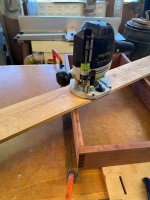
The long extension router base (just a bit of pine with an 'ole in it) is then screwed to the bottom of the OF1400 where a suitable rebate router cutter has been installed:

IMG_7792.jpeg

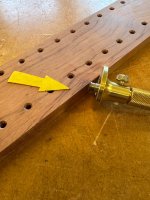
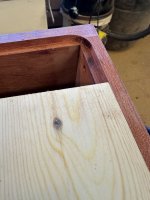
...and from the pic above, the doc has been set to 7mm with the ever handy gauge blocks. On previous projects, I neglected to use a wheel gauge to mark the doc on the inside of the job, sometimes resulting in horrendous tear out which took ages and a lot of ingenuity to repair. If the gauge line:

IMG_7793.jpeg

...(arrowed) is just a teeny tiny fraction bigger that the doc, in theory it ought to prevent tear out. Bearing in mind how awkward this stuff is I wasn't taking any chances! When everything was hunky-doodly, I proceeded taking small cuts until the full doc was achieved:

IMG_7795.jpeg

I then tested a corner of the back panel in the rebate:

IMG_7796.jpeg

...just to check I hadn't made any ghastly measuring errors; it has been known!

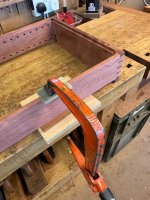
The next job is to square out the corners, once the lines have been marked with a 4H pencil. Each corner in turn is cramped (using packer shims here) over the bench leg:

IMG_7797.jpeg

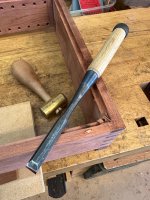
...which is by far and away the strongest position on the bench for vertical choppage. I used my new 12mm Japanese chisel to chop out most of the waste:

IMG_7798.jpeg

...and then the widest Narex 'Richter' to pare carefully to the line:

IMG_7799.jpeg

Rinse and repeat thrice more. I know some folk detest the 'screaming monster' with a passion, but setting in a panel like this would be a lot more difficult and time consuming to do it any other way . As is, the rebate from start to finish took about 40mins - Rob
 
I know some folk detest the 'screaming monster' with a passion, but setting in a panel like this would be a lot more difficult and time consuming to do it any other way . As is, the rebate from start to finish took about 40mins - Rob
Totally agree. There are some ideological Luddites around.

Or, ...maybe they need more time away from.....
 
I am trying to imagine, and failing, how difficult it would be to make the rebate before the dovetails.:unsure:
Doable, with a classic bit of joinery, but best of luck trying it in Bubinga. This illustration from the book:

IMG_7802.jpeg

...from one of my old tutors at Shoreditch ('Stropy' Jack Maynard):

IMG_7801.jpeg

...shows how it's done. The peg to fit a square rebate - Rob
 
Interesting. What I like about Rob's approach here is that he pragmatically uses the powered router on awkward wood, but has the good taste to square off the corners properly, not round the back panel to fit a machine-cut rebate.

By the way, I don't think I've seen such an impressive diy-veneer thin back panel in anyone else's project.
 
Back
Top