• Hi all and welcome to TheWoodHaven2 brought into the 21st Century, kicking and screaming! We all have Alasdair to thank for the vast bulk of the heavy lifting to get us here, no more so than me because he's taken away a huge burden of responsibility from my shoulders and brought us to this new shiny home, with all your previous content (hopefully) still intact! Please peruse and feed back. There is still plenty to do, like changing the colour scheme, adding the banner graphic, tweaking the odd setting here and there so I have added a new thread in the 'Technical Issues, Bugs and Feature Requests' forum for you to add any issues you find, any missing settings or just anything you'd like to see added/removed from the feature set that Xenforo offers. We will get to everything over the coming weeks so please be patient, but add anything at all to the thread I mention above and we promise to get to them over the next few days/weeks/months. In the meantime, please enjoy!

The Niff-Naff Cabinet; WIP and an 'Oh cr*p!' moment......

Woodbloke

Sequoia
Joined
Jul 22, 2014
Messages
7,184
Reaction score
1,072
Location
Salisbury, UK
My wife likes to collect little odds n'sods when we're on a our travels; they have no special financial value but she 'requested' a smallish wall hung cabinet to display them, mentioning that It needed a door to keep the dust off. I hoiked out a few lumps of Bubinga, a couple of which were crown cut which makes for much easier planing:

IMG_7672.jpeg

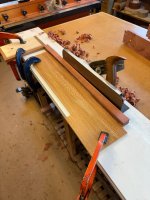
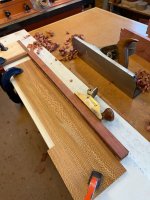
After some careful bandsaw cutting and machining on the pt, I was left with a pile of thicknessed Bubinga, yet to be machined to it's final width (though one door rail has developed a very slight bow, which is irritating)

IMG_7672.jpeg

IMG_7674.jpeg

However, this isn't the timber that I intended to make this little cabinet out of, as a couple of weeks ago, a very recently joined member of this forum verbally promised me one these two boards of Georgian mahogany which he acquired for nothing from an old boy who was shutting down his workshop:

PHOTO-2026-05-18-14-06-53 2.jpg

In conversation on WotsAp with this person, I told him what I intended to make with it but whist I was away in Bromley seeing my son and grandson, this individual used his board and then part of the board promised to me for a turning project, leaving me with offcuts, some of which were of reasonable size, but offcuts none the less.

The mahogany, in and of itself isn't crucial (SWIMBO's very happy with Bubinga) but what really hurt was that he'd gone back on his word and as a consequence has left a very bitter taste in my mouth. When I think of the unstinting generosity of all members of WH2 (Mike G and AndyT to name two, just to embarrass them:ROFLMAO:) his actions make my blood boil and as such I've cut off all contact and will have nothing further to do with him as he simply can't be trusted - Rob
 
It's never good when anyone does that. :( Bubinga is much nicer not that it's much consolation.
Not the done thing in this close knit community.
Thanks chaps, for the support, much appreciated. The Bubinga is machining up nicely but as I've only got one bit of crown cut stuff, I'm having to be über careful. Luckily, the bow in the slightly warped door rail has been planed flat and it appears now (fingers crossed) to be behaving itself. I had a swift peek at the new LV hinges on the CHT page which are roughly half the price of the Brusso equivalents, so it's the 8mm wide ones that I'll be ordering when they arrive (after having 'phoned them) - Rob
 
Further progress on the Naff-Naff Cabinet today, but it's slooooooooow work as this Bubinga is a tad hard; the Wood Database (my go-to for most stuff on timber) gives it a density of 56 lbs/cu'. Fortunately, with a new set of cutters in the pt, it machines very well with little, if any, tear out. However, get a really sharp, high angle plane near it and with a bit of luck and a following wind, it'll plane well too, but more often than not, you'll hit a patch of awkward grain and it'll rip out!

The best thing I found to clean up the pt surface was:

IMG_7676.jpeg

...my little diddy LN scraper plane, which is worth it's weight in gold (or bronze) for this sort of job. The lengths were easy enough to shoot in to size and squareness on the shooting board with a very sharp blade in the LN51. Shovetails were marked out but they were cut on the bandsaw:

IMG_7675.jpeg

....and then the waste was sawn out:

IMG_7677.jpeg

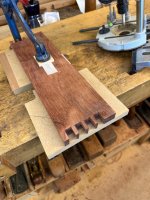
Finished tails look respectable:

IMG_7678.jpeg

...but I can't say with unbridled joy that I'm looking forward to chopping out the waste to the line tomorrow. Could be a job for my new Japanese chisels from this establishment in Tokyo - Rob
 
Further progress on the Naff-Naff Cabinet today, but it's slooooooooow work as this Bubinga is a tad hard; the Wood Database (my go-to for most stuff on timber) gives it a density of 56 lbs/cu'. Fortunately, with a new set of cutters in the pt, it machines very well with little, if any, tear out. However, get a really sharp, high angle plane near it and with a bit of luck and a following wind, it'll plane well too, but more often than not, you'll hit a patch of awkward grain and it'll rip out!

The best thing I found to clean up the pt surface was:

View attachment 55039

...my little diddy LN scraper plane, which is worth it's weight in gold (or bronze) for this sort of job. The lengths were easy enough to shoot in to size and squareness on the shooting board with a very sharp blade in the LN51. Shovetails were marked out but they were cut on the bandsaw:

View attachment 55038

....and then the waste was sawn out:

View attachment 55040

Finished tails look respectable:

View attachment 55041

...but I can't say with unbridled joy that I'm looking forward to chopping out the waste to the line tomorrow. Could be a job for my new Japanese chisels from this establishment in Tokyo - Rob
Funny, that’s the bit I always enjoy- but I’ve never worked Bubinga, is it really that hard?
Will you be putting a cut line across where needed Rob?
 
Now if only you had a drum sander, Rob! Save all that angst with tear-out ;)
 
Funny, that’s the bit I always enjoy- but I’ve never worked Bubinga, is it really that hard?
Will you be putting a cut line across where needed Rob?
It is Ian and crown cut surfaces are much easier than quarter sawn, which is a complete nightmare and the only safe way (imo) is to scrape it.
Now if only you had a drum sander, Rob! Save all that angst with tear-out ;)
Ah but I have Rog, only the drum loading is 80g which means that I'd have to spend interminable hours scraping out the scratch marks before sanding. I do this normally with softer woods (oak, walnut etc) and it doesn't take too long but Bubinga is in a class of it's own. I have one board of Bog Oak which is even harder; a mind boggling 63lbs/cu' - Rob
 
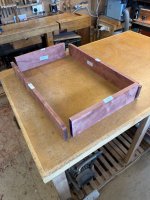
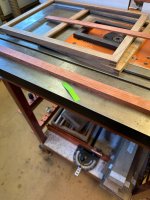
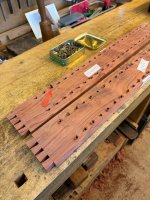
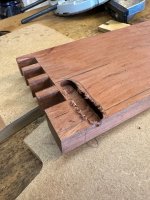
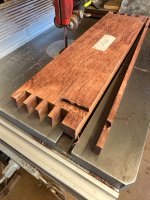
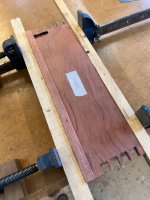
Tails weren't too onerous to cut on the bandsaw but needed careful work, taking very thin shavings to work the Bubinga to the shoulder lines. Cabinet pieces are then set out on the assembly table, with corners marked with spotty dots and edges taped with those facing outwards. Inside faces are also marked with tape:

IMG_7681.jpeg

I've used the 'blue tape' method now for a few years to mark out the sockets:

IMG_7679.jpeg

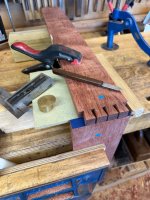
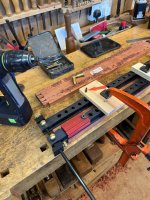
The transfer jig, for me, is foolproof and consists of a bit of 6mm mdf glued at exactly 90 degrees into a bit of oak; it's that simple. The adjustable square is set using gauge blocks which measure 0.5mm more than the height of the tails (18mm), which is then used to position the shoulder line exactly on the edge of the green mdf, so that when the joint is glued there'll be 0.5mm to pare away. Once marked, an exact cutting line is provided by the blue tape:

IMG_7680.jpeg

I find it necessary to have a very bright light source exactly where I need to cut, so I've rigged up this system from an adjustable Ikea clip-on spot light and some old lab fittings (retort stand and test tube holder) from another life; similar fittings can be purchased on the Bay of Fleas. It's convenient and provides an infinitely variable position for the lamp:

IMG_7682.jpeg

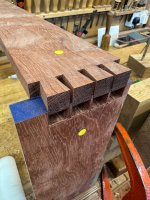
Once installed squarely in the Moxon, it takes about 50 mins to saw out each set of sockets. To ensure accuracy, I saw each of the eight cuts in three passes as you would normally do to saw a tenon. This stuff has absolutely no 'squishiness' of any sort, so I can't rely on faces compressing slightly as the joint is tapped together; they have to fit. This was yesterdays effort:

IMG_7684.jpeg

...and this is today's:

IMG_7688.jpeg

IMG_7689.jpeg

...with the horizontal being held steady after it's been tapped 2mm into the sockets. There's going to be a fair amount of tuning and 'adjustment' with a very sharp chisel before the tails will tap in smoothly to the bottom of the sockets, but it's reassuring to see the the tails will fit initially straight from the saw - Rob
 
Last edited:
Most impressive Rob, I can see now from those very clear close up pics what the nature of the beast - beastly stuff is now, reminds me a bit of that timber they use for the beds on trucks Keruing. Very hard!
 
Most impressive Rob, I can see now from those very clear close up pics what the nature of the beast - beastly stuff is now, reminds me a bit of that timber they use for the beds on trucks Keruing. Very hard!
Thanks Ian. Got a problem with a door rail which I'm trying to sort out now, so I'd value your opinion tomorrow when I post some pics of my 'solution'. Or not:cry: - Rob
 
As mentioned yesterday, I have a problem and it's to do with stress. Not me, but in the wood:ROFLMAO: One particular door rail refuses to behave itself and after a few days of being flat then develops a bow:

IMG_7691.jpeg

...such that a couple of bits of thin card can be inserted in the middle. This will eventually be a door rail; the completed door will then be rebated ready for some glass. However, a sheet of glass is distinctly 'unbendy' and if made to try and conform to a bowed rail will probably shatter. Not good!

What I needed to do was to try and remove the stress from the rail; I couldn't cut another bit of wood as this was all I had but rummaging around I found a couple of offcuts of the right colour which were glued together:

IMG_7690.jpeg

....the plan being to make a laminate of the bendy wood and the new bit shown above. To prepare for gluing, the concave part of the bendy rail was planed flat and out of 'wind':

IMG_7692.jpeg

...as was the new bit, made from two offcuts:

IMG_7693.jpeg

With both pieces as flat as a flat thing, they were glued together:

IMG_7694.jpeg

...and once the TB3 was cured, I used my long veneer shoot to plane off most of the excess:

IMG_7695.jpeg

...and then to bring it onto the glue line, I used the little LN scraper:

IMG_7696.jpeg

This stuff is so unpredictable that I'm very wary of getting a normal plane anywhere near it, so the scraper did a pretty good job of producing a flat and square edge. The remaining proud edge was machined almost the line on the P/T and then scraped to the line on the big shooting board. The section of the new rail that was convex was then removed on the bandsaw and it was then machined to 16mm thick. The next pic:

IMG_7699.jpeg

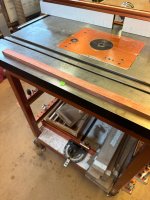
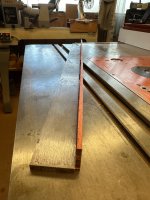
...shows the sawn off waste against a 600mm Veritas straight edge and the amount of stress in the wood can clearly be seen. When the new composite piece was placed on the ci router table:

IMG_7698.jpeg

...I was unable to squeeze even a single piece of card underneath. The issue now is that I'll have a glue line showing on the outside edge so I need to come up with a 'cunning plan' to disguise it....but what? Hopefully, the rail will now stay straight permanently - Rob
 
Knew that was going to be it! I nearly said “ cut and glue” but turn one bit over to prevent interlocking grain.
Perhaps a thin inlaid dark line where the glue line is but all the way around the door edge? Or as you are a veneer sort of man how about glueing a thin strip onto that outer side, but perhaps stopping a fraction short of the front face so it can’t be seen when the door is closed.
Ian
 
Knew that was going to be it! I nearly said “ cut and glue” but turn one bit over to prevent interlocking grain.
Perhaps a thin inlaid dark line where the glue line is but all the way around the door edge? Or as you are a veneer sort of man how about glueing a thin strip onto that outer side, but perhaps stopping a fraction short of the front face so it can’t be seen when the door is closed.
Ian
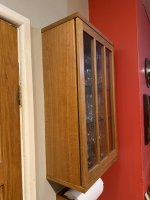
Pondering on this a little further, the obvious solution that occurred is to machine a full length cove into the edge to act as a door pull:

IMG_7700.jpeg

...which is what I did a few years ago on this glassware cabinet. The dissimilar grain on that rail would then completely vanish and I reckon that would work, nest ce pas? - Rob
 
More progress on the shovetails, this time on the sockets. I prepped my new 6mm Japanese chisel (back flattened on a 'Kanaban' lapping plate, hoop fitted, then honed at 30deg) and set up one of the pieces with the sockets:

IMG_7707.jpeg

The adjustable try square is now set at 16.5mm giving me 0.5mm to pare away once glued together. Then comes the tweaking:

Each side is checked for squareness using a teeny-tiny adjustable square and made true with a chisel:

IMG_7708.jpeg

Any high spots on the tail sides are also flattened with a...

IMG_7711.jpeg

...12mm chisel.

For severial years now, I've used a wicked little Swiss whittling knife to clean out the bottom corners of each socket:

IMG_7709.jpeg

All this faffing n'fiddling takes time, but if it's not done, there's a better than even chance that as the tails are driven, a split(s) will form in the socket board. Here's one done yesterday:

IMG_7705.jpeg

...and herewith this morning's effort:

IMG_7710.jpeg

...tapped in with a geno hammer (plus Paduk block) to within a couple of mm of the bottom - Rob
 
Rob, noticed the brass discs, what is their use? Nice pics of your shovetails.
The brass discs are gauge blocks of varying thickness which can be used for 'set up' applications or for inspection purposes in machine shops. Depending on the accuracy of manufacture, different grades of blocks can get to an insane price, but an everyday woodwork set might be the Veritas ones made in your neck of the woods. I have an aversion to aluminium in my 'shop (too soft and bendy) but Tim Styles at Axminster said a gauge block set may be reintroduced made from machined stainless steel - Rob
 
Having got the thing together, I started to roughly pencil in the internal locations for the fittings (hinges, shelf pin holes, door stop) Unless I do this it has been known for me to machine holes and slots in the wrong places, so if there's a scribbled pencil mark I know what it means. Hopefully...

First up was to set up the Veritas Shelf Hole Drilling Jig which is a very, very handy jig to have as used carefully, I can usually get all four holes for each shelf to be co-planar:

IMG_7722.jpeg

I haven't used it for a while, so there was a bit of head scratching to sort it out but:

IMG_7723.jpeg

...I got there in the end. Apart from a gardening task tomorrow, the next job is to machine the 8mm slots for the hinges and one for the Krenov style, spring loaded door closer - Rob
 
I believe that's a Pfeil knife Rob, excellent quality, I have a couple and Pfeil carving tools are my favourites.
 
I believe that's a Pfeil knife Rob, excellent quality, I have a couple and Pfeil carving tools are my favourites.
It is indeed and purchased from CHT some time ago. On the rare occasions I need to purchase a carving tool, the Pfeil ones are my 'go to' choice. The little blade is ideal for cleaning out dovetail sockets and very easy to sharpen on the Ax Ultimate Edge with it's belt finisher but just as easy on the Sorby Pro-Edge machine - Rob
 
I went out the 'shop fully intending to have a nice, peaceful 'sesh' by machining out the various recesses needed, so first up was the 5mm deep slot for the JK style door closer. The router depth was set to the aforementioned 5mm with gauge blocks:

IMG_7726.jpeg

IMG_7727.jpeg

...and the job cramped to the bench with a wider piece of scrap underneath for the fence to run against....and then it happened!

A moment's loss of concentration and I'd machined too far!

IMG_7728.jpeg

This is one of those 'Oh cr*p!' (or similar) moments that instantly throw me into panic mode, so I sliced off the offending piece:

IMG_7729.jpeg

...and very fortunately managed to rummage around in my oddments box and find a replacement which was a decent colour match:

IMG_7730.jpeg

It's not perfick, but close enough. Once both pieces had been machined flat and jointing surfaces skimmed with a hand plane, it was glued:

IMG_7731.jpeg

...and will later be planed flush and then machined back to the correct width of 100mm. Fortunately, I never throw away offcuts in case one of these 'all too often' events happen. The saving grace is that the glue line won't be seen unless anyone looks for it after having spotted the discrepancy in the grain. The section glued on will also sit directly underneath the door rail as well, so with a little luck and a following wind the 'fix' ought to be a gud'n 🤞 - Rob

Edit - the 5mm drill bit to make the shelf 'oles was also as blunt as a blunt thing! Now sharpened but a bit late after the event
 
Last edited:
Sympathies Rob... I can understand how you felt... but... that's a good save for sure 👌.

Initially in reading my thoughts was "maybe insert/glue a plug from an offcut... but then looked closer and saw you where right on the edge of the board - a plug/insert wouldn't have worked... Lucky you had that strip to make/use.

As a slight diversion... are you still thinking about the Yew jewellery box?

You didn't get back to me about thickness/thicknesses of the boards - I've some from 5½"~7" boards... varying between ⅞" down to ⅝".

I may have the 12"/300mm width (max) you mentioned but it's in a couple of thicker boards... around 1¾"+...marginally +... if I recall. I'm thinking of resawing it... may get ⅞" to then plane to ¾"~⅝"... Length of the board may give you all the pieces - but... If you're still thinking of doing it let me know and I'll make the effort to cut one or both boards through the thickness to see what they'll end up as when planned. Already planned both faces at 1¾"+...
 
As a slight diversion... are you still thinking about the Yew jewellery box?

You didn't get back to me about thickness/thicknesses of the boards - I've some from 5½"~7" boards... varying between ⅞" down to ⅝".

I may have the 12"/300mm width (max) you mentioned but it's in a couple of thicker boards... around 1¾"+...marginally +... if I recall. I'm thinking of resawing it... may get ⅞" to then plane to ¾"~⅝"... Length of the board may give you all the pieces - but... If you're still thinking of doing it let me know and I'll make the effort to cut one or both boards through the thickness to see what they'll end up as when planned. Already planned both faces at 1¾"+...
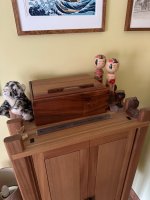
Please accept profuse apologies for not getting back to you. I'm still pondering about materials but a another jewellery box has definitely been pencilled into the Projects Book and if it's in there, it will get made. I'll be spending a considerable amount of wonga in August at Yandles, Martock to restock the workshop so perhaps could call in at Frome on the way? In any event, the pic below:

IMG_7732.jpeg

...shows her existing jewellery box (Koa wood), now rammed to bursting, which sits on top of her Alan Peters style eight legged cabinet. The new box will occupy the same space but will fit between the little ebony rectangles as shown; 300mm rule included to judge dimensions a little easier. I have no idea as yet of a suitable design but whatever transpires, it's going to be a substantial sized jewellery box and Yew sounds perfick...and a lot easier to work with than Bubinga! If you could postpone the re-sawing I'd be very grateful - Rob

Edit - re-sawing here in the 'shop at Wilton is no problem
 
No need for the apologies... honestly - none needed. We all get distracted.

I'll try to get a couple of photos of the boards so you can zoom in on them to check (as best as possible from a photo). I'll also provide the measurements of the boards - a couple of. If the sizes you originally gave (as max sizes) you'll maybe have enough for two jewellery boxes when resawing - good to hear you've facilities to do such. I did contact a couple of local mills but only one responded. They could 'possibly' do it, would loose 3mm on the cut/blade kerf, but mention possibility of blade wander if any knots etc! I was going to do it on my Evolution R255TBL+ , cutting the depth of the blade in stages and then handsaw to split the two halves.

Depends when in August as we're having a week in Cornwall... think it's around 8th to 15th?

Should I DM you the photos when I've taken them? Probably be in about a week?

ATB
Frank
 
No need for the apologies... honestly - none needed. We all get distracted.

I'll try to get a couple of photos of the boards so you can zoom in on them to check (as best as possible from a photo). I'll also provide the measurements of the boards - a couple of. If the sizes you originally gave (as max sizes) you'll maybe have enough for two jewellery boxes when resawing - good to hear you've facilities to do such. I did contact a couple of local mills but only one responded. They could 'possibly' do it, would loose 3mm on the cut/blade kerf, but mention possibility of blade wander if any knots etc! I was going to do it on my Evolution R255TBL+ , cutting the depth of the blade in stages and then handsaw to split the two halves.

Depends when in August as we're having a week in Cornwall... think it's around 8th to 15th?

Should I DM you the photos when I've taken them? Probably be in about a week?

ATB
Frank
Thanks Frank, I can sort out with SWIMBO a suitable date in August for both a visit to your good self and thence onto Yandles. The max I can re-saw on my big Ax bandsaw is 350mm (that's with a new blade) but the most I've ever done thus far is 300mmish. A DM with photos would be excellent with an indication of size(s) if poss...please remind me again of how long you've had the Yew in stock? I'm wary of using Yew as it's prone to splitting if not completely seasoned - Rob
 
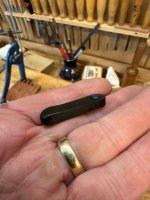
As luck would have it, I found by chance an ebony door closer which is exactly what I need:

IMG_7735.jpeg

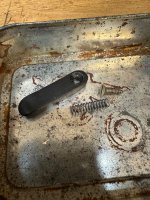
...so this is now sitting, along with a brass screw and spring in a 'baccy tin in the bench tool well:

IMG_7739.jpeg

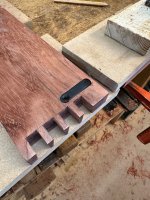
Once the 'fix' had been cleaned up and the piece planed back to size, I rigged up a stop on the bench so that the newly found closer would drop exactly into the machined slot:

IMG_7736.jpeg

Once cleaned up with a card scraper, the slot and the 'fix' look respectable:

IMG_7737.jpeg

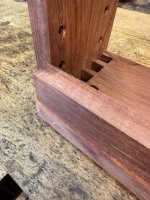
...and with the side partly in place as well as a door rail:

IMG_7738.jpeg

...the difference, if any, between the 'fix' and the cabinet bottom can't be seen. I'll call that a win - Rob
 
I'd think it's well seasoned Rob... I've had it around 36 years 😉. Photos and sizes to follow by DM... aiming for sometime next week 🤞
 
Back
Top