• Hi all and welcome to TheWoodHaven2 brought into the 21st Century, kicking and screaming! We all have Alasdair to thank for the vast bulk of the heavy lifting to get us here, no more so than me because he's taken away a huge burden of responsibility from my shoulders and brought us to this new shiny home, with all your previous content (hopefully) still intact! Please peruse and feed back. There is still plenty to do, like changing the colour scheme, adding the banner graphic, tweaking the odd setting here and there so I have added a new thread in the 'Technical Issues, Bugs and Feature Requests' forum for you to add any issues you find, any missing settings or just anything you'd like to see added/removed from the feature set that Xenforo offers. We will get to everything over the coming weeks so please be patient, but add anything at all to the thread I mention above and we promise to get to them over the next few days/weeks/months. In the meantime, please enjoy!

The pattern makers, the infill plane and the foundry workers

toolsntat

Nordic Pine
Joined
Apr 4, 2021
Messages
750
Reaction score
418
Location
Leicestershire
Name
Andy
I was pleasantly surprised to spot an infill plane being used on some old film posted by John Kent Joiner the other day.
I gave him a shout to ask where he found the footage and this is it, quite an insight into a foundry and its workers.

Cheers, AndyScreenshot_20251227-145344_YouTube.jpg
 
Thanks for that Andy, I've not seen that one before.

It's fascinating to compare and contrast working techniques from then (1930s?) with either the many YT videos of current work in Pakistan (much less equipment, even worse working conditions) or S Korea (automated, robotic, clean).
 
My granddad was a pattern maker. I had a 2ft rule of his. It had four different 2' scales on it, a true 24" then three others all slightly bigger. I can't remember, but I'm guessing for cast iron, brass and either bronze of aluminium. So he would make the pattern using whichever scale was suitable for the material, then, when the casting had been made, and it had cooled and shrunk, it would end up being the right size.
Unfortunately it was one of the things stolen when my kit went into storage. I'm convinced that it was sold on ebay, because I found an expired listing, which matched its description perfectly, but by then the photograph was no longer part of the listing.
It was very difficult to read any of the markings, but it was an interesting artefact, as well as being my granddad's.
 
I "liked" your post, Steve but that's only because there's no "I sympathise" button.

Things like that ruler spark memories, and it's horrible to lose them that way. As you know, my wife lost her engagement ring when her handbag was pinched in a house burglary here. It was special at many levels.

On a lighter note, i have my grandfather's boxed set of 12" engineering drawing rulers. The little, short ones are long gone, but i have the rest of them - I should look to see if there's a similar scaled ruler...
 
The tool chest that belonged to Ernest Warrington gives a snapshot of the toolkit of toolmakers in the late 19th/early twentieth century.
At the back of this drawer, you can see a couple of steel rules.

Second back till.jpg

They are a standard 24" steel rule (Chesterman no 378D) and alongside it the dangerously similar Chesterman 612D. Looking at these two led me to this relatively late (1949) Chesterman Catalogue:


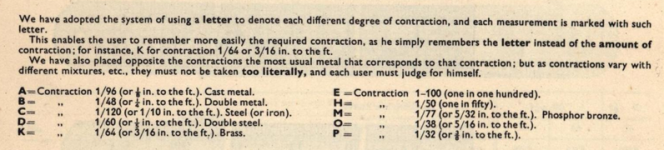
It has six pages of "contraction or shrink rules" and helpfully explains what the different scales were for:

1767104786858.png

Here's the 612D:

1767105845726.png

The references to "double metal" or "double steel" were for the times when a wooden pattern was to be made, from which a small number of steel or iron patterns would be cast, with those metal patterns then being used for repeated production of many castings, where wooden patterns would have been worn out.

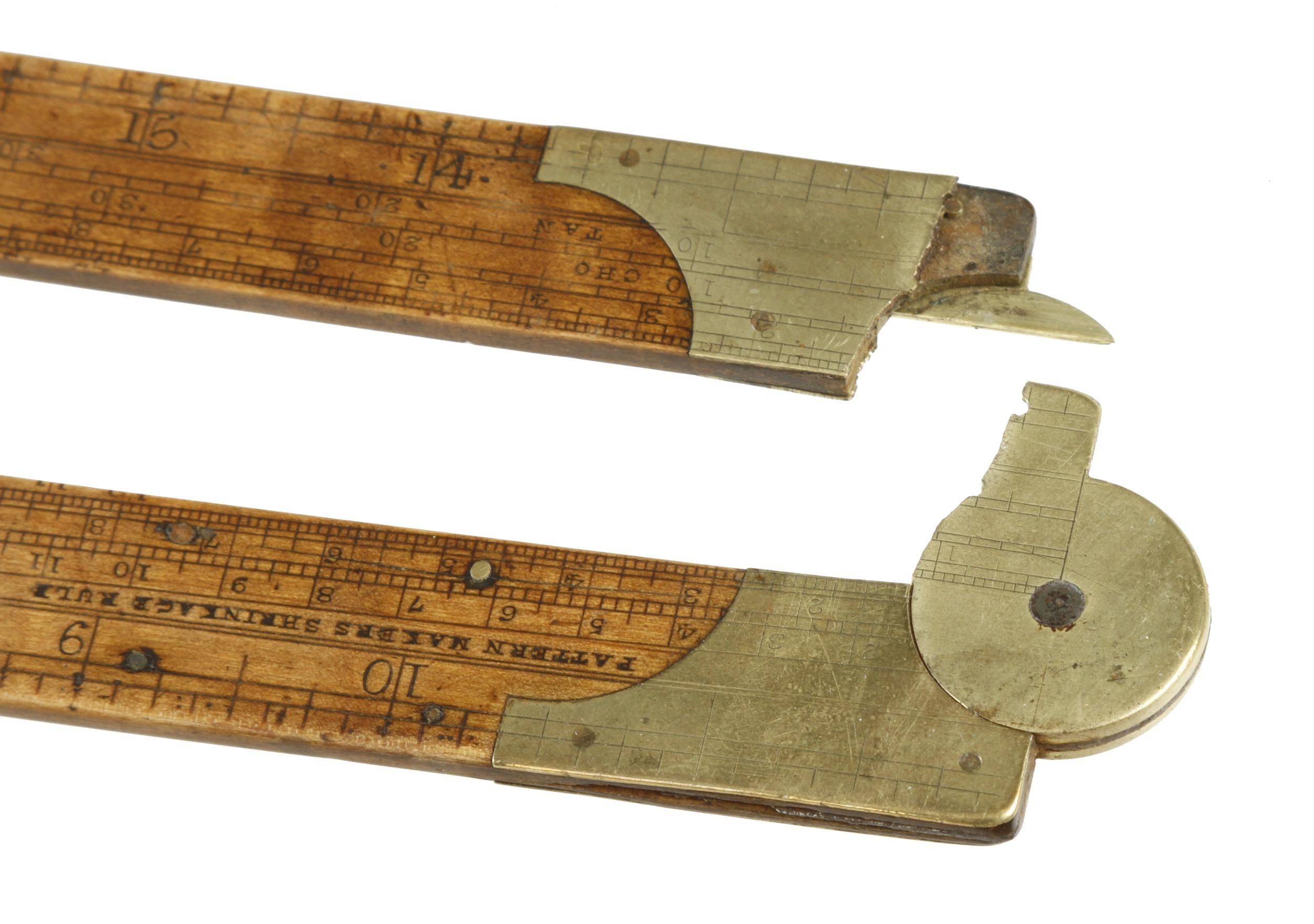
Before steel rules became the norm, contraction rules (like most other rules) were made in boxwood. They are harder to find - here's one with a broken brass hinge at a past David Stanley auction.

1100015266.JPG
 
Back
Top