• Hi all and welcome to TheWoodHaven2 brought into the 21st Century, kicking and screaming! We all have Alasdair to thank for the vast bulk of the heavy lifting to get us here, no more so than me because he's taken away a huge burden of responsibility from my shoulders and brought us to this new shiny home, with all your previous content (hopefully) still intact! Please peruse and feed back. There is still plenty to do, like changing the colour scheme, adding the banner graphic, tweaking the odd setting here and there so I have added a new thread in the 'Technical Issues, Bugs and Feature Requests' forum for you to add any issues you find, any missing settings or just anything you'd like to see added/removed from the feature set that Xenforo offers. We will get to everything over the coming weeks so please be patient, but add anything at all to the thread I mention above and we promise to get to them over the next few days/weeks/months. In the meantime, please enjoy!

Thingamejigs

Steve Maskery

Old Oak
Joined
Jul 27, 2014
Messages
2,374
Reaction score
1,329
Location
87290 Laplagne, France
Google is great at finding things when you know the name of the thing you are interested in, but less so when you know know the item but not the name.
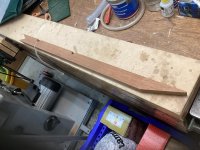
There is a tool which is a flat pointed stick with zig-zag teeth on it. It's for laying out non-regular shapes. I believe boat-builders use them. Does it ring a bell? If so, can you enlighten me please? I know how to use one, but I have no idea what they are called.
S
Edit - sorry about all the typos, I originally wrote this post without my eyes in and have only just noticed...
 
Google is a master, not a servant. Try Duckduckgo if you want a decent search engine.

It's a tick stick you're after, I believe. Sometimes called a ticking stick.
 
Another of those things that have different names in different places. Ticking stick is what I had forgotten.

A mate has asked me to make a window board for a trapezoidal recess. This is the tool for the job, I think. I just couldn't remember what it was called.

Thanks, both.
 
IMG_1357.jpeg Steve. All those curves or notches are not really vital, I’ve used one many times and never found use for more than a straight line with a single notch.
 
Never come across one myself BUT.....!

When I worked at a yacht builders we used to make a frame out of thin strips of wood/MDF etc.

The strips would be wide enough and long enough to be fit into the profile of each edge.

After each edge was profiled each strip was placed against the shape so as to overlap each other at the corner intersections.

We would then pin each corner and then brace the strips together to make an exact profile of the shape required.

You could not go wrong.
 
Hi Meccarroll
I’ve used that system of profile making in the past and know that it takes lots of time and care to get a spot on profile.
Use of a Joggle stick only takes a fraction of the time and effort, and gives a very accurate result. There is no on site work to do planing shapes to fit etc. You walk away with all the stick marks on a piece of ply in just a few minutes. No tools required except a pencil.

Mike.
 
Cabinetman, The rounded edges or toothed shapes are different sizes to ensure that the stick can only be repositioned on the template board in the same place when back in the workshop where the profile is reproduced on a sheet of material at full size.

Mike.
 
Steve,
Really helpful video and easy to follow as ever. Thanks.
Can you say what the function of the notches are in the tick sticks?
I can see that the distance from the point to the end is critical when transferring the points and that it is important to have the stick facing the same way up for both measuring and transferring processes and the notches or curved profile assist that but to me a parallel stick plus point marked "topside" would do just as well.

What am I missing?

Bob
 
I don't think you are missing anything, Bob. It could be a plain stick, just as long as you can be sure of putting it back in exactly the same place. But the tick marks make that part of the operation easier, there is then no doubt about where it needs to go.

I first (and last) used this method ten years or so ago when I had to fit some shelves into a wonky cupboard. It was tricky because I didn't really have anything good onto which to attach my tick board, but it came out alright in the end. Then I used a saw-tooth pattern stick, but it worked in exactly the same way.

The exact profile doesn't matter, only that you can easily and confidently put the tick stick back in exactly its original place.

S
 
I had heard of these (ticking sticks) years ago and had someone trying to explain their use, an explanation made up of most of the ways you shouldn't use them or many different ways of making them which resulted in an explanation that was as clear as mud.

This on the other hand has been most informative, thank you to all for clearing up something that was confined to the "too confusing to use" part of my dim and distant memory.
 
Back
Top