• Hi all and welcome to TheWoodHaven2 brought into the 21st Century, kicking and screaming! We all have Alasdair to thank for the vast bulk of the heavy lifting to get us here, no more so than me because he's taken away a huge burden of responsibility from my shoulders and brought us to this new shiny home, with all your previous content (hopefully) still intact! Please peruse and feed back. There is still plenty to do, like changing the colour scheme, adding the banner graphic, tweaking the odd setting here and there so I have added a new thread in the 'Technical Issues, Bugs and Feature Requests' forum for you to add any issues you find, any missing settings or just anything you'd like to see added/removed from the feature set that Xenforo offers. We will get to everything over the coming weeks so please be patient, but add anything at all to the thread I mention above and we promise to get to them over the next few days/weeks/months. In the meantime, please enjoy!

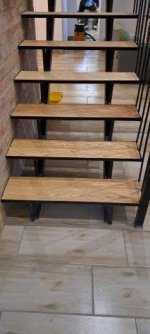
Treads for metal staircase

Phil

Old Oak
Joined
Jul 23, 2014
Messages
4,156
Reaction score
369
Location
Southern Africa 0054
Treads for metal staircase

My bee-hive friend asked me to source, plane, cut, trim & finish some treads on a stairway.
New build cottage on a farm.

The framework is metal that they will treat and paint and is already installed, not yet painted.
Temporary treads are scaffold planks (I nearly fell going down.)

See finishing thread https://www.thewoodhaven2.co.uk/threads/stair-treads-finish.9627/

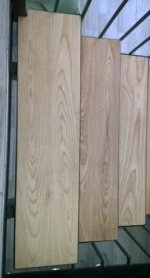
He wants American Ash, as light colour as possible. Bit of a problem in selecting the grain and figure in the planks. Will see this later in finished product.

First a visit to Silvertonhout to see what is in stock.

The yard chap took me into a warehouse to see the stack of Ash. Walking in from bright sunlight into darkish warehouse I did not see the broken-up floor and severely twisted my left foot. Hobbled around for 2 weeks before visiting Dr, xrays taken and nothing broken, soft tissue damage. Then foot and ankle into a support and could walk reasonably ok. Had some physio and got rid of the support after nearly 10 weeks.

What they had in stock was 2400mm and 3600mm by 154mm wide and 25/26mm thick. Drew up cutting list and costed it out before buying as it is ZAR39,000.00 per m3 and got customer approval. Money in my bank following day.

I got fedup using a calculator and paper in the garage, then transcribing it into Excel on the laptop.

Sooooooooo, I dug out the old laptop and set it up on the table saw top. It is an old XP, limited in working software, used OpenOffice spreadsheet, not as good as new Excel, but still ok. It also has a CD player for listening to music.


13 Treads, 1000mm long and 248mm wide. Will have to join 2 planks per stair, with 26 Planks required.

XP_Helper.jpg


Back to Silvertonhout to buy.

The yard chap and I sorted through about 40 planks just to select 9 flat and straight and with grain as light as possible, 3600mm long.

They also plane and trim the edges for me. Off the plane all of them at 23mm thick. I will plane again once matching up the planks and dealing with any chip-out.

He also recorded shorter lengths where defect would need to be cut off. As well as standard width although some were a lot wider.

Final cost as loaded onto LDV ZAR5,433.00
The cost calculation excluded the bad board.

Back home.

ArrivingHome.jpg

One bad board, can use most of it.
One bad board end.jpg


The planks were carried from the LDV to the table on the patio for first view & sort.


StackedB4Cutting.jpg

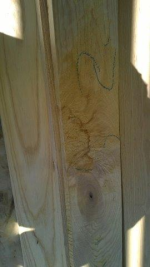
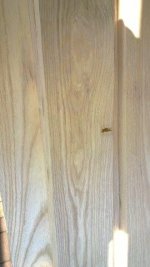
End defect
1725193869620.png

Middle defect
1725193907380.png
Another defect

AnotherDefect.jpg

Move the car out to get extra space.

Cutting list Job Card

Treads_Cutting&JobCard.jpg


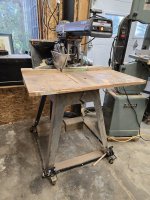
The 3600mm is not a problem for me on the RAS, however the tread is 1000mm long, plus offcut of 30mm is longer than my cutting space on the RAS.

I ended up buying a cheap circular saw to cut the boards.

{cuttinglengths} Missing Pic! :confused:

Offcuts

All the offcuts.jpg

Offcut.jpg

The Ash is very nice to work with, close grain, mostly straight and heavy. Between 650 and 860kg per m3.

Once cut, the planks were matched side by side for shade and grain and edge fit.
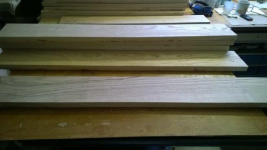
1725194301034.png

This is when you realise that they are not all light. The one plank a lot darker which will be seen once fitted.

Edge grain

Edgegrain.jpg


Each pair is then numbered and label top or base.

A last plane through the EB, each pair. Final 23mm to 21.5mm per pair.

Matchedpairs.jpg
Matched pairs

Numbered ready for biscuits.jpg
Numbered ready for biscuits

Each pair will be joined with 3 number 20 biscuits. Biscuit slots cut on the router table. The Ryobi was not sounding healthy so I bought a Makita RPO900.

NewMakita.jpg

The biscuit cutter shank was bent. Not sure how I managed to do that, had to buy a new one, Protech at ZAR650.00
RouterBiscuitCutterShank.jpg


What I found with these long planks was that the router table needed a longer take off.

Some other issues with the table, might discuss elsewhere.

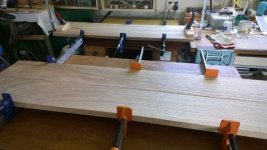
Then proceeded with the gluing and clamping using the long sash clamps.

Apologies for the break in transmission, we have reached the 20 pic limit.

Next instalment to follow.

Thank you for reading
Phil

{EDIT to fix pic narrative}
 

Attachments

  • beingsorted.jpg
    beingsorted.jpg
    30.1 KB · Views: 1
  • ArrivingHome.jpg
    ArrivingHome.jpg
    31 KB · Views: 0
  • EndDefect.jpg
    EndDefect.jpg
    22.6 KB · Views: 1
  • MiddleDefect.jpg
    MiddleDefect.jpg
    16.1 KB · Views: 1
Last edited:
Next instalment ...........

A water proof glue was used and a silicone brush (bought for this job – wished I had bought it years ago, absolute pleasure to use.)
SiliconeBrush.jpg

First pair in traction

Fisrtpairintraction.jpg
Being wood with some tension released with the cutting, there was some slight bowing which I tried to clamp out.

2 Of the treads showed some wobble and two corners would need to be shimmed up when being installed.

Boardone.jpg
Board one

flatteningout.jpg

Flattening out

Final width cut on table saw to 248mm and then the edge cleaned up on the router table with a flute bit down to 246mm.

FinalEdgeTrim.jpg
Final edge trim

The top edges, length, were then also given a slight round-over.

The length was trimmed on the RAS to 998mm cutting off at both ends to get all nice and square.

Then some sanding, 100grit on Makita third-pad and 180grit on ROS.

Lastly some scraping with Stanley blades (could not source scrapers).

My deadline date was end June completely finished.

I was really hamstrung with my foot not being able to stand for very long, so I delivered on 22 June and asked them to do the finishing. Gave a list of instructions of which grits to use between the coats of PU.

They also did the final trim-sanding-fitting.


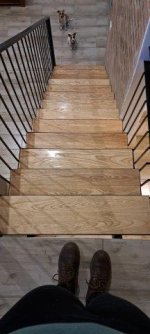
Finished and Installed


I have not seen them fitted apart from some pics, will have a closer look when I deliver the beehive rooves.


Installed1.jpg Installed2.jpg Installed3.jpg

Does not look shabby at all 😊

Thank you for reading.

Phil
 
Interesting post, revealing the amount of planning, sorting, thinking and arranging that has to go into what might sound a simple project, to the uninitiated. But from the pictures of the finished job, I'm sure your customer will be happy!
 
Next instalment ...........

A water proof glue was used and a silicone brush (bought for this job – wished I had bought it years ago, absolute pleasure to use.)
View attachment 28343

First pair in traction

View attachment 28344
Being wood with some tension released with the cutting, there was some slight bowing which I tried to clamp out.

2 Of the treads showed some wobble and two corners would need to be shimmed up when being installed.

View attachment 28345
Board one

View attachment 28346

Flattening out

Final width cut on table saw to 248mm and then the edge cleaned up on the router table with a flute bit down to 246mm.

View attachment 28347
Final edge trim

The top edges, length, were then also given a slight round-over.

The length was trimmed on the RAS to 998mm cutting off at both ends to get all nice and square.

Then some sanding, 100grit on Makita third-pad and 180grit on ROS.

Lastly some scraping with Stanley blades (could not source scrapers).

My deadline date was end June completely finished.

I was really hamstrung with my foot not being able to stand for very long, so I delivered on 22 June and asked them to do the finishing. Gave a list of instructions of which grits to use between the coats of PU.

They also did the final trim-sanding-fitting.


Finished and Installed


I have not seen them fitted apart from some pics, will have a closer look when I deliver the beehive rooves.


View attachment 28348 View attachment 28349 View attachment 28350

Does not look shabby at all 😊

Thank you for reading.

Phil
Nice job Phil, the Ash you chose has a very nice grain.
 
Last edited:
Interesting post, revealing the amount of planning, sorting, thinking and arranging that has to go into what might sound a simple project, to the uninitiated. But from the pictures of the finished job, I'm sure your customer will be happy!

You are correct regarding planning, it is important and I try to write out a job card with all steps and tick off as I go along.
However ………….

The beehive brood boxes, I have made 7. It was number 8 that caught me, did not look at the job card.

It was all glued, nailed, sanded and screwed to the floor ready for finishing with Waksol.

Standing on the finishing table something just did not look right. :confused:

I had forgotten to make the handles and drill all the screw and bolt holes before assembling the box. Sh1t, a bit awkward once assembled.

The customer seems very happy. Paid some funds into the bank account, which was not part of the deal. I am delivering some hive rooves this week and will have a look.
 
An interesting thread but just wonder why:
The 3600mm is not a problem for me on the RAS, however the tread is 1000mm long, plus offcut of 30mm is longer than my cutting space on the RAS
A RAS (Radial Arm Saw) is usually placed in a position allowing for cutting long lengths of timber either side so is your problem space or other?
 
Nice Job Phil
Ive made quite a lot of furniture in ash with med oak stain. Oak colour obviously but much more interesting grain from the ash.

Thanks Bob.
When I eventually do something with the offcuts, I will also try stain as well as fuming. I fumed some Beech years ago and it looked really good.
 
An interesting thread but just wonder why:

A RAS (Radial Arm Saw) is usually placed in a position allowing for cutting long lengths of timber either side so is your problem space or other?
Just to give an idea of how cramped I am. This was taken a week after we moved in, 9 years ago. I moved from a workshop area of 18m2 plus another extended area of 23m2 still leaving the double garage for the cars, another 49m2. It was for me a very sad traumatic downsize and move, had to dispose of lots of stuff. I kept all the machines and power tools.

This area is 45m2 and has to accommodate both vehicles.

New_V__98E0.JPG

Starting from the right next to the door is upright flat sheet stock.
Then the offcuts boxes on wheels.
Then the door into the scullery (that’s why I have to keep the area as clean as possible.)

In the corner is a metal table bolted to the floor with a small metal vice and the drill press. All the sanders are now kept here. Above that the sockets, spanners, hand tools.

Then the small Hegner Multicut on wheels.

Then the RAS, and the workbench under the window, not visible is a small multi drawer cabinet (on wheels) sandwiched between the bench and RAS – contains all the Forstners, biscuits, dowels.

After the bench the router table and the gap between has a box on wheels with all the electrical stuff. The base of the table has a very large pull out drawer with the power tools. Above this is now the shelves with all the fastners.
Then the TP in the corner, also on wheels. Squeezed in is also the 3Kw vacuum, also on wheels.
After that the lathe, also on wheels, and the Hegner Polycut also on wheels. The Hegner now lives in front of the RAS, easier to use.
The table saw is in the corner in front of the TP and router and is also on wheels.

A 2 door cabinet for storing project plans and scroll saw work waiting for finishing.
(also cold drinks and wine)

After that on the left I built shelving a couple of years ago. There was a thread somewhere, looks like it has been lost..
There is about 2.0m in front of the cars enough space to work and assemble these treads, beehive boxes and floors, etc.


Ok now to answer your question after the tour – the left front leg of the metal table is in the way when cutting anything wider than 130mm on the RAS. Narrower just slides in under the table.

There is no way the table and RAS will be moved in my lifetime.

Wider planks just get cut by hand saw or circular using the gap between the bench and router table. The one lot of Pine was 4030mm long, I try and buy lengths for the least amount of offcuts, generally the stock is 3600mm.
 
Duke, what RAS have you got?
Mine is a DeWalt fitted on its own stand.
Too late to try wheels now as the table height is the same as the bench height and router table height.
 
"I moved from a workshop area of 18m2 plus another extended area of 23m2 still leaving the double garage for the cars, another 49m2. It was for me a very sad traumatic downsize and move, had to dispose of lots of stuff. I kept all the machines and power tools.
This area is 45m2 and has to accommodate both vehicles."

Phil, I consider myself privileged (by U.K. standards) to have 5m x 2.3m solely for woodworking. I have 2m x 0.75m elsewhere for metal working.

In there are: a 6' bench, Wadkin saw, Jet lathe, Elektra planer thicknesser, floor drill press, mortiser that weighs 4 times what I do, combo belt and disc sander, bandsaw, 4 routers and one table, umpteen corded hand tools, supplies, some stock, 42 small cramps snd 7 sash 4' clamps, yada, yada.
Crowded? Nahhh....just over-stocked...😎

I suspect a certain PhD near Bristol will now weigh in, Monty Python style, and declaim:" 5mx 2.3m?!?!? We 'ad 'ole in wall...." G'wan, g'wan, g'wan, Al, you know you want to!!
 
Maybe possible to get wheels that will bolt onto the legs where you step of push down on a lever to engage the wheels.:unsure:
 
Maybe possible to get wheels that will bolt onto the legs where you step of push down on a lever to engage the wheels.:unsure:
Watch Carl Holmgren's video, and look at the various options he's come up with.

The same timeless design is utilized on a few machines like the RP300 or IWOODlike machines.
Once you use a single pedal system, even just a quick timber lash up, you won't consider anything else.

Sorry for drifting off topic, very snazzy stairs by the way.
All the best
Tom
 
Just to give an idea of how cramped I am. This was taken a week after we moved in, 9 years ago. I moved from a workshop area of 18m2 plus another extended area of 23m2 still leaving the double garage for the cars, another 49m2. It was for me a very sad traumatic downsize and move, had to dispose of lots of stuff. I kept all the machines and power tools.

This area is 45m2 and has to accommodate both vehicles.

View attachment 28457

Starting from the right next to the door is upright flat sheet stock.
Then the offcuts boxes on wheels.
Then the door into the scullery (that’s why I have to keep the area as clean as possible.)

In the corner is a metal table bolted to the floor with a small metal vice and the drill press. All the sanders are now kept here. Above that the sockets, spanners, hand tools.

Then the small Hegner Multicut on wheels.

Then the RAS, and the workbench under the window, not visible is a small multi drawer cabinet (on wheels) sandwiched between the bench and RAS – contains all the Forstners, biscuits, dowels.

After the bench the router table and the gap between has a box on wheels with all the electrical stuff. The base of the table has a very large pull out drawer with the power tools. Above this is now the shelves with all the fastners.
Then the TP in the corner, also on wheels. Squeezed in is also the 3Kw vacuum, also on wheels.
After that the lathe, also on wheels, and the Hegner Polycut also on wheels. The Hegner now lives in front of the RAS, easier to use.
The table saw is in the corner in front of the TP and router and is also on wheels.

A 2 door cabinet for storing project plans and scroll saw work waiting for finishing.
(also cold drinks and wine)

After that on the left I built shelving a couple of years ago. There was a thread somewhere, looks like it has been lost..
There is about 2.0m in front of the cars enough space to work and assemble these treads, beehive boxes and floors, etc.


Ok now to answer your question after the tour – the left front leg of the metal table is in the way when cutting anything wider than 130mm on the RAS. Narrower just slides in under the table.

There is no way the table and RAS will be moved in my lifetime.

Wider planks just get cut by hand saw or circular using the gap between the bench and router table. The one lot of Pine was 4030mm long, I try and buy lengths for the least amount of offcuts, generally the stock is 3600mm.
I was wondering but now see what you mean having to share your workshop with cars makes quite a difference.

All of my machines are on wheels and the cars live outside mostly. I do keep an MG Midget under cover and it lives with some of my machines but has to go outside when I am machining then pop back in at the end of the day when I finish hence the reason I keep my machines on wheels to make room for the MG.
 
Phil my RAS is on wheels so I can move it around to depending on the length of boards.

Looks a good sturdy saw :cool:

I might consider moving the metal table forward but would need to add a shelf at the back to stop stuff falling through.
The table is bolted to the floor and would then need new bolts and holes.

Watch Carl Holmgren's video, and look at the various options he's come up with.

The same timeless design is utilized on a few machines like the RP300 or IWOODlike machines.
Once you use a single pedal system, even just a quick timber lash up, you won't consider anything else.

Sorry for drifting off topic, very snazzy stairs by the way.
All the best
Tom

Tom, I did look at this when I built the mobile platforms for some of the machines, but it was just quicker to have a ply base with wheels.
It raised the table saw up a bit to what is a nice height for assembling projects. Also for drawing and computer use.
The lathe stand is very heavy and I fitted wheels that fold out. With the stand weight and the weight of the lathe I am unable to lift it to flip out the flipping wheels! :mad: So I ended up making a small platform to stand on to get the right height.
Snazzy, thanks! Will see them tomorrow, and take the old camera phone with.

Parking the cars outside - not in front of the garage door as the distance is not great enough for my car and our neighbours car to turn. Also the visitors parking is for visitors not owners (our Estate rules are very clear, there are fines, also as a trustee I need to keep my nose clean :D).
 
Ha, was looking at your pic then realised I needed to rotate the laptop 90 degrees.
Excellent , they are holding up well Phil.
 
I looked at the strairs in the main house which has oak treads all the same grain and shade, prefer this Ash, bit more character.

And to digress again, my workshop area taken from the scullery.
Bit untidy at the moment.

WorkShopSpace.jpg
 
I looked at the strairs in the main house which has oak treads all the same grain and shade, prefer this Ash, bit more character.

And to digress again, my workshop area taken from the scullery.
Bit untidy at the moment.

View attachment 28635
Now I can appreciate the tightness of your workshop area. You said your regs don't allow you to park in your driveway, what about on the road?
 
Duke, same thing.
It is actually very pleasant living here, one adapts to the rules. It is very safe compared to our previous house, wife can go walking at night if she wants to.
When I go and buy timber next week, then both cars will be outside for a day or two. My neighbour in front of us passed away last year and the house is still in the estate-late.
 
Talking about being safe, my son yearly had to travel to your country some years ago for cyber security work. He had an armed escort/driver and was not allowed to go anywhere without his body guard. It was an eye opener for him.
 
Interesting. Which areas did he visit? There are unsavoury places which one would stay out of especially at night.

My contract work took me away from home a lot.

Flying – to the airport and back home all in the dark, 70Km. The one factory I drove to was 75Km from the small rural town where I stayed at a BnB, travel in the dark both ways especially during winter. The biggest danger was cattle and goats and the occasional buck.

Did not deem it necessary to take a fire arm with me.
 
Not sure but Johannesburg - Pretoria rings a bell. The security was a corporate call, He recalls all the nice properties were behind tall walls and metal fencing.
 
Living behind walls is to stop the normal break-inns and petty theft, African way of life.

We live in a retirement village (sectional title) which is a gated estate and security is shared with the next-door estate (free hold). Number of units – 230 FH 300ST with another 250ST being built.

Yes, we have high walls, electric fencing and cameras as part of the security. 1Km down the road is still farmlands. Access to the estate is fingerprint or a disk in my case (no print!) Visitors are only allowed when authorised by the unit owner.
 
Living behind walls is to stop the normal break-inns and petty theft, African way of life.

normal break-inns! sound like an accepted way of life.

I met a south african chap who was sent to the UK do work for a company I was doing carpentry for, he said he would not use the trains in S/A for fear of being stabbed.

I have often thought what the Uk would have been like to live in before we had an established police force. I would imagine break-inns and petty theft were common here too...still are in some locations.
 
Agree, the trains that were safe and running are no longer there.
Overhead power lines stripped, stations stripped, even railway lines stolen.
The past 30 years has just seen huge loss and damage to the infrastructure.
 
Back
Top