

Last edited:

-
Hi all and welcome to TheWoodHaven2 brought into the 21st Century, kicking and screaming! We all have Alasdair to thank for the vast bulk of the heavy lifting to get us here, no more so than me because he's taken away a huge burden of responsibility from my shoulders and brought us to this new shiny home, with all your previous content (hopefully) still intact! Please peruse and feed back. There is still plenty to do, like changing the colour scheme, adding the banner graphic, tweaking the odd setting here and there so I have added a new thread in the 'Technical Issues, Bugs and Feature Requests' forum for you to add any issues you find, any missing settings or just anything you'd like to see added/removed from the feature set that Xenforo offers. We will get to everything over the coming weeks so please be patient, but add anything at all to the thread I mention above and we promise to get to them over the next few days/weeks/months. In the meantime, please enjoy!
You are using an out of date browser. It may not display this or other websites correctly.
You should upgrade or use an alternative browser.
You should upgrade or use an alternative browser.
Unusual scrapers, or are they?
- Thread starter CHJ
- Start date

Lons
Old Oak
Interesting, new to me as well. It would be simple enough to make one like that. 

AJB Temple
Sequoia
- Joined
- Apr 15, 2019
- Messages
- 7,720
- Reaction score
- 1,200
New to me too. Basically a simple rasp I suppose.

Dr.Al
Old Oak
Interesting. Reminds me a bit of a planemaker's float. I wonder if it's a pig to sharpen.

Mike G
Petrified Pine
I wonder if you would just drag it backwards over a fine file, and just raise a burr on each one. They're glued in place, so I don't see how you could deal with each blade individually........I wonder if it's a pig to sharpen.
According to Google:-
"This is a traditional woodworking tool known as a "centipede plane" or U-shaped planer, featuring a rosewood handle and multiple manganese steel blades for leveling straight circular parts of hardwood. [1, 2]"
Link to Alibarba.com
Looks like my original link is a homemade version with simpler straight blades.
"This is a traditional woodworking tool known as a "centipede plane" or U-shaped planer, featuring a rosewood handle and multiple manganese steel blades for leveling straight circular parts of hardwood. [1, 2]"
Link to Alibarba.com
Looks like my original link is a homemade version with simpler straight blades.
Last edited:

SamQ aka Ah! Q!
Old Oak
Me too, Andy. Deffo in the last 5 years or so.I'm sure I have seen pictures of an old one somewhere but haven't been able to work out where it was.
Maybe a curiosity publicised by the Cousins across the Pond, or, possibly Jake Whatisname on the Aussie forum; him what used to canibalise (beautifully) standard planes to make them do extraordinary things.
Or King Crimson sharing a 'wizard wheeze'....mind just won't crystalise it.
SamQ aka Ah! Q!
Old Oak
Jake Darvall, the legendary "Appricotripper".
Lurker
Old Oak
Well, it can’t be very good or we would all have one already.

SamQ aka Ah! Q!
Old Oak
Spoken as a direct descendant of Ned Ludd?Well, it can’t be very good or we would all have one already.
Lurker
Old Oak
Poor old Ned was massively slandered.Spoken as a direct descendant of Ned Ludd?
You might be aware that I live in Loughborough, which was the epicentre of the Luddite riots.

GaryR
Nordic Pine
The late Chris Hall had a blog post about these awhile back
https://thecarpentryway.blog/category/tools-and-tool-reviews/centipede-plane/
https://thecarpentryway.blog/category/tools-and-tool-reviews/centipede-plane/
Dr.Al
Old Oak
Fascinating article, thanks for sharing Gary. It also explains why our Luddite Lurker doesn't have one if his tools are from the Western tradition rather than the Chinese oneThe late Chris Hall had a blog post about these awhile back
https://thecarpentryway.blog/category/tools-and-tool-reviews/centipede-plane/

Brilliant, Gary, many thanks for finding and sharing that. It's interesting to have confirmation of the origin and use of the tool.
It also answers my question of where I had seen one before. Many years ago I picked up on some book recommendations by Roy Underhill. One I'd not heard about anywhere else was a study of life in China, first published in 1937. I managed to find a reprint at a reasonable price and bought it. I can now confirm that it includes this picture and text:
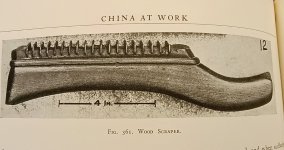

The book is "China at Work" by Rudolph P. Hommel.
It's a great read, but prices for used copies are wild, so I apologise for praising it and then spreading disappointment. According to Worldcat, some university libraries have copies.
It also answers my question of where I had seen one before. Many years ago I picked up on some book recommendations by Roy Underhill. One I'd not heard about anywhere else was a study of life in China, first published in 1937. I managed to find a reprint at a reasonable price and bought it. I can now confirm that it includes this picture and text:
The book is "China at Work" by Rudolph P. Hommel.
It's a great read, but prices for used copies are wild, so I apologise for praising it and then spreading disappointment. According to Worldcat, some university libraries have copies.

Windows
Old Oak
Chü - an elm not affected by any changes in temperature or moisture - also sounds interesting.
GaryR
Nordic Pine
I've been unable to find out anything about this wood. Could it be Ulmus parvifolium, the Chinese elm?Chü - an elm not affected by any changes in temperature or moisture - also sounds interesting.
Edit: with a little more digging, it may be Catalpa bungei, or Manchurian catalpa. Not an elm at all.
Last edited:
Another dusty corner of my memory has just had a light shone on it...
I knew I had seen another tool like that centipede plane and now I know that I have this picture in a book. It's a French drag - no sniggering at the back please - and do your own googling if you must .
.

Note that the text explains that they exist in different tooth sizes and with plain straight blades.
The video that reminded me of this was this one, from a stonemason at Lincoln cathedral, who is doing some excellent videos explaining the mason's craft.
No surprise that a scraping action that's good on stone is also effective on hard, gnarly wood.
I knew I had seen another tool like that centipede plane and now I know that I have this picture in a book. It's a French drag - no sniggering at the back please - and do your own googling if you must
.Note that the text explains that they exist in different tooth sizes and with plain straight blades.
The video that reminded me of this was this one, from a stonemason at Lincoln cathedral, who is doing some excellent videos explaining the mason's craft.
No surprise that a scraping action that's good on stone is also effective on hard, gnarly wood.