• Hi all and welcome to TheWoodHaven2 brought into the 21st Century, kicking and screaming! We all have Alasdair to thank for the vast bulk of the heavy lifting to get us here, no more so than me because he's taken away a huge burden of responsibility from my shoulders and brought us to this new shiny home, with all your previous content (hopefully) still intact! Please peruse and feed back. There is still plenty to do, like changing the colour scheme, adding the banner graphic, tweaking the odd setting here and there so I have added a new thread in the 'Technical Issues, Bugs and Feature Requests' forum for you to add any issues you find, any missing settings or just anything you'd like to see added/removed from the feature set that Xenforo offers. We will get to everything over the coming weeks so please be patient, but add anything at all to the thread I mention above and we promise to get to them over the next few days/weeks/months. In the meantime, please enjoy!

Vintage tool collection - dating

Don, I see you have now put out a video showing your new old tools.

Just picking up on the subject of rebate planes. The first one you picked up, the one with long arms on the fence, is generally named as a sash fillister. Its usual purpose is for cutting the glazing rebate on windows, but it will be useful any time you want to cut a rebate on the far side of a piece, with the fence against the face side or edge, close to you.

The other rebate plane, generally termed a moving fillister, works the other way around, cutting a rebate into the reference surface, beside you.

That's probably not a very clear description, so here's a drawing by Charles Hayward, from Salaman's Dictionary of Tools. IMG_20241122_222010365.jpg
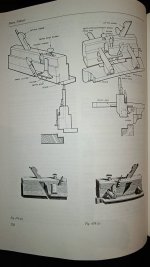
The moving fillister is on the left, the sash fillister on the right.

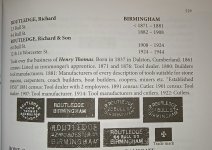
And for completeness, here's the entry on Routledge from Goodman's British Planemakers.
IMG_20241122_220614294.jpg

Did I mention that they are both useful books? ;)
 
Andy, thank you again for the wealth of information, Salaman's Dictionary of Tools does indeed look like a handy book! Appreciate the info on Routledge, I'd been able to find out online when the company started, but wasn't sure when he ceased trading, so knowing all his tools are pre-1944 is nice to know. I suspect my planes are a bit older than that, though.
 
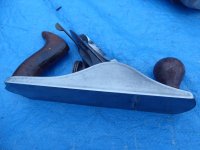
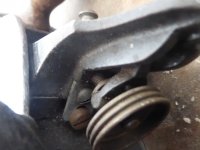
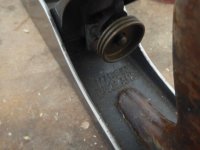
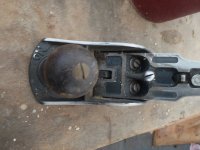
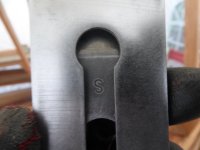
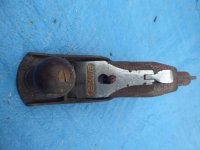
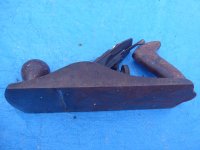
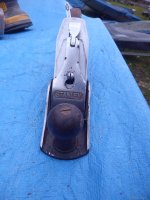
Sorry to revive this thread, but I was cleaning up an old Stanley No. 4, which came with the set of vintage tools, and I'm wondering if it is at all possible to date English-made Stanley planes? Online research is fairly negative about being able to date them at all, but I figured that if anyone could help, it would be the good people on this site. :) Thanks all.
 

Attachments

  • P1000947.JPG
    P1000947.JPG
    145.7 KB · Views: 6
  • P1000946.JPG
    P1000946.JPG
    112 KB · Views: 5
  • P1000945.JPG
    P1000945.JPG
    104.6 KB · Views: 6
  • P1000944.JPG
    P1000944.JPG
    148 KB · Views: 6
  • P1000942.JPG
    P1000942.JPG
    94 KB · Views: 5
  • P1000941.JPG
    P1000941.JPG
    97.9 KB · Views: 4
  • P1000940.JPG
    P1000940.JPG
    95 KB · Views: 4
  • P1000939.JPG
    P1000939.JPG
    126.6 KB · Views: 7
  • P1000937.JPG
    P1000937.JPG
    143.3 KB · Views: 7
  • P1000949.JPG
    P1000949.JPG
    167.5 KB · Views: 7
That's a harder question Don. The story of the English made Stanleys is complicated, not least by the way that Stanley subcontracted their castings. (Foundries used included SIF/Qualcast and Crane in Wolverhampton).

This post, on another forum, might be useful - it's someone trying to emulate the US type studies:

 
Thanks Andy. I'd seen that forum, but I'm afraid it didn't make much sense to me in terms of dating? The OP has divided the English made Stanleys into "types" but not sure how that relates to dates as there don't seem to be any dates mentioned? There is probably background knowledge that I don't have that would make it all make sense to anyone more knowledgeable than I am!
 
Thanks Andy. I'd seen that forum, but I'm afraid it didn't make much sense to me in terms of dating? The OP has divided the English made Stanleys into "types" but not sure how that relates to dates as there don't seem to be any dates mentioned? There is probably background knowledge that I don't have that would make it all make sense to anyone more knowledgeable than I am!
Ok, my very brief version, based on generalisations, general knowledge and and Geoff Tweedale's work, goes like this.

Stanley established manufacturing in Sheffield in 1936 by buying AJ Chapman. Production of planes was at 800 a week plus 500 of the cheaper Acorn brand.

With the outbreak of WWII, production switched, as it did for much of British Industry, to support the war effort. Stanley made parts for munitions and some tools (eg drills) for the military.

After the war, production expanded, to support post-war building which still needed hand tools. Production expanded into modernised plants, which could take advantage of more mechanisation and advances in metallurgy. So the late 40s through to the 60s were the period of highest quality planes, with no concessions to building down to a price.

As the DIY boom took hold, cheaper lines were developed such as the "Handyman" planes and those with disposable blades, but the established designs continued, but probably in smaller quantities.

Planes from the 70s or 80s of the established designs can be perfectly good, in my experience, though many people don't like the plastic handles some came with. Stanley plane production ceased in Sheffield in 1998.
 
Cheers Andy. Final question, any thought on what the handle and knob are made of on my plane? I'm poor at ID'ing timber that's been stained...
 
They did use a lot of beech, often under a dark brown varnish. That might well be what you have.
 
Back
Top