• Hi all and welcome to TheWoodHaven2 brought into the 21st Century, kicking and screaming! We all have Alasdair to thank for the vast bulk of the heavy lifting to get us here, no more so than me because he's taken away a huge burden of responsibility from my shoulders and brought us to this new shiny home, with all your previous content (hopefully) still intact! Please peruse and feed back. There is still plenty to do, like changing the colour scheme, adding the banner graphic, tweaking the odd setting here and there so I have added a new thread in the 'Technical Issues, Bugs and Feature Requests' forum for you to add any issues you find, any missing settings or just anything you'd like to see added/removed from the feature set that Xenforo offers. We will get to everything over the coming weeks so please be patient, but add anything at all to the thread I mention above and we promise to get to them over the next few days/weeks/months. In the meantime, please enjoy!

Wagatabon

GaryR

Nordic Pine
Joined
Jan 22, 2024
Messages
654
Reaction score
1,146
Location
Bloomington, Indiana, USA
Name
Gary
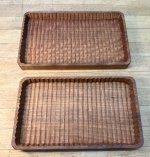
A wagatabon is a style of carved tray from Japan. Making a couple of these in black cherry as gifts. I removed the bulk of the waste with a Forstner bit, then flattened and removed the divots with a bottom cleaning bit on a router table. Now I'm attacking it with the 7/10 Pfiel gouge. The walls are about done and I'm starting on the floor.

B75750A8-0610-48BD-B30D-580647EBF589_4_5005_c.jpegC1EC32A1-F1E7-4F71-B18B-E0F29F4C23BD_4_5005_c.jpegE2D9BD4A-BB04-41DD-A5EA-8A5A05CBC55D_4_5005_c.jpeg
 
Last edited:
This is a very interesting serving tray, what region of Japan did these originate from?
It has a good story. "Wagatabon" means "Wagatani tray". Wagatani was a town in western Japan that was abandoned when a dam was built for a reservoir that flooded the town site. The trays were a local craft made by shingle/shake makers to make use of chestnut blanks that weren't good enough for shakes. When the town's citizens were dispersed, the craft nearly died.

https://www.angelarobins.com/blog/2019/5/23/wagata-bon-the-life-of-a-japanese-folk-craft
 
There's a German lady on my InstaG feed now living in Japan who makes these. I saw some of them a few years ago in the craft gallery at the Kenrokuen Garden, Kanazawa - Rob
 
Not sure I understand the rationale behind these Gary, was it to save time and effort cleaning them up, or were they designed for use in cooking to keep something up so that it would marinate perhaps?
Or just purely decorative?
 
Lovely work, I instantly thought of Jack Wheeler’s wagatabon. Zed’s videos with greenwood workers are well worth a watch for anyone who hasn’t seen them before.

They’ll make great presents.
 
Not sure I understand the rationale behind these Gary, was it to save time and effort cleaning them up, or were they designed for use in cooking to keep something up so that it would marinate perhaps?
Or just purely decorative?
I think just decorative. The ridges on the bottom does make it a little easier to pick up things like coins but that is a side benefit.
 
I like it and had never come across the style before but as a woodcarver it looks like one of my unfinished projects
 
I like it and had never come across the style before but as a woodcarver it looks like one of my unfinished projects
An image search for 我谷盆 shows many variations on the theme. The common features seem to be the fluting, of course, but also shallow flared sides and rounded corners. Finishes vary from oil, to ebonized, to smoked, to no finish. Although the originals were Japanese chestnut there is no reason not to use just about any other wood.
 
I really like that.

One of the apprentice pieces at Edward Barnsley is a carved coin tray. You can do it how you like, but most leave a scalloped finish straight off the gouge. Here's one pictured on their website:

1779473525480.jpeg
 
An image search for 我谷盆 shows many variations on the theme. The common features seem to be the fluting, of course, but also shallow flared sides and rounded corners. Finishes vary from oil, to ebonized, to smoked, to no finish. Although the originals were Japanese chestnut there is no reason not to use just about any other wood.
I should have said I'd never come across the description wagatabon Gary. Certainly I've seen many examples of fluted work and even made a couple myself.
 
Back
Top