• Hi all and welcome to TheWoodHaven2 brought into the 21st Century, kicking and screaming! We all have Alasdair to thank for the vast bulk of the heavy lifting to get us here, no more so than me because he's taken away a huge burden of responsibility from my shoulders and brought us to this new shiny home, with all your previous content (hopefully) still intact! Please peruse and feed back. There is still plenty to do, like changing the colour scheme, adding the banner graphic, tweaking the odd setting here and there so I have added a new thread in the 'Technical Issues, Bugs and Feature Requests' forum for you to add any issues you find, any missing settings or just anything you'd like to see added/removed from the feature set that Xenforo offers. We will get to everything over the coming weeks so please be patient, but add anything at all to the thread I mention above and we promise to get to them over the next few days/weeks/months. In the meantime, please enjoy!

What should the bevel be on this wooden plough plane?

SteveMP

New Shoots
Joined
Jun 18, 2026
Messages
112
Reaction score
165
Name
Steve
LOCATION
San Diego
I measured and the angle of the skate is 55 degrees, so I guess York pitch? The blades i have are not original and they are at 25 degrees, but i put a 30 degree secondary. But ai am wondering if the bevel angle is causing my issues with this thing. It works, but after about 3-4 swipes the blade gets pushed back to flush and stops cutting. So I am constantly tapping it back in. Looking at Veritas plow irons they are all ground to 35 degrees, which made me start questioning all of my plow irons Thoughts?
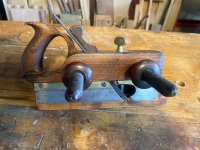
image.jpg
 
I don't claim any expertise in these matters, but I tend to work on the premise that for any bevel down plane, the cutting angle is defined by the bed angle. As long as the bevel angle is less than the bed angle (and hence the tip touches the wood with a bit of clearance at the back), then any angle is functionally equivalent in terms of cutting action. Steeper angles mean stronger cutters.

I tend to sharpen everything bevel down at 35° apart from my 36° block plane, which gets sharpened at 30°. For a 55° bed bevel down plane, pretty much any bevel should be fine I think.

If the blade's getting pushed back to flush then it seems the wedge isn't doing its job.
 
I don't claim any expertise in these matters, but I tend to work on the premise that for any bevel down plane, the cutting angle is defined by the bed angle. As long as the bevel angle is less than the bed angle (and hence the tip touches the wood with a bit of clearance at the back), then any angle is functionally equivalent in terms of cutting action. Steeper angles mean stronger cutters.

I tend to sharpen everything bevel down at 35° apart from my 36° block plane, which gets sharpened at 30°. For a 55° bed bevel down plane, pretty much any bevel should be fine I think.

If the blade's getting pushed back to flush then it seems the wedge isn't doing its job.
Ok thank you , i may try the 35 to see. Any idea how to make the wedge hold better? Its pretty much as-is when I bought it. I got it cheap because i like the looks, but it is actually kind o fun to use. BUt I didn't want to ruin it by sanding the wedge or something without knowing if that would make it worse.
 
Looking at the visible gap in front of the top of the wedge, it is not fitting perfectly, with this iron. Perhaps the iron is more tapered than than the wedge was made for.
 
Looking at the visible gap in front of the top of the wedge, it is not fitting perfectly, with this iron. Perhaps the iron is more tapered than than the wedge was made for.
Ooh, good spot, yes that seems plausible.

@SteveMP You could try rubbing a soft pencil all over the top of the blade and then fitting the wedge. When you remove the wedge you should see an even coating of graphite on it. If it's all at one end then the wedge angle needs a tweak.

You could also do the same with the top surface of the wedge but that might be more awkward.
 
I'd guess that the bevel angle is not the cause of the problem.

The wedge should make contact all along its upper and lower surfaces but there's a visible gap in front of it.

I suggest you hold the wedge above a candle flame to deposit some soot on it, then insert it fully and remove it. You should be able to see which bits are touching - the high spots. Carefully bring them down until the whole surface touches when you retest it.

It's probably easier to use a file for this.

Oops, cross-posted while cooking 😏
 
Ooh, good spot, yes that seems plausible.

@SteveMP You could try rubbing a soft pencil all over the top of the blade and then fitting the wedge. When you remove the wedge you should see an even coating of graphite on it. If it's all at one end then the wedge angle needs a tweak.

You could also do the same with the top surface of the wedge but that might be more awkward.
Ok may need to clean up both surfaces as they are kind of black dirty with oxidation etc.
 
If the blades are not original, then their taper may not be the same, and the wedge is not holding them securely enough. The blade is being pushed back in use.

Before making a new wedge, just try wacking the wedge a little harder. This is to test this theory, but also may be the issue all along.

Regards from Perth

Derek
 
Back
Top