• Hi all and welcome to TheWoodHaven2 brought into the 21st Century, kicking and screaming! We all have Alasdair to thank for the vast bulk of the heavy lifting to get us here, no more so than me because he's taken away a huge burden of responsibility from my shoulders and brought us to this new shiny home, with all your previous content (hopefully) still intact! Please peruse and feed back. There is still plenty to do, like changing the colour scheme, adding the banner graphic, tweaking the odd setting here and there so I have added a new thread in the 'Technical Issues, Bugs and Feature Requests' forum for you to add any issues you find, any missing settings or just anything you'd like to see added/removed from the feature set that Xenforo offers. We will get to everything over the coming weeks so please be patient, but add anything at all to the thread I mention above and we promise to get to them over the next few days/weeks/months. In the meantime, please enjoy!

What stripper?

Woodbloke

Sequoia
Joined
Jul 22, 2014
Messages
7,354
Reaction score
1,321
Location
Salisbury, UK
Our old dining room chairs are solid teak, (now approx 40yo) finished with an acid catalyst lacquer. They need re-upholstering but I'm also thinking about re-finishing them at the same time and will obviously need to strip off the old lacquer. When we had a marine aquarium some years ago, the salt water from which didn't do the finish a lot of good, though the teak is bullet proof and wasn't harmed.

What would the team recommend? - Rob
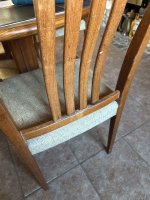
IMG_6200.jpeg
 
Last edited:
If it was me Rob I would think really hard before starting, nightmare of a job if you ask me.
Most of the chair is fine as it is, perhaps just a bit of a deep clean and a scrape of the worst bits?
 
I'm with Ian. I don't know if any of the strong paint strippers will shift it in which case its a sanding job.
I had to refurbish a couple of speaker cabinets years ago which I believe were a similar finish and after trying lots of chemicals I ended up sanding back to bare wood. With hindsight I would have just lightle sanded the surface and applied a finish on top.
 
Thanks chaps, pretty much as I thought, unfortunately:(. However, earlier I was doing a bit of Googling and came across this stuff which had very good reviews from the pros on The Decorator's Forum. It's sold in Brewers and recently we've found the staff in the Salisbury branch to be very helpful and knowledgeable, so the next time I'm round that way I may pop in and ask their advice. Apparently, guys in the trade pass onto staff details of their products which they've found to be worthwhile (bought some really great ceiling paint on their recommendation). If they give it 'null points' and the thumbs down regarding acid cat lacquer then I'll leave the chairs alone as there's no chance whatsoever that I'm going to spend a lot time and effort to scrape off the old finish - Rob
 
I've no personal experience of this but a Google search (Ai) result gave this when searching for the removal of the catalyst lacquer. Offered for consideration (2 methods):

From Google:
Removing catalyzed lacquer from teak furniture is best achieved using a chemical stripper or a combination of methods, as catalyzed finishes are more durable than standard lacquers. Physical sanding alone is labor-intensive and risky, especially if the furniture has a thin veneer.

Recommended Method: Chemical Stripper
A chemical paint/varnish stripper is generally the most effective method for this type of finish.
Materials Needed:
  • Chemical paint/varnish stripper (solvent-based is often most effective for tough finishes)
  • Chemical-resistant gloves, safety goggles, and a respirator mask
  • Stiff-bristled brush for application
  • Plastic or metal scraper (putty knife)
  • Steel wool (fine grade, e.g., #000 or #0000)
  • Clean rags or paper towels
  • Mineral spirits or specific neutralizer (check product instructions)
  • Drop cloths
Step-by-Step Instructions:
  1. Prepare the Area: Work in a well-ventilated area, preferably outdoors. Lay down drop cloths to protect the surrounding floor/surface. Remove any hardware (handles, etc.) from the furniture.
  2. Apply the Stripper: Following the manufacturer's instructions, apply a generous, even layer of the chemical stripper to a manageable section of the furniture using a brush.
  3. Allow to Dwell: Let the stripper sit for the time specified in the instructions (usually 15-40 minutes), or until the lacquer bubbles or softens. Do not let it dry out.
  4. Scrape Off the Finish: Use a plastic or metal scraper to gently lift the softened lacquer off the wood surface. Work with the grain of the wood to avoid gouging, and use the scraper in tight corners and detailed areas.
  5. Repeat if Necessary: For thick or stubborn finishes, repeat the application and scraping process until all the lacquer is removed.
  6. Clean and Neutralize: Use fine steel wool dampened with mineral spirits or the manufacturer's recommended neutralizer to remove any remaining residue. Wipe the surface thoroughly with clean rags.
  7. Final Prep: Allow the wood to dry completely (at least 1-2 days). The surface will need light sanding (150 to 220-grit sandpaper) to achieve a smooth finish before applying a new protective coating suitable for teak.

Alternative Method: Heat Gun
A heat gun can be used as a chemical-free alternative, particularly for flat surfaces, though it requires caution to avoid scorching the wood.
  1. Heat the Varnish: Hold the heat gun a few inches away from the surface on a low or medium setting. Move it steadily over the varnish until it softens.
  2. Scrape: As the finish softens, immediately scrape it away with a scraper.
  3. Cool and Clean: Allow the wood to cool completely, then clean the surface with soapy water or mineral spirits and a cloth.
Always test your chosen method on an inconspicuous area first to ensure it does not damage the teak.
 
Original Paramose works well on most things. It has good old-fashioned dichloromethane in it like Nitromors used to have, which will absolutely burn if you get it on your skin, so definitely wear gloves and probably a respirator.

You're technically supposed to be trade to buy it, but it's only a tick-box.
 
A few years ago I had some teak veneered speakers with similar wear to the finish. I smartened them up by adding some Osmo Poly-x to the surviving finish and it blended in nicely without needing to strip it off. I'll see if I can l the photos later.
 
I remember that Mike G used dried ice blasting to clean up beams during his renovation. I wonder if this could be used. According to Google can be used for renovating old buildings and historical furniture. Does anyone have any further info on this? I have a lacquered dining room table I want to strip
 
I've had a look but it seems that I didn't take any photos of my old teak veneered speakers, sorry. But if you can find a damaged area that doesn't show, I do think it would be worthwhile to experiment and see how well some fresh oil would blend in with the old finish, before you take on the tedious job of stripping all those fiddly components.
 
FWIW, I doubt that any strippers are up to the job now due to restrictions on ingredients used. If I was looking for a comprehensive restoration back to bare wood and you are happy to at least partially disassemble I would be looking at commercial stripping companies.

Ok.... just seen Trevanion's comment which looks interesting.
 
I remember that Mike G used dried ice blasting to clean up beams during his renovation. I wonder if this could be used. According to Google can be used for renovating old buildings and historical furniture. Does anyone have any further info on this? I have a lacquered dining room table I want to strip
I don't think this is practical, as it is rather massive equipment, and a long set-up time.......unless you can find an ice-blasting business which has a furniture-stripping arm. I'll bet you'd be charged hundreds of pounds. I'd be amazed if it didn't work, though.
 
As Trevanion suggested the best stuff is almost certainly the dichloromethane as still available in Paramose. I can assure anyone that's reading it will soften acid catalysed lacquer as I've used it myself on this a few times, as well as other finishes such as oil based varnishm pre-cat, etc. You do need to prove in the first case to your supplier you are a 'professional' to buy it. Add paintbrush(es), plastic paint kettles, metal scrapers, toothbrushes, green scouring pads/ wire wool to your armoury, plus overalls, goggles, and solvent resistant elbow length rubber gauntlets and plenty of moving fresh air.

A useful tip is to get the stripper on fairly generously and wrap the goop slathered part with plastic sheeting which helps keep it wet and working reducing the need for quite so much reapplication. Gun wash (cheap lacquer) thinner and white spirit are good for cleaning off the last of the stripper, and neutralising it prior to repolishing. I prefer white spirit as it doesn't evaporate so fast, especially as you tend to use quite a lot of it as it's slopped about. Slainte.
 
Last edited:
If stripping was a must I would endeavour to locate someone who could Blast them with Plastic or Shell stripper, should only need light finishing sanding afterwards.

Save any problems from liquid stripper chemicals penetrating the wood and certainly easier and quicker than attempting hand sanding.
 
Back to the Grain in Lewes, East Sussex, is a place I have used before for stripping furniture. They use commercial product and have two enormous tanks capable of taking an entire table and chairs set in one go. They strip and neutralise.

The downside (apart from whatever they charge) is glued joints may be weakened, depending on the adhesive used.
 
Called in at Brewer's today and nattered to one of their fairly knowledgable staff who recommended Strypit as it's a product, so he said, where the original 'recipe' had been kept and not watered down. Nitromors was at one time very good (he also said) but is nigh on useless now. If the regs changed some years ago, how come Strypit has stayed the same....or has it? - Rob
 
Called in at Brewer's today and nattered to one of their fairly knowledgable staff who recommended Strypit as it's a product, so he said, where the original 'recipe' had been kept and not watered down. Nitromors was at one time very good (he also said) but is nigh on useless now. If the regs changed some years ago, how come Strypit has stayed the same....or has it? - Rob

From what I recall Strypit was far weaker than Nitromors back in the day as it was classed as an “Eco-Friendly” alternative to other strippers with the dichloromethane component, with a big selling point that it wouldn’t burn you and that you could rinse it down the sink.
 
My first reaction on seeing the topic was .......
Christine Keeler:ROFLMAO:

Ok, I am leaving
Nice chair! And for the younger members who are wondering what we’re talking about.
 
If the regs changed some years ago, how come Strypit has stayed the same....or has it? - Rob
The Rustins website describes it as new formula so presumably it has changed.

 
Back
Top