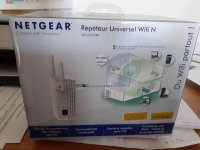
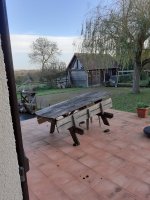
Mains power circuit adapters do work, but I think they'll struggle with big motors on the same circuit, because of interference. If your enthusiasm is for C18th hand skills, no problem! Otherwise, you probably need to send it as a radio signal
to the garage, then re-broadcast it
inside the garage. That requires a bit of extra kit (and costs a bit, too).
I know you said you don't want a cable, but that is far and away the best performing and probably most reliable solution, and CAT5 is very inexpensive compared to using a wireless solution. There's no reason you can't bury it, too if you wish., or fly it from building to building over such a short distance (use something like galvanized fencing wire to support the actual CAT5 cable with cable ties).
You can also use a dedicated range-extending pair of devices to work across the gap. Signal "boosters" will give you slow WiFi as they're almost always 'simplex' devices, i.e. signal in one direction at a time (both ways simultaneously is 'duplex' and I've never seen a plug-in-and-go one for domestic use). Proper range extenders just do the job, but by using radio instead of physical cable.
Where, with respect to the garage and modern extension, is your broadband router? I assume it's also providing the WiFi (i.e. from the same box)... Also, do you have neighbours close by (i.e. lots of other WiFi networks in proximity)? Interactions with other households' WiFi can result in your own WiFi being worse than expected.
You can use most mobile devices as pretty useful diagnostic tools. There's a raft of good apps that will show you both your own network's performance, and the 'WiFi environment'. These two are for Android:
If there are neighbours close by, I'd start by looking at the environment. Note the channels other networks are using, and which are the 'loudest'.
I live in an urban neighbourhood. The screengrab below from my tablet shows the wifi networks detectable from my dining table (using Net Analyser):
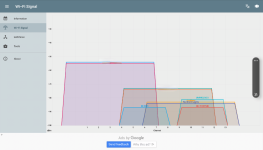
I've blurred out my WiFi SSIDs ("network names"), but they're the two biggest ones (both my access points use the same two SSIDs, which is why the two trapesiums are almost exactly superimposed). This graph is fiine for this house, as my access points are plenty loud enough in comparison to the neighbours' ones (it gets a bit busier in the evenings and upstairs too, as the signals carry further).
You can see how almost all the neighbours' stuff is centred on band 10 and 11, whereas ours is on bands 3 and 8 (x-axis centre point of the shapes). It means the others probably interfere with each other but we mostly have clean signal (it's a bit more complex, but not much).
Note also the Y-axis scale. Decibels are logarithmic, so in this case a 3dB difference on the Y-axis is a halving or doubling of received power. So my downstairs access point (on channel 3) is roughly 1024 times 'louder' than the neighbour's "northern lights" SSID (if I read that wrong I welcome correction!).
The challenge you'll have is if all the other local networks arrive in the garage on the same channels and with similar signal strength - the ones you don't want are just interference for your own network.
So step1: install something like Net Analyser, and see what you get inside and outside the garage. You should see your own WiFi along with everyone else's. if they're all centred on the same channel (e.g. 11, as my neighbours' ones are),
and yours is too, that's not good. If you can't force your extender to use a quieter channel (or there
isn't a quieter channel available!), you'll probably continue to have poor performance.
Regarding Faraday cages: their effectiveness varies hugely with frequency. There are usually enough gaps in buildings for signal to get in, but it will be attenuated (made smaller) by large conductive areas of metal foil. Net Analyser should be able to show you the effect - near a doorway (assumed wooden), signals will be louder from outside. You can't blast through the foil, but you can pick up and rebroadcast signal sneaking in round the edges!
Hope some of the above is food for thought!
E.
PS: I'm not a radio frequency engiineer, but I've used specialist radio equipment since long before the internet was a thing, and RogerS will confirm I probably had a reasonable technical education!