• Hi all and welcome to TheWoodHaven2 brought into the 21st Century, kicking and screaming! We all have Alasdair to thank for the vast bulk of the heavy lifting to get us here, no more so than me because he's taken away a huge burden of responsibility from my shoulders and brought us to this new shiny home, with all your previous content (hopefully) still intact! Please peruse and feed back. There is still plenty to do, like changing the colour scheme, adding the banner graphic, tweaking the odd setting here and there so I have added a new thread in the 'Technical Issues, Bugs and Feature Requests' forum for you to add any issues you find, any missing settings or just anything you'd like to see added/removed from the feature set that Xenforo offers. We will get to everything over the coming weeks so please be patient, but add anything at all to the thread I mention above and we promise to get to them over the next few days/weeks/months. In the meantime, please enjoy!

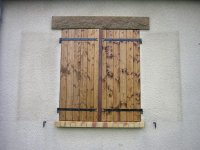
Wood suitable for window shutters.

Andy Kev.

Nordic Pine
Joined
Jan 4, 2021
Messages
698
Reaction score
43
I've been asked to make some replacements for ageing window shutters. The existing ones seem to be of some kind of pine type wood and their best days are long behind them.

I was wondering if there is a particularly suitable kind of wood. I don't think that anything particularly heavy e.g. oak wood do. I was thinking about American Tulip/Whitewood as once it decides to behave it can be planed very smooth and flat. The finish will be with Swedish linseed oil based paint, so weathering will no be a factor.

Any thoughts?
 
Reproduced from a thread I posted elsewhere in 2010. 16 years on and after 2 or 3 more coats of cuprinol they show no signs of rot. The new timber used was a pine of some sort.

It seems to me that the basic design of the shutters as seen throughout most of france is fundamentally flawed, if made from bog standard pine. The problem is that water collects behind the lower horizontal part of the Z and rot inevitably follows. This would not be so bad if one could replace the last 6" of each affected board, but this is not possible as 1) a joint at this point would lead to more problems and 2) the tongue and grooved boards are nailed, presumably with a nailgun as the heads are at least 1/4" below the surface of the board hence removing one or two boards without damaging the rest is nigh on impossible - for me anyway.
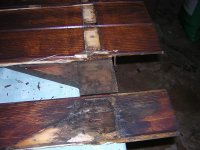
IMG_4869.jpeg


So I decided to practise my french and head off to the sawmill. Ordinarily I would go to one of the large sheds/timber merchants but the standard width of prepared shutter boards is 9cm and all mine are 10cm - sensible really as the windows are 120cm wide that is 6 boards per shutter. 9cm boards would mean some odd shaped boards.

The hardwood Zs (some kind of exotic mahogany type timber i think) all seem to be in good condition and do not need replacing.

I though it would be a good idea to keep the Z intact (joints are just skew nailed) and I wanted to put the hinges back in exactly the same place so I thought it would be a good idea to replace the boards one at a time.

The first 3 boards were removed
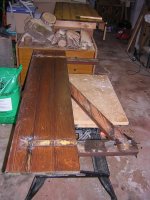
IMG_4870.jpeg

The first 2 new boards were attached to the Z, the hinge was then screwed back onto the old boards providing the exact location for the holes in the new boards. This way would ensure that 1) the hingers would be the correct spacing apart and 2) no additional holes need be drilled in the hardwood.
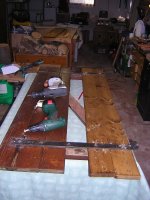
IMG_4871.jpeg


Stainless steel screws were used throughout so if a board does need to be replaced it should be a doddle.
The first complete shutter
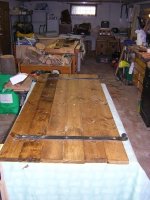
IMG_4872.jpeg


I forgot to alternate the growth rings on this one, I hope it will be OK.

1 coat Cuprinol shed and fence preserver was applied before construction and another coat added when complete. There seems to be nothing like cuprinol over here. The finish of the choice is a "lassure" which like paint forms a skin and allows moisture to be trapped underneath. I much prefer cuprinol as it allows the wood to breath and is a doddle to reapply.
metalwork treated to a couple coats of Hammerite
I down 8 more to do.
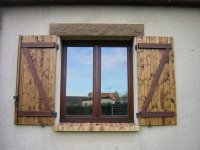
IMG_4873.jpeg
IMG_4874.jpeg


I tried to reduce the gap all round by as much as possible as the smaller the gap the smaller the heat loss
 
I’m curious Andy do you keep them shut or open most of the time? If it’s open (most of the ones I see are never closed) why not turn them inside out then you wouldn’t get the rot as much?

Winter months and colder nights all shutters closed at night for insulation benefits. Bedroom shutters closed every night all year round. South and west facing can be closed on hot sunny days to keep living room cooler.

The rot on the original shutters, IMO, was due to failure of the gloop that they were covered in. Water got behind the finish and had nowhere to go. I have a love hate relationship with any exterior wood finish that forms a skin. I once heard an old timer proclaim that paint is for decoration not protection.
The spirit based Cuprinol allows wood movement and those replacement shutters have now been in place just one year less than the originals.
I guess to answer Andy K’s original question wood choice is perhaps less important than choice of finish although rereading his post he does not say whether he’s making internal or external so I may have gone off on a tangent…….sorry.
 
If the shutters are external Tulip wood is not remotely suitable.
 
Andy P: that's really interesting but unfortunately the shutters in question have a frame construction with lots of cross pieces (styles, I suppose). I was surprised to note that they are not angled, thinking that they would slope from back to front so that rain could drip off. I have seen some made that way but I've seen others like the ones in question where the vertical elements of the frame have simple grooves (the other construction would require a series of slightly angled grooves) and the tongues of the styles simply slide into them. I'm pretty sure that your back door style construction would be rejected which is a shame as it is so straightforward.
 
Back
Top