• Hi all and welcome to TheWoodHaven2 brought into the 21st Century, kicking and screaming! We all have Alasdair to thank for the vast bulk of the heavy lifting to get us here, no more so than me because he's taken away a huge burden of responsibility from my shoulders and brought us to this new shiny home, with all your previous content (hopefully) still intact! Please peruse and feed back. There is still plenty to do, like changing the colour scheme, adding the banner graphic, tweaking the odd setting here and there so I have added a new thread in the 'Technical Issues, Bugs and Feature Requests' forum for you to add any issues you find, any missing settings or just anything you'd like to see added/removed from the feature set that Xenforo offers. We will get to everything over the coming weeks so please be patient, but add anything at all to the thread I mention above and we promise to get to them over the next few days/weeks/months. In the meantime, please enjoy!

Restoration of a Bailey pattern plane (Stanley No. 7)

Mike G

Petrified Pine
Joined
Jul 30, 2014
Messages
12,222
Reaction score
2,558
Location
Suffolk
Name
Mike
This isn't aimed at the regulars here, who know how to get a plane working again. It's more aimed at newcomers and beginners who might have an old plane which doesn't work, and don't know where to start.

I recently bought a Stanley No. 7 plane in poor nick, and have just spent a couple of hours sorting it out. Here's what it looked like originally:

IMG_8524.jpg

IMG_8525.jpg

IMG_8526.jpg

This is, I think, a 1930's plane. I picked it up for £40 on Facebook Marketplace. The first job is to take it all apart. If you've not done it before, don't worry.....re-assembly is very easy and self-explanatory. Here it is in bits:

IMG_8527.jpg

Now, I have a rotary wire wheel on my bench grinder. It's got brass wires, so it pretty gentle. I spent an hour cleaning every part:

IMG_8528.jpg

IMG_8529.jpg

If you don't have a brass-wire wheel, you can buy the same thing on a smaller scale on a shaft which can go in a pillar drill or lathe. It's a seriously useful bit of kit.

The handle has clearly been repaired previously:
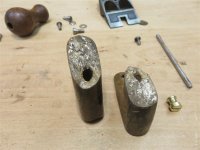
IMG_8530.jpg

I picked at the old glue and got rid of most of it, but the surfaces didn't mate well. I'll come back to the handle later. Let's get into the iron (blade). It was in a bit of a mess:

IMG_8533.jpg

I have a mount for my belt sander, and use a jig set to the angle I want (25 degrees). The first thing I do, though, is hold the blade at right angles to the belt, and flatten off the gnarly business end. Then, it's just a question of sanding/ grinding for a few seconds, then cooling it by dunking it in water for 20 or 30 seconds, and repeating the process until you reach the edge:

IMG_8536.jpg

What you're trying to avoid is the end of the iron overheating and turning blue/ black. So, you might not get the grind all the way down to the end....but you need to get as close as you dare. Then, it's to the sharpening station:

IMG_8537.jpg

I use diamond plates and a honing guide, and produce just a single bevel (25 degrees). Your preference may be different, but I don't like grinding, and the single bevel means I never have to do it again after the initial work.

Those not used to sharpening need to work away until you can feel a raised edge (burr) on the back of the iron (the opposite side to that you've been working on. That's when you move to finer stones/ plates to finish off the bevel, before removing the iron from the honing guide. Flip the iron over and get to work on the other side. You only need the first inch or so flattened on the back. After a few rubs, I could see that this iron had never been flattened before:

IMG_8538.jpg

So, I had to spend a few minutes on the coarser plate getting rid of the low patches (well, you know, getting rid of the high spots around the low patches until everything was flat):

IMG_8539.jpg

The keen-eyed will notice that I always ease the corners of plane irons so that they don't dig in and leave lines or sharp edges up the wood as you plane. In this case, I'd done so much work to the back of the iron that I had to re-hone the bevel, before moving on to the strop (big burrs can break off roughly leaving an un-clean edge). Here's the blade ready for use:

IMG_8540.jpg

It's never easy getting a good photo of a shiny piece of steel!

The next job, whilst still at the sharpening station, was to "sharpen" the under-face of the cap iron. If you don't do this, you'll find shavings forcing there way in between the blade and the cap iron:

IMG_8542.jpg


Finally, a quick rub of the frog casting to check that there are no high spots on the machined faces:

IMG_8543.jpg

Back to the body of the plane. I got a little white spirit and a toothbrush and cleaned the inside of the body, and the nooks and crannies of the frog:

IMG_8544.jpg

That's my picture limit, so I'll be back in a sec.....
 
Last edited:
We're now going to re-assemble the plane. First, pop in the frog adjustment screw (it's easier to access now than when the handle is in place):

IMG_8546.jpg

Then screw the little plate which registers into the frog adjustment screw onto the frog:

IMG_8547.jpg

Next pop the frog in place, and with a little ruler check that something flat lying on the face of the frog doesn't touch the throat of the plane body:

IMG_8548.jpg

Screw the frog into place, and pop in the screw which retains the blade assembly:

IMG_8549.jpg

Assemble the cap iron, cap iron screw, and iron (blade) taking extreme care with the razor sharp edge you've created:

IMG_8551.jpg

This plane is a fore plane, which means that you aren't looking for the finest shavings and the perfect finish, so the cap iron is left a mm or 2 back from the cutting edge (it can be much closer with a plane set up to produce a final finish). And I forgot to mention, the front end of the cap iron was smoothed and polished (including stropping) at the sharpening station.

Fit the handle and knob. You'll note that I have temporarily fitted a spare plastic handle, because the handle repair will take a day or two, and we'll need to have a handle on the plane to flatten the sole. More on that in a second.

Raise the toe of the plane and insert the iron & cap iron assembly, WITHOUT bumping the cutting edge into anything at all. Pop the lever cap in place, and screw the lever cap screw until be blade assembly well held, but still loose enough to be able to undo the lever cap using the lever:

IMG_8552.jpg

Withdraw the blade as far as you can. Scrape off any rust you can with a scraper:

IMG_8532.jpg

Ideally, your flat reference surface for the next stage would be longer than the body of the plane:

IMG_8554.jpg

Nonethless, it's do-able with a shorter piece of sandpaper, albeit you have to take care to keep everything level. You just rub backwards and forwards, periodically checking the sole to see what you can see. This must be done with the whole of the plane assembled, because the lever cap applies certain pressures which can slightly distort the casting of longer planes, apparently):

IMG_8556.jpg

I've highlighted in chalk the low areas. This is a fairly typical wear-pattern for a plane which has been used for flattening edges of boards. I rubbed the sole for 10 or 15 minutes, without seeking to achieve perfection:

IMG_8558.jpg

The next job is for aesthetics only. Clean up the sides of the casting with sandpaper and/ or one of those plastic Brillo-pad-like scouring things:

IMG_8557.jpg

Finally, wax the sole:

IMG_8559.jpg

Then go and wash your hands. There's no avoiding this; it's a dirty job:

IMG_8560.jpg


Adjust the setting of the blade using a piece of scrap, paying particular attention to the lateral adjustment (the swinging lever):

IMG_8561.jpg

This is what this plane is for......taking away the high points to flatten boards:

IMG_8562.jpg

All I've said relates to any bench plane, though. I would focus more on perfection in the sole on a number 3 and 4 than with a number 7....and nothing other than perfection is acceptable with a block plane.

Then stick it on a shelf with the rest of your planes..........and use it as much as possible!

IMG_8563.jpg


I scraped the worst of the old glue from the two halves of the broken handle:

IMG_8564.jpg

.......and Araldited them together. I have relatively low expectations:

IMG_8565.jpg
 
Last edited:
That’s a pretty good comprehensive description of how to do it Mike.
It isn’t just lever cap that exerts pressure, I had my no4 professionally surface ground once and after screwing all the parts back on including the handles it was obvious that the screws also distended the sole. Surprisingly soft stuff cast iron.
 
Nice save Mike. (y)

Whenever I've repaired a handle like that I've used a 6mm dowel in the meaty part to give it a bit of extra strength. I don't know if that's strange practice just seemed logical to me. It could actually weaken it I suppose. :unsure:
 
Great job. I would have junked the handle and made a new one. But so what - No 7 is very useful.
 
If you need to take any amount of the damaged iron off to get to the clean face you're less likely to blue it if you grind it off (near) square first then regrind the angle.
 
Enlightening step by step guide... I've a couple of old planes to be renovated - hopefully next year after getting the workshop sorted.

I've had them since around 1982 (?) when I worked for a builder's merchant in the tools department. They got put in a box some years ago but got wet when the back shed roof leaked.

Temporarily cleaned off, sprayed with WD40 and wrapped in some greased/waxed type paper metal bits used to get wrapped in. I was dreading what they may be looking like but seeing what you've achieved with this one gives me hope.
 
The existing ones don't match! Annoying.
Extremely! Were it me my OCD would kick in and I'd have to do something about it. As Lons has suggested, a bit of Bog Oak wouldn't look too shabby but you'd probably need to ask a few friends to see if they've got a lump or two to spare:ROFLMAO::ROFLMAO: - Rob
 
Nice job; I too would have made a new handle and probably a front knob to match - Rob
On that Rob, I like the (prepares for smutty reactions...) wider, flatter knob shape on the older planes, of which I think you might have a couple? Any chance of a cross section with dimensions for me to copy on the lathe for mine...?
 
On that Rob, I like the (prepares for smutty reactions...) wider, flatter knob shape on the older planes, of which I think you might have a couple? Any chance of a cross section with dimensions for me to copy on the lathe for mine...?
Sorry Trim, dry hole. I've got plenty of planes (wot moi, collector? surely not!) but no older ones with the smutty knob as described. AndyT is the oracle on this sort of stuff and I suspect would probably be able to give you 'chapter n'verse' - Rob
 
Did somebody call?

To be honest, although I have a few planes, I've never got into "type studies" and don't feel the need to collect the full set of anything, but I do have one older Stanley no 4 with the low knob.

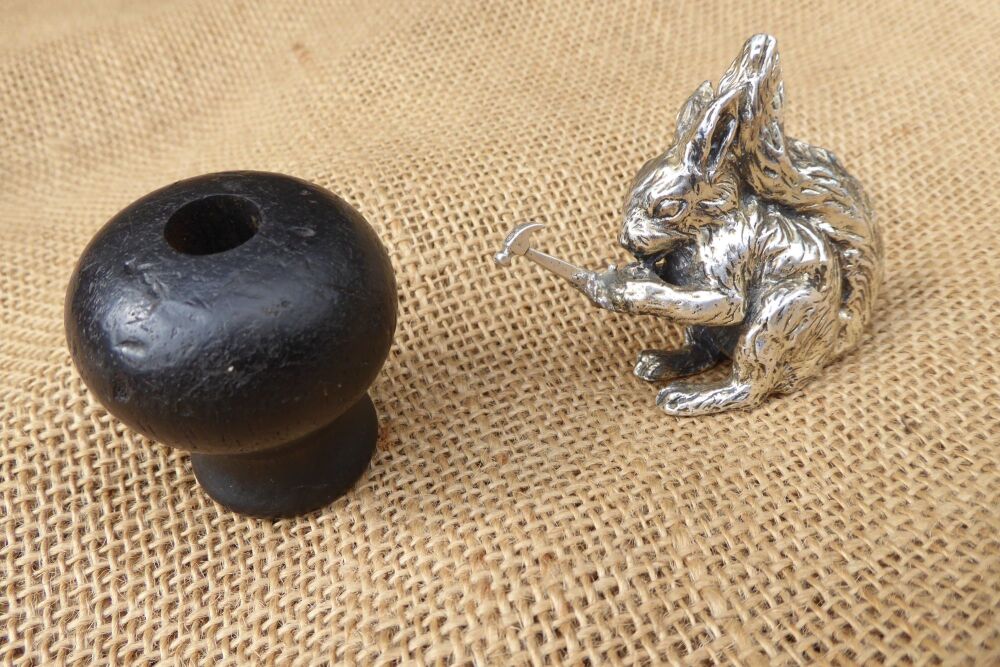
Here it is, alongside what I think of as the ordinary style. You can see that on the later plane the knob sits inside a raised ring, which is part of the casting.

The low knob is about 46.5 mm diameter at the widest part and 48mm tall. Base is 31.5mm diameter, narrowest point 23.5mm.

The common knob is 40mm max diameter and 60mm tall.

Hope this helps.

IMG_20251125_093823417.jpg

IMG_20251125_093903768.jpg
IMG_20251125_093832126.jpg
 
Last edited:
Did somebody call?

To be honest, although I have a few planes, I've never got into "type studies" and don't feel the need to collect the full set of anything, but I do have one older Stanley no 4 with the low knob.

Here it is, alongside what I think of as the ordinary style. You can see that on the later plane the knob sits inside a raised ring, which is part of the casting.

The low knob is about 40mm diameter at the widest part and 40mm tall. Base is 31.5mm diameter, narrowest point 23.5mm.

Hope this helps.

View attachment 37088

View attachment 37089
View attachment 37090
I like the look of that old style knob Andy, how does it feel in practice- does it work? But I can only presume that the one that became the norm was an improvement?
 
It feels very good, but frankly I don't do enough consecutive hours of planing to say that it's any different. *

I suspect the change could have been an economy measure so that the front knobs could be made from the same thickness stock as the rear handles.


* My hands can't feel the difference between rosewood and stained beech either! 😏
 
I've got a No 7 with the old style knob and I really like it. (Reminds me that I should use that plane more. I've got in the habit of using a more modern No 6 recently but I do like using a >100 years old tool.)
 
Thanks Andy. I'm definitely going to make a low knob at some point, but we know how far out my timelines for ANYTHING workshop related can be...
 
Great find and great recondition job... , I wish I could find a No7 for £40 on FB,,, or anywhere for that matter.
 
Mike I forgot to say that is a laminated blade you can tell by the square shoulders, you should be able to see the colour difference in the bevel.
I have a few laminated blades and they are very nice.

Pete
 
What a polite lot you all are. My original measurements made no sense. I've corrected them now.

And as the rear handles are all about 23mm thick, ignore my stupid suggestion about using the same stock for both.

Mark, I hope you haven't rushed out to the workshop with the duff information just yet..😟
 
As an aside for which I apologise... does anyone happen to know the maximum thickness of blade that will retrofit in an older Stanley no7 without needing to file the mouth? Better yet which of the current options (Ray Iles, Qiangsheng etc) would drop in. I know for a fact the Clifton is way too thick.
Cheers
G
 
As an aside for which I apologise... does anyone happen to know the maximum thickness of blade that will retrofit in an older Stanley no7 without needing to file the mouth? Better yet which of the current options (Ray Iles, Qiangsheng etc) would drop in. I know for a fact the Clifton is way too thick.
Cheers
G
You can file the back of the mouth to fit a thinker iron in and still go back to a thinner one, It will need the adjustment leaver modifying as it won't reach the slot through the thicker blade, but I don't think you will gain anything.
The square shouldered blades are very nice a good edge and last well.

Pete
 
What a polite lot you all are. My original measurements made no sense. I've corrected them now.

And as the rear handles are all about 23mm thick, ignore my stupid suggestion about using the same stock for both.

Mark, I hope you haven't rushed out to the workshop with the duff information just yet..😟
If you laminate your tote stock you will have a piece thick enough for a knob.


Pete
 
Back
Top