Mike G
Petrified Pine
This isn't aimed at the regulars here, who know how to get a plane working again. It's more aimed at newcomers and beginners who might have an old plane which doesn't work, and don't know where to start.
I recently bought a Stanley No. 7 plane in poor nick, and have just spent a couple of hours sorting it out. Here's what it looked like originally:


This is, I think, a 1930's plane. I picked it up for £40 on Facebook Marketplace. The first job is to take it all apart. If you've not done it before, don't worry.....re-assembly is very easy and self-explanatory. Here it is in bits:

Now, I have a rotary wire wheel on my bench grinder. It's got brass wires, so it pretty gentle. I spent an hour cleaning every part:


If you don't have a brass-wire wheel, you can buy the same thing on a smaller scale on a shaft which can go in a pillar drill or lathe. It's a seriously useful bit of kit.
The handle has clearly been repaired previously:
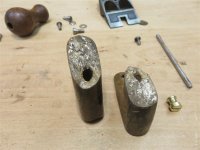
I picked at the old glue and got rid of most of it, but the surfaces didn't mate well. I'll come back to the handle later. Let's get into the iron (blade). It was in a bit of a mess:

I have a mount for my belt sander, and use a jig set to the angle I want (25 degrees). The first thing I do, though, is hold the blade at right angles to the belt, and flatten off the gnarly business end. Then, it's just a question of sanding/ grinding for a few seconds, then cooling it by dunking it in water for 20 or 30 seconds, and repeating the process until you reach the edge:

What you're trying to avoid is the end of the iron overheating and turning blue/ black. So, you might not get the grind all the way down to the end....but you need to get as close as you dare. Then, it's to the sharpening station:

I use diamond plates and a honing guide, and produce just a single bevel (25 degrees). Your preference may be different, but I don't like grinding, and the single bevel means I never have to do it again after the initial work.
Those not used to sharpening need to work away until you can feel a raised edge (burr) on the back of the iron (the opposite side to that you've been working on. That's when you move to finer stones/ plates to finish off the bevel, before removing the iron from the honing guide. Flip the iron over and get to work on the other side. You only need the first inch or so flattened on the back. After a few rubs, I could see that this iron had never been flattened before:

So, I had to spend a few minutes on the coarser plate getting rid of the low patches (well, you know, getting rid of the high spots around the low patches until everything was flat):

The keen-eyed will notice that I always ease the corners of plane irons so that they don't dig in and leave lines or sharp edges up the wood as you plane. In this case, I'd done so much work to the back of the iron that I had to re-hone the bevel, before moving on to the strop (big burrs can break off roughly leaving an un-clean edge). Here's the blade ready for use:

It's never easy getting a good photo of a shiny piece of steel!
The next job, whilst still at the sharpening station, was to "sharpen" the under-face of the cap iron. If you don't do this, you'll find shavings forcing there way in between the blade and the cap iron:

Finally, a quick rub of the frog casting to check that there are no high spots on the machined faces:

Back to the body of the plane. I got a little white spirit and a toothbrush and cleaned the inside of the body, and the nooks and crannies of the frog:

That's my picture limit, so I'll be back in a sec.....
I recently bought a Stanley No. 7 plane in poor nick, and have just spent a couple of hours sorting it out. Here's what it looked like originally:
This is, I think, a 1930's plane. I picked it up for £40 on Facebook Marketplace. The first job is to take it all apart. If you've not done it before, don't worry.....re-assembly is very easy and self-explanatory. Here it is in bits:
Now, I have a rotary wire wheel on my bench grinder. It's got brass wires, so it pretty gentle. I spent an hour cleaning every part:
If you don't have a brass-wire wheel, you can buy the same thing on a smaller scale on a shaft which can go in a pillar drill or lathe. It's a seriously useful bit of kit.
The handle has clearly been repaired previously:
I picked at the old glue and got rid of most of it, but the surfaces didn't mate well. I'll come back to the handle later. Let's get into the iron (blade). It was in a bit of a mess:
I have a mount for my belt sander, and use a jig set to the angle I want (25 degrees). The first thing I do, though, is hold the blade at right angles to the belt, and flatten off the gnarly business end. Then, it's just a question of sanding/ grinding for a few seconds, then cooling it by dunking it in water for 20 or 30 seconds, and repeating the process until you reach the edge:
What you're trying to avoid is the end of the iron overheating and turning blue/ black. So, you might not get the grind all the way down to the end....but you need to get as close as you dare. Then, it's to the sharpening station:
I use diamond plates and a honing guide, and produce just a single bevel (25 degrees). Your preference may be different, but I don't like grinding, and the single bevel means I never have to do it again after the initial work.
Those not used to sharpening need to work away until you can feel a raised edge (burr) on the back of the iron (the opposite side to that you've been working on. That's when you move to finer stones/ plates to finish off the bevel, before removing the iron from the honing guide. Flip the iron over and get to work on the other side. You only need the first inch or so flattened on the back. After a few rubs, I could see that this iron had never been flattened before:
So, I had to spend a few minutes on the coarser plate getting rid of the low patches (well, you know, getting rid of the high spots around the low patches until everything was flat):
The keen-eyed will notice that I always ease the corners of plane irons so that they don't dig in and leave lines or sharp edges up the wood as you plane. In this case, I'd done so much work to the back of the iron that I had to re-hone the bevel, before moving on to the strop (big burrs can break off roughly leaving an un-clean edge). Here's the blade ready for use:
It's never easy getting a good photo of a shiny piece of steel!
The next job, whilst still at the sharpening station, was to "sharpen" the under-face of the cap iron. If you don't do this, you'll find shavings forcing there way in between the blade and the cap iron:
Finally, a quick rub of the frog casting to check that there are no high spots on the machined faces:
Back to the body of the plane. I got a little white spirit and a toothbrush and cleaned the inside of the body, and the nooks and crannies of the frog:
That's my picture limit, so I'll be back in a sec.....
Last edited: