• Hi all and welcome to TheWoodHaven2 brought into the 21st Century, kicking and screaming! We all have Alasdair to thank for the vast bulk of the heavy lifting to get us here, no more so than me because he's taken away a huge burden of responsibility from my shoulders and brought us to this new shiny home, with all your previous content (hopefully) still intact! Please peruse and feed back. There is still plenty to do, like changing the colour scheme, adding the banner graphic, tweaking the odd setting here and there so I have added a new thread in the 'Technical Issues, Bugs and Feature Requests' forum for you to add any issues you find, any missing settings or just anything you'd like to see added/removed from the feature set that Xenforo offers. We will get to everything over the coming weeks so please be patient, but add anything at all to the thread I mention above and we promise to get to them over the next few days/weeks/months. In the meantime, please enjoy!

Accoya, but it the finish?

tony.w

New Shoots
Joined
Jul 7, 2024
Messages
83
Reaction score
11
Name
tony
LOCATION
shrops
i'm now in a position to start making new wooden windows for our house, existing windows softwood hard wood base 22 years ish being the oldest. my organal thoughts where Iroco top to bottom not Oak as for me very lovely but stane to easy and far to popular commanding crazy prising, we digress as i came across Accoya which for me tick all boxes (less maint better) but its the finish and i will finish with a light oak Sikens translucent and im hearing Accoya is best painted as the process rather greys the timber making it look kind of Yuk. Please somone tell me they have the same and Im wrong, I am the sort of person who is happy to let any exteria wood silver up naturally and happy to apply zero finish which i get is kind of wrong and pretty much all wood machined will need somthing to resist moisture.

Looking forward to hear your comments
 
No experience of not painting Accoya sorry, but if you think Oak is expensive (I have to disagree) then Accoya is hugely more so.
But for windows that are to be painted Accoya is hard to beat, probably has a guaranteed 50? Year life.
 
Waiting to speak to the wood yard i use as a rule but oak is twice the price of Iroko and Accoya approx 30% less, agreed prices vary
 
I've been working with Accoya for the past ten years extensively, it's a very good timber for a commercial user but it does have its downsides.

So with Accoya you have the benefits of very little seasonal movement compared to other timbers, not only does this help in regards to not having the windows and doors expanding and binding on the frames in the winter months. It also significantly increases the life of the coating used as it doesn't end up cracking and allowing water behind the finish causing it to blister and peel off, so you have much longer periods before coatings need renewing, unlike softwood or hardwood that require recoating much sooner.

A translucent finish on Accoya isn't ideal but it can be done, it's not so much "silver" but it is black on the first 3-5mm of each face of the plank, once you get beyond that the timber is typically bright white, there are also places where it is much darker than other which is where they have stickered it out in the autoclaves during the process so you can end up with a black line across the timber which can be unsightly unless planed out entirely. It can be tricky to get a perfect white finish all around the timber without removing a significant amount, though the blackness isn't very noticeable when you apply a darker finish. I've not used Sikkens on Accoya but I have used Teknos and Anker Stuy's water-based stains and topcoats with success and have had no issues.

The quality of Accoya has declined significantly over the last few years unfortunately, though there are more good planks than bad there are certainly more bad ones than there used to be. It's not uncommon to come across planks that are completely riddled with honeycomb cracks internally from the very aggressive kilning processes used which renders them practically unusable, there's also the issue of bark inclusions which can be very large and detrimental to the structural integrity and some are completely invisible within the timber and so it's impossible to tell whether the piece of timber is fine or will cause issues down the line.

My personal advice since you're going to be producing them yourself would be to save your money and make them from Iroko, overbuy the amount of material required and choose the planks with the straightest grain for your sashes and you should have very few issues. Iroko takes Sikkens products very well and lasts for years and years without requiring maintenance.
 
The other thing to remember about Accoya (I've only used it once), is that you can't use water-based adhesives like PVA or Cascamite. Accoya is made by removing the -OH groups, so water has nothing to stick to. You will need either epoxy-resin or polyurethane glue for a successful glue-up.

I, too, am surprised at the price difference, it used to be mega-expensive.
 
The price has come down significantly since the pandemic where it reached prices of over £4000cu/m, it now is around £2000-2500cu/m.

The supply of the timber itself has stabilised and also a third autoclave was installed in the processing plant in Holland so production has increased a fair bit.
 
The price has come down significantly since the pandemic where it reached prices of over £4000cu/m, it now is around £2000-2500cu/m.

The supply of the timber itself has stabilised and also a third autoclave was installed in the processing plant in Holland so production has increased a fair bit.

You have a reasonble supplier Trevanion at £2000 cu/m.

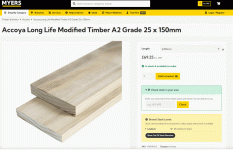
I have just made an online search for Accoya and Myers are charging twice that:

Myers.gif

Another supplier was charging about eight times what you are paying £176!

I have never been able to find Accoya at a price that would make it's use viable for me to use it. If I do occasionally get a joinery job I have to use Redwood. I make a bath to submerge cills etc in a bath of wood preservative and that normally works, some of my windows are still going strong after 40 years, I don't think they would last much over ten years without the preservative though. If I could buy Accoya at a reasonable price I would use it as it sounds perfect for a lasting job.
 
Thankyou for all your good info, prices i had where on the phone and info can be misinterpreted so i will know for sure when i have it, interesting Travenion about aggresive kilning thats ashame but i suppose its to keep up with demand. That said i think i may well be going down the Accoya road and try just enough for one window and see how i get on, thankyou Steve for the glue info I hadn't taken that in account, think i will spend this evening reserching a little more
 
Thankyou for all your good info, prices i had where on the phone and info can be misinterpreted so i will know for sure when i have it, interesting Travenion about aggresive kilning thats ashame but i suppose its to keep up with demand. That said i think i may well be going down the Accoya road and try just enough for one window and see how i get on, thankyou Steve for the glue info I hadn't taken that in account, think i will spend this evening reserching a little more
Just food for thought when I did a search for Accoya I noticed different grades.

This link explains the diffrence between them: https://www.accoya.com/app/uploads/2020/07/Lumber-Grading_EN_NEW.pdf

Would be worth checking to see you are getting the quality/grade you need for your windows.
 
You have a reasonble supplier Trevanion at £2000 cu/m.

If you don’t get it from the two main importers directly (Lathams and International Timber) you do get shafted on price because other suppliers are simply buying it in from them and selling it on with a mark-up, particularly smaller quantities. We buy a reasonable volume of Accoya every year so we do tend to have better prices than someone who’s a first-time buyer or only buys small amounts.

Just food for thought when I did a search for Accoya I noticed different grades.

Yes, A1 and A2. There’s not a massive difference between the grades now as you will come across bows, twists, knots, and other defects in A1, but they are more prevalent in A2. It used to be that A1 was perfect and A2 was good on one face but not now, it’s basically that you’ll have more of a chance of getting better timber with A1 than A2, but occasionally we’ve had A2 planks that could easily pass for A1.

Thankyou for all your good info, prices i had where on the phone and info can be misinterpreted so i will know for sure when i have it, interesting Travenion about aggresive kilning thats ashame but i suppose its to keep up with demand. That said i think i may well be going down the Accoya road and try just enough for one window and see how i get on, thankyou Steve for the glue info I hadn't taken that in account, think i will spend this evening reserching a little more

They have to aggressively kiln it to get it down to the correct moisture content, which is less than 4%MC, so it’s just an unfortunate side effect but I suspect they could achieve the same results over a slightly longer period without the risk of the honeycomb cracks occurring.

Steve is correct about the glue, because the process destroys the cells that react to water you cannot use water-based glues such as PVA or UF. Polyurethane, epoxy resin, or EPI must be used instead.

Another consideration also is that because of the high acetic acid content of the timber stainless steel fasteners and hardware must be used to prevent corrosion and ultimately failure. I saw many jobs when Accoya first started coming about where galvanised nails have been used to fix glazing beads and they have rusted in a matter of weeks leaving orange spots around the glazing which look dreadful, also it can completely rot out door and window hardware so you must use quality hardware and coat it in an anti-corrosion coating such as ACF-50 spray or grease to help prevent that.
 
If you don’t get it from the two main importers directly (Lathams and International Timber) you do get shafted on price because other suppliers are simply buying it in from them and selling it on with a mark-up, particularly smaller quantities. We buy a reasonable volume of Accoya every year so we do tend to have better prices than someone who’s a first-time buyer or only buys small amounts.


Yes, A1 and A2. There’s not a massive difference between the grades now as you will come across bows, twists, knots, and other defects in A1, but they are more prevalent in A2. It used to be that A1 was perfect and A2 was good on one face but not now, it’s basically that you’ll have more of a chance of getting better timber with A1 than A2, but occasionally we’ve had A2 planks that could easily pass for A1.


They have to aggressively kiln it to get it down to the correct moisture content, which is less than 4%MC, so it’s just an unfortunate side effect but I suspect they could achieve the same results over a slightly longer period without the risk of the honeycomb cracks occurring.

Steve is correct about the glue, because the process destroys the cells that react to water you cannot use water-based glues such as PVA or UF. Polyurethane, epoxy resin, or EPI must be used instead.

Another consideration also is that because of the high acetic acid content of the timber stainless steel fasteners and hardware must be used to prevent corrosion and ultimately failure. I saw many jobs when Accoya first started coming about where galvanised nails have been used to fix glazing beads and they have rusted in a matter of weeks leaving orange spots around the glazing which look dreadful, also it can completely rot out door and window hardware so you must use quality hardware and coat it in an anti-corrosion coating such as ACF-50 spray or grease to help prevent that.
Thankyou again trevanion for your comments, I have switched to stainless for a number of years now in whatever i have worked with which has been a lot of Cedar but in saying that zinc finish on fixings these day are pretty poor.

If quoted is correct wrongly or rightly for the timber it should come out roughly £250 inc (it is one of the importers you mention) when i have finished including the wood finish sickens or whatever i choose to apply the wife will be the judge and i think i'm right in saying they have a keen eyesight for judgment so if satisfaction cannot be achieved it will be a new window for the workshop and i go again with different timber .... what else would i do with my spare time
 
I turned some Accoya once and the shavings stuck to everything in an alarming manner, me, my clothes, the tool, the lathe, the wall, everything, my Question is when machining- say thicknessing, do the shavings stick inside the ductwork and clog up?
 
I turned some Accoya once and the shavings stuck to everything in an alarming manner, me, my clothes, the tool, the lathe, the wall, everything, my Question is when machining- say thicknessing, do the shavings stick inside the ductwork and clog up?

It does develop a certain amount of static, when feeding 20mm boards through a spindle moulder with a power feed once you lift the piece off the table you can feel the hairs stand up on your arms if they get near it, probably because it is so dry.

Never had issues with ducting or clogging and Accoya, that’s more of an issue with wet timber or timbers that don’t break into small chips easily, a common one to clog ductwork is sycamore because when you take a planing off it tends to stay in one big chip and it can get caught on the screws that hold ducting together or not make it through the reduction from the machine to the ducting.
 
Back
Top