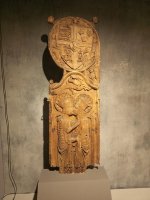
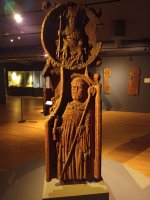
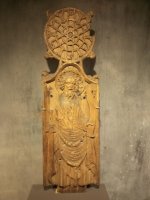
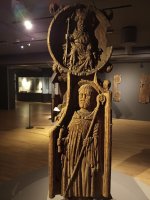
The story of Ólavskirkjuni and theese pew ends is interresting. The church albeit small was the cathedral of the bishopric of the Faroe Islands. In medieval times Greenland and the Faroes had one bishop each and Iceland had two though the population of each bishopric was very small by international standards. Communications were bad and the only way to run the clerical organisation was to do it on site.
Kirkjubøur was at the time a significant village dominated by the bishop's mansion. The land was fertile and there were flat fields stretching far out into what is now the sea. There was also some sort of cathedral school.
Anyway the bishopric was small and sparsely populated with an estimated population of 5000 so when the new cathedral of saint Mary (later of saint Olaf) that is Ólavskirkjan was built on the site of an older cathedral, likely around 1250 it became no more than 7,5 metres wide by 21,8 metres long. The lime was burned from local seashells and how they burned lime in a treeless land is a mystery to me.
Around year 1300 a larger gothic cathedral of saint Magnus now known as Múrurin (the masonry) was begun. Money run out and the building was left unfinished. In the 1420-s or threabout the pew ends were ordered from Norway likely intended for Múrurin. It seems they got some sort of roof on the building before money run out again and it was abandoned and left to crumble.
The old small cathedral remained in use and that was were the pew ends came to be used.
At the time of the reformation in the mid 16th century the bishopric was disolved and Ólavskirkjan became an ordinary parish church for the parish of Kirkjubøur (fields of the church).
As with most other parishes in the Faroes there was no resident vicar so some local read the service when the ambulatory vicar wasn't present.
Kirkjubøur became Danish state property and the farm was leased out to the Patursson family who run the main farm to this day and live to some extent in what is left of the bishop's mansion.
The bishop's mansion had been destroyed by some natural disaster in the 14th century and atop of the stone basement a log building was erected. This building known as stokkastovan and was apparently built partly from Norwegian timber and partly from driftwood around 1350. Some old timbers from the old bishop's mansion and possibly from some old stave church were also used in this improvised building which was obviously intended for some other site as none of the measurements fit the old basement. The building was much longer but in the early 1800-s the inland end was torn down. Only a decade or two before people started to take an interrest in medieval buildings.
I am fortunate to know enough of the faroes language to read what is published online. For instance
https://www.tjodsavnid.fo/naer-var-mururin-bygdur
By the way Olav Digre (Olav the fat) as we non-religious people know him was a ruthless viking. According to some sources he was one of the leaders of the viking gang who made London Bridge fall down. Which the English sing about to this day. In all likelyhood he was killed following due legal procedure for killing a king who had been found guilty of violating the rights of the people of Tröndelag. Yet he became saint Olav. What a pity.