• Hi all and welcome to TheWoodHaven2 brought into the 21st Century, kicking and screaming! We all have Alasdair to thank for the vast bulk of the heavy lifting to get us here, no more so than me because he's taken away a huge burden of responsibility from my shoulders and brought us to this new shiny home, with all your previous content (hopefully) still intact! Please peruse and feed back. There is still plenty to do, like changing the colour scheme, adding the banner graphic, tweaking the odd setting here and there so I have added a new thread in the 'Technical Issues, Bugs and Feature Requests' forum for you to add any issues you find, any missing settings or just anything you'd like to see added/removed from the feature set that Xenforo offers. We will get to everything over the coming weeks so please be patient, but add anything at all to the thread I mention above and we promise to get to them over the next few days/weeks/months. In the meantime, please enjoy!

Faroese Carvings

Tiresias

Nordic Pine
Joined
Sep 3, 2020
Messages
618
Reaction score
99
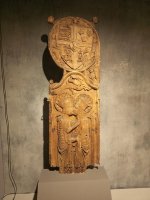
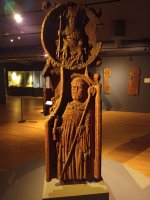
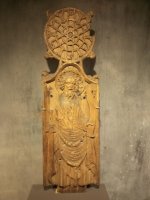
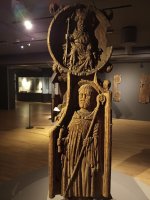
Some may be interested in these. 1400's from a church, Ólavskirkjan in Kirkjubøur.

IMG_20231022_142745_312.jpg

IMG_20231022_142908_957.jpg

IMG_20231022_142828_699.jpg

IMG_20231022_142059_034.jpg

Number of other photo', including some of a seyðurslaktir (sp.? Faroese is incomprehensible), which I might need to run by the mods. Not suitable for veggies, or sensitive souls.
 
Tiresias":1slm4zw1 said:
Number of other photo', including some of a seyðurslaktir (sp.? Faroese is incomprehensible), which I might need to run by the mods. Not suitable for veggies, or sensitive souls.

Go on do it. You know you want to :lol: :lol: :lol:

Nice fine work carving.
 
What's the story behind the first one? Can't say I have ever seen a sculpture of two people snogging in a church before!
 
AndyT":uh9umml2 said:
What's the story behind the first one? Can't say I have ever seen a sculpture of two people snogging in a church before!

More to the point, what are they doing with their hands!
 
We are all grown up and mature here and I guess these carvings are on public display so please share.
 
The story of Ólavskirkjuni and theese pew ends is interresting. The church albeit small was the cathedral of the bishopric of the Faroe Islands. In medieval times Greenland and the Faroes had one bishop each and Iceland had two though the population of each bishopric was very small by international standards. Communications were bad and the only way to run the clerical organisation was to do it on site.

Kirkjubøur was at the time a significant village dominated by the bishop's mansion. The land was fertile and there were flat fields stretching far out into what is now the sea. There was also some sort of cathedral school.
Anyway the bishopric was small and sparsely populated with an estimated population of 5000 so when the new cathedral of saint Mary (later of saint Olaf) that is Ólavskirkjan was built on the site of an older cathedral, likely around 1250 it became no more than 7,5 metres wide by 21,8 metres long. The lime was burned from local seashells and how they burned lime in a treeless land is a mystery to me.

Around year 1300 a larger gothic cathedral of saint Magnus now known as Múrurin (the masonry) was begun. Money run out and the building was left unfinished. In the 1420-s or threabout the pew ends were ordered from Norway likely intended for Múrurin. It seems they got some sort of roof on the building before money run out again and it was abandoned and left to crumble.
The old small cathedral remained in use and that was were the pew ends came to be used.

At the time of the reformation in the mid 16th century the bishopric was disolved and Ólavskirkjan became an ordinary parish church for the parish of Kirkjubøur (fields of the church).
As with most other parishes in the Faroes there was no resident vicar so some local read the service when the ambulatory vicar wasn't present.
Kirkjubøur became Danish state property and the farm was leased out to the Patursson family who run the main farm to this day and live to some extent in what is left of the bishop's mansion.

The bishop's mansion had been destroyed by some natural disaster in the 14th century and atop of the stone basement a log building was erected. This building known as stokkastovan and was apparently built partly from Norwegian timber and partly from driftwood around 1350. Some old timbers from the old bishop's mansion and possibly from some old stave church were also used in this improvised building which was obviously intended for some other site as none of the measurements fit the old basement. The building was much longer but in the early 1800-s the inland end was torn down. Only a decade or two before people started to take an interrest in medieval buildings.

I am fortunate to know enough of the faroes language to read what is published online. For instance
https://www.tjodsavnid.fo/naer-var-mururin-bygdur

By the way Olav Digre (Olav the fat) as we non-religious people know him was a ruthless viking. According to some sources he was one of the leaders of the viking gang who made London Bridge fall down. Which the English sing about to this day. In all likelyhood he was killed following due legal procedure for killing a king who had been found guilty of violating the rights of the people of Tröndelag. Yet he became saint Olav. What a pity.
 
Faroese is a funny language. As it was told to me, some nutter called Venceslaus Ulricus Hammershaimb came up with a written version (prior to that it was an oral language), based on his understanding of Old Norse/Norn, which only bears a limited relationship to how it is spoken.

There is a letter ð that appears to have no sound at all; but seems to be in just about every other word. Except occasionally when it is associated with a g, in which case it is pronounced r. Or the other way round. Basically, you can’t tell how a word is pronounced from how it is written. Far worse than the odd bits of English which non-native speakers find tricky. Or Scottish for that matter.

Once you get past that, and just listen to it, it seems to me to have a fair amount in common with most Germanic/scandi languages. Which will horrify philologists but works from a practical point of view. Incidentally, we have some German friends who came to stay with us in Sweden and maintained that Swedish is just German pronounced badly. Whereas our Swedish friends have it the other way round.

The two frisky bints are in fact the BVM and Elizabeth (mother of John the Baptist, in pod fairly late in life). So, nothing salacious there. And, indeed, one of the carvings is Olav the Mighty.

As I was told it Kirkjubøur was a settlement that was only established because that was where all the driftwood (building material) and sea weed (fertiliser) washed up. They did appear to be a bit strapped for resources.

What I was going to ask the mods about was the seyðaslaktir (I hope I have that right). The sheep are slaughtered each year in September/October. Generally timed to coincide with the half term, so the children can help. For the urban folks in the massive metropolis that is Tórshavn they have this event in the town square, where sheep and cattle are butchered and cut up. This is not publicised in any way (perhaps they have got fed up with the pelters they get for the whale thing), and we would not have known about it if we hadn’t shared a taxi with a Faroese man from the airport.

Once killed, the carcasses were butchered on site. Children were bouncing up and down on a cow’s stomach like a space hopper. And young children were helping stretch out the intestines, under fairly lax supervision. I don’t think you have lived until you have seen a toddler wandering around with a dead sheep’s heid with blood dribbling down a white puffa jacket. The parents were sublimely unconcerned. I think it is a brilliant idea: if you eat meat you should know where it comes from. If you then want to be a veggie, then OK.

I have photographs, but some may find them distressing. Which is why I was going to ask.
 
In order not to upset the squeamish who might accidentally happen upon the post if these photos are available off site than perhaps you could provide a link for those who would like to see them. I for one.
 
This is how I have been told:
The pronounciation of the faroese language varied hugely between villages and islands in the 19th century before ferries and roads. While words and grammar were largely the same people from different islands could barely understand each others because of pronounciation differences.
People were also fiercely local partiotic and would not accept their own language being spelled according to the pronounciation in another valley.

Hammershaib's solution was to go backwads in time and try to figure out how each word may have sounded before pronounciation diverged and spell it according to that. While words and grammar closely follow the spoken language.
Theese days people move around more and the pronounciation differences though still significant have schrunk to the point that a more phonetic spelling would be practicable. However they are stuck with the spelling they have.
So I was told anyway.

For an ordinary Swede speaking standard Swedish the faroece language is totally impossible to understand except a few words here and there. However I live in Österbotten in Finland where we speak a number of very local very oldfashioned dialects which someone from for instance Stockholm cannot understand at all. Both in words and grammar we have quite a bit of old Norse left. Such as went out of use in Stockholm in the 13th and 14th centuries. Which in turn means that for me it didn't take much effort to learn to understand faroese. Some 8 or 9 faroese words out of 10 exist either in standard Swedish or in one or another of the Swedish dialects in Österbotten.
Icelandic is a bit more difficult and I haven't really put any effort into learning it but I usually get a fair idea of what they are saying though I certainly miss plenty of details.
 
Back
Top