• Hi all and welcome to TheWoodHaven2 brought into the 21st Century, kicking and screaming! We all have Alasdair to thank for the vast bulk of the heavy lifting to get us here, no more so than me because he's taken away a huge burden of responsibility from my shoulders and brought us to this new shiny home, with all your previous content (hopefully) still intact! Please peruse and feed back. There is still plenty to do, like changing the colour scheme, adding the banner graphic, tweaking the odd setting here and there so I have added a new thread in the 'Technical Issues, Bugs and Feature Requests' forum for you to add any issues you find, any missing settings or just anything you'd like to see added/removed from the feature set that Xenforo offers. We will get to everything over the coming weeks so please be patient, but add anything at all to the thread I mention above and we promise to get to them over the next few days/weeks/months. In the meantime, please enjoy!

From across the pond Florida USA

Biotec

Seedling
Joined
Sep 24, 2026
Messages
12
Reaction score
8
Location
Ocala Florida USA
Name
Joe
LOCATION
Ocala FL USA North Central Florida
I have spent my last 28 years doing mechanical engineering And building automation for control of air conditioning heating and ventilation systems.

...Over the last 50 years I've dabbled in woodworking or maybe more carpentry work building project specifically we need at the time But now it's getting closer to becoming hobby work and less about work real work. A paid job.

About 25 years ago I started collecting some of my own woodworking tools like table saw miter saw Hand tools But prior to that I had worked on and maintained a lot of woodworking tools for others And enjoy the challenge of working on machines that work nearly as old or older than I am.
In reality I didn't take a lot of pictures of stuff back then because it would have been fil and recently got into actually focusing on taking pictures of some of the work I work on in the last 15 years the reality was it was more geared toward engineering and not toward woodworking.

I also participate in number of other forums Mostly in America but they are worldwide organizations.

What I have noticed on the last number of years is lack of good constructive conversations about dust management Just collection dust extraction From the tools that we like to use.

They work in what I consider a fairly small space About 200 square feet or a 10 by 20 garage single ingress aggressive point is the garage door itself.
Single electrical outlet to work from In my particular case it's a singal 110 volts socket because that's what the garage is wired for. It's a rental garage cannot be altered or change therefore the downside is no heating and no cooling. A large floor fan garage door open and most of the tools get used out in the driveway apron.

Also in 2019 recently I received some of my father's tools that he had They have been added to my small collection.

February of this year 2026 I retired at 70 years old And now I'm making woodworking my full time hobby.
Live in north Central Florida Between Gainesville and Ocala Florida USA.
Work for a university the division I was in with agriculture.
 
welcome - your garage sounds a bit bigger than mine however when we re-wired it (and the adjoining shed we added over 90 sockets - so now I have red ones for power tools (can be isolated) / white for charging or power computers etc. and blue for fridges and freezers... no idea how you manage from just one socket!
 
@akirk
It has a lot to do with managing electrical loads.

Example table saw has to be up to full speed before another electrical motor begins to start is a both start at the same time the breaker trips.

For myself my dust collection system has time delay built so it can't start at the same time as sees the current sensing.
the table saw or whatever the load is like planer has come up to speed And then it starts, overall current drops off leaving a reasonable amount of margin for working loads.

Also the joy of managing appropriate size extension cords. Also keeping and choosing them as short as possible.
Example would be 8, 15, and 25 foot long extension cords either in heavyweight or lightweight wire size.

The other challenge compared to the two countries North America uses 120 Volt systems versus Europe using two 220 Volt.
Real challenge involved is wire size comparison of the two areas drop the voltage increase the current So since the voltage is half half of 220 Then the current is double.
Tools running wattage remains constant in either voltage.

Then there's the debate switching to the metric system.

Most Road vehicles and machinery are using metric. The worst part of all is even to this day some manufacturers because how they outsource parts have a mix.

Toward the end of my career having to work between metric and American Standard was becoming more challenging because equipment is sourced from all over the world or maybe the reverse is sold all over the world that must meet the other countries requirements.

Joy of woodworking, You have to have some mechanical skills, comprehension of electrical and the willingness to continuously learn.
 
it is a good thing that you have the knowledge to keep an eye on it!
I think I would struggle - I am very much of the - hit a switch and expect it to work - personality!
 
@akirk

It's actually as easy as you would like. You can only drive one table saw or one Band saw or other tool at a time is when you need something extra go to go with it you have to think about it like dust collection as I mentioned or a large shop Fan but in general each one of the tools is within the electrical circuits capability.. Reality is how often you really need two large motors running at the same time.

From the people I have met either in person or online most of us work in the shop by ourselves. most of the time, therefore there's no need for two large motors running at the same time.
 
I think you are right, however, it possibly varies from place to place...
In my workshop - I have a large wine storage fridge in the corner which runs continuously
I also may well be using the CNC and the laser to put out jobs at the same time as spinning up the lathe or bandsaw etc.
I do sometimes also have others in there, so there may then be an additional machine running which they are using...
In addition I have an area for battery charging / laptops running / a shop vac / dust extraction / laser fumes extraction
So, can easily end up with c. a dozen of plugs being used simultaneously...
 
Welcome Joe!

Around 1987, my wife and I were invited to a friend's brother and family in Ocala for Sunday lunch. We drove up from Orlando, but were extremely late for the church service where we were to meet, because of an apparently-endless freight train, triple-headed, if I remember, that actually couldn't make the grade just south of town.

Like an idiot I sat and waited for ages at a level crossing (the three engines should have been a clue!), until we watched, incredulously, as the train stopped and started rolling backwards! At that point I did do a U-turn, ansd we found an empty level crossing further along the line, before the train, now continuing backwards, reached it.

My understanding is that the highest point in Florida is 300 feet above sea level, and it's not near Ocala!


Anyway, On electrickery:

The consumer mains supply in the UK is 240V AC per phase. The EU, which we used to belong to, suggested 'harmonizing' this with the Continental 220V, by declaring both to be 230V. So you will see 230V on products and in official documents, although nothing has changed at a practical level.

Our mains is 240V per phase (WRT neutral), or 3-phase at 415V between phases. In the UK (and probably most of the wealthier parts of continental Europe), three phase normally runs along a road, with the properties each getting a single phase of that in rotation, the idea being that the three phases' demand wil be roughly similar, and thus the grid stays reasonably balanced, with low neutral currents.

Because 3-phase is present almost to the end of the line, It's fairly easy to get a three-phase supply (you'll still be charged a significant amount, but it's usually do-able). We have a large-ish older property in an urban setting, which has three phase into the house (almost right up to our consumer unit), even though we only use a single phase of it. This is uncommon, but not unheard of.

The UK and the rest of Europe contrast very favourably with American consumer suppplies: Most US residential properties get two (out of three) phases. This gives 120V WRT neutral for a single phase, but 240V across two phases, used for heavy power demand, such as HVAC, water heaters and so on. In residential suburbs you rarely see three phase supplies since the pole transformers and the cabling are configured to deliver two phases only, normally. It's a real nuisance for running induction motors, since the extra cost of running the extra phase to the property makes three-phase equipment uneconomic (not true of industrial and commercial premises, obviously).

Then there's the other issue, that, even if you could operate three-phase equipment, it would still only be 240V, compared to the 415V available here. The long and short of it is that US electricity distribution largely sucks at the consumer end.

Historic note: In the late C19th, Edison pioneered electricity in homes, with the awkward 110V DC system (hard to make and switch, and totally unsuitable for long distance power distribution). The 120V AC system was implemented piecemeal from the 1920s onwards, with the initial de facto 'standard' imposed as a result of lobbying by the copper industry (much better for the copper business, as lower voltages need much more copper for a given power). To my surprise, Googling says that 120/240V didn't become a proper national standard until the 1960s, which is amazing, considering the US put men on the Moon in the same decade.

Anyway, the first thing I would do is investigate the possibility of getting three phase supplied to the property. The power company will probably refuse, but it doesn't hurt to inquire. Running 3 phase motors will be more efficient, and give quieter and smoother running. Obviously not every saw table, etc. can be converted, but things like dust extractor fans are simple and it ought to be more straightforward.

There's no magic bullet for this either. I don't know the details of two-phase operation (you'd expect the two phases to come into the pole transformer so as to remove the neutral reference (i.e. Live+Live+Neutral) and replace it with a single Live+(arbitrary)Neutral, more like the British system, but at the end of the day you're still stuck with nominally 240V, at best.

Don't run things on extension cords, and do buy the heaviest duty copper cables you can reasonably afford. Chinese cable manufacturers are using both aluminium ("aluminum") and steel now, electroplating over both to look like copper. Aluminium is insufficiently ductile to last (it will snap), and steel has much higher resistivity than copper -- both are a cheap and nasty substitute and will give trouble.

Take similar care over the built-in wiring. Wherever you can use 240V circuits in the workshop, do so.

Hope the above is of interest...
 
Last edited:
@Eric the Viking
thanks
I know Florida reasonably. I was well born and raised here and I believe the area you were referring to about the trains it's still an issue to this day is called Wildwood and it is still a major train hub so sometimes people think that it can't make the grade it's actually just trying to break the train up to add or remove cars from it... for CSX the average track grade is near 0% to 0.5%. Florida is one of the flattest states in the country.

Florida East Coast Railway running up and down from Jacksonville to Homestead The longest freight trains on the Florida East Coast Railway (FEC)—often referred to by railfans in the region—frequently reach lengths of roughly 13,800 to 14,000+ feet (over 2.6 miles long) and consist of 210 to 237 intermodal rail cars. Then there's the stupidity factor that people try to beat the train across the tracks whether it be with a car or a truck and lose. That may end up blocking major intersections for hours.

Back at that time because of engine power train length wasn't very long Nowadays it is now unusual to see them Over 10,000 feet two miles long as one. a train sometimes with Three or four power units in the beginning one the middle and one toward the end.
this is from may 2022 the yard is 1.5 miles long Still active to this day. US Route 301 Which goes down to Orlando up to Ocala Gainesville and eventually to Jacksonville US301 now has a bridge going over the tracks so you can't get trapped.

Florida is flat Yes we do have some hills and little valleys but they're 30 to 40 feet at the most.

Over the years the tools that I have acquired were bought because of mobility to workout the trailer Work at other friends places or my mother's house or my brother's Empower requirements always require everything to be at 120V.

Rental garage doesn't leave me much choice of where I can get the power One outlet and that's about it Technically there's one ceiling for the garage door opener but on the same circuit.

The other challenge is no opportunity for a real cabinet saw due to high current horsepower.

examples
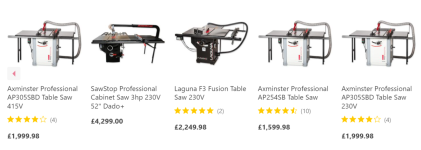
1790692159658.png

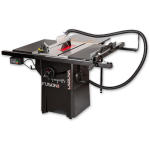
1790692396665.png 1.45kkw or 2 hp at 230volt
this would a nice choice. more info at Laguna table saw at ax minister tools uk £1,149.98 or in Florida dealer at US$1,399.00
In North Florida

Woodcraft Jacksonville 542​

11160 Beach Blvd
Suite 121 Jacksonville, FL 32246 USA

1,149.98 Pound sterling equals
1,520.85 United States Dollar

So if and when I buy a new piece of equipment Power is to be considered.

Otherwise have a Grand Day
 
Last edited:
Depends on the type of stuff you make, but you'll find that there's a couple of us (moi inc) on WH2 who have no use for a tablesaur and use a bandsaw(s) instead. I've had two tablesaurs and have got rid of them - Rob
 
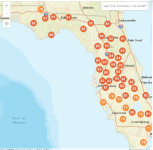
For others who are interested in Florida's weather for today and current conditions.

This map is provided by the University of Florida college of Institute Food Agricultural Science.
With small to large research sites scattered across the state.
The place I worked at for last 28 years.

1790694446700.png

This is the group I worked at for 28 years https://fpo.ifas.ufl.edu/

And here's the information on what I did when I retired February this year

I spent the majority of my life in around agriculture And I have watched a change.
when I was young at 14 years old I worked on a farm during the summer The tractor was a massive Ferguson 35 horsepower It was adequate for BL small peanut combine and Hay bailing.
They have changed Considerably over the years.
The average good-sized farm tractor in the 1960s had an engine output of 35 to 60 horsepower (HP), though larger row-crop and to high-horsepower models ranged from 70 to over 100 HP.
Florida Average Farm Size: According to the USDA National Agricultural Statistics Service, the average farm size in Florida is approximately 220 hp.

Research and Education Centers (RECs)
These centers host off-campus faculty, laboratories, and specialized research facilities:

Citrus REC: Lake Alfred

Everglades REC: Belle Glade

Florida Medical Entomology Laboratory: Vero Beach

Fort Lauderdale REC: Fort Lauderdale

Gulf Coast REC: Balm & Plant City

Indian River REC: Fort Pierce

Mid-Florida REC: Apopka

North Florida REC: Marianna & Quincy

Range Cattle REC: Ona

Southwest Florida REC: Immokalee

Tropical REC: Homestead

West Florida REC: Jay & Milton.
To drive from Gainesville home campus to the Furthest Point South Homestead campus was approximately seven hours of continuous driving.
Or to drive NW from Gainesville to West Flora campus was 7 hours of driving.

I travel to these sites on a regular basis Site inspections mechanical inspections New projects new construction.
The challenges and to work with always enjoyable Sometimes it got difficult because of monotony of driving but ultimately it was a great place to work at.
 
@Woodbloke

I thought about a year ago a DeWalt DWE 7485 For doing small work It has a eight and quarter inch blade There is UK equivalent to it The top is approximately 19 inches by 19 inches so therefore small light enough to lift off the floor set on the bench use it and put it back down.

I do have a larger table saw as portable considered a construction style saw. in the last year spent more time sitting relegated in the corner of the trailer than being used It is a rigid TS2400-01 About 24 years old Still works OK does not have much market value so therefore I just go ahead and hang on to it. I have the space to stored at the moment.

At the moment I am doing toy model work I spend what time doing and only use the small table saw to break the parts down to go on scroll saw.
The German version of the Hegner 18 inch From 1997. I have a small band saw and a larger band saw pretty much keep different size blades on them.

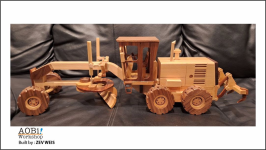
This is my current project that I'm working on
1790698988967.png
The original author also has videos on Youtube on how to make them About 30 videos and 40 some different models

420mm L x 140mm H x 120mm W
The plans are all in metric and have to print out A4 paper Not a very common size here in the USA.

I find with this hobby of making these Large wood toys. I end up using majority of my woodworking tools.
These are template style plans but still require a lot of patience And find detailed work.

I been buying rough milled wood ends , cut, plane to shape.

I've built a fair number of cabinets in my younger days And I've built some furniture for out on the deck But that is the past.
Really not enough workspace for assembly easily.

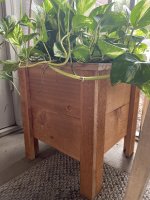
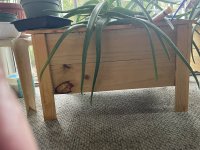
planter boxes from free on plans made these last summer In this case the need for a table saw.

IMG_9312.JPG..

IMG_9314.JPG..

If someone wants the plans I'll find the link Post them.
 
hello @duke On another forum I had posted a series Links to other woodworking forms mostly North America A few others and another Canadian sent me the link for this site.
Have a grand day.
 
Last edited:
Back
Top