• Hi all and welcome to TheWoodHaven2 brought into the 21st Century, kicking and screaming! We all have Alasdair to thank for the vast bulk of the heavy lifting to get us here, no more so than me because he's taken away a huge burden of responsibility from my shoulders and brought us to this new shiny home, with all your previous content (hopefully) still intact! Please peruse and feed back. There is still plenty to do, like changing the colour scheme, adding the banner graphic, tweaking the odd setting here and there so I have added a new thread in the 'Technical Issues, Bugs and Feature Requests' forum for you to add any issues you find, any missing settings or just anything you'd like to see added/removed from the feature set that Xenforo offers. We will get to everything over the coming weeks so please be patient, but add anything at all to the thread I mention above and we promise to get to them over the next few days/weeks/months. In the meantime, please enjoy!

Haul of hand planes

I am quite disappointed tbh Andy, probably I could and should have been a bit kinder to it but as it progressed I thought it's never going to be worth collecting and I got carried away trying to get the main pits down. With hindsight I should have tried electrolysis before resorting to coarse abrasives. Anyway it is what it is now now matter how much I regret it. :oops:

Any ideas why the lack of blade clearance in the mouth? The only thing I can think of is the blade being too thick or the angle is wrong, the only way I can see him using it is if he had a packer behind to increase the angle though nothing was present, or perhaps I just have brain fog and the answer is obvious. It wouldn't be the first time. :?
 
I'd say that the very fine mouth is evidence that this plane was used as a very fine-set smoother, taking off tissue-thin shavings only. I wouldn't open it up at all.
 
AndyT":3cv3j1c9 said:
I'd say that the very fine mouth is evidence that this plane was used as a very fine-set smoother, taking off tissue-thin shavings only. I wouldn't open it up at all.
Dunno Andy, that mouth is really, really close; even for a finely set smoother it could be a smidge wider - Rob
 
As a non-plane user I'm struggling to visualise how the mouth opening can affect the shaving thickness.
I'd have thought it would solely (see what I did there!) depend on the blade projection?

Please be gentle with my obvious ignorance :D

Bob
 
9fingers":1dizb9s9 said:
As a non-plane user I'm struggling to visualise how the mouth opening can affect the shaving thickness.
I'd have thought it would solely (see what I did there!) depend on the blade projection?

Please be gentle with my obvious ignorance :D

Bob

It's like this. Conventional wisdom, which I don't want to debate here, says that a very fine mouth helps prevent tear-out, as the shaving is held down as much as possible by the foward edge of the mouth opening. There's no room for a split to develop and run ahead of the cutting edge of the iron. The closer the edge of the mouth is to the cutting edge of the iron, the better the tear-out prevention.

However, there's a compromise at work too. The gap must be wide enough to let the shaving through. If you set a plane up to have a very narrow mouth, it can only take very thin shavings. Try a thicker shaving and it will jam.

So a very fine mouthed plane is a specific tool for final surface clean up only. You need a different plane, with a wider mouth, to get the pieces to the sizes you want.

Bob (Lons) have you managed to get it to cut at all with the iron that's in it?
 
AndyT":23upz2hs said:
9fingers":23upz2hs said:
As a non-plane user I'm struggling to visualise how the mouth opening can affect the shaving thickness.
I'd have thought it would solely (see what I did there!) depend on the blade projection?

Please be gentle with my obvious ignorance :D

Bob

It's like this. Conventional wisdom, which I don't want to debate here, says that a very fine mouth helps prevent tear-out, as the shaving is held down as much as possible by the foward edge of the mouth opening. There's no room for a split to develop and run ahead of the cutting edge of the iron. The closer the edge of the mouth is to the cutting edge of the iron, the better the tear-out prevention.

However, there's a compromise at work too. The gap must be wide enough to let the shaving through. If you set a plane up to have a very narrow mouth, it can only take very thin shavings. Try a thicker shaving and it will jam.

So a very fine mouthed plane is a specific tool for final surface clean up only. You need a different plane, with a wider mouth, to get the pieces to the sizes you want.

Bob (Lons) have you managed to get it to cut at all with the iron that's in it?

Thanks Andy makes sense!
 
I tried with the original blade Andy, I haven't sharpened or altered it and the blade actually touches the front of the mouth so no clearance and the shavings I made just stuck to the sole so something has moved or changed as the guy clearly used it a lot looking at the amount of blade wear. I managed decent shavings using the slightly thinner tapered Lewis blade so I need to look at it more closely. I won't touch the mouth until I decide on the blade to use and even then only as a last resort.
 
No problem Sam but thanks anyway, it's very kind of you to look, I have a load of blades now and thing one of the tapered ones will work but if not there are a few parallel examples around without having to pay a fortune.

That bedrock plane sounds very nice I'll have to have a nosey next time I see you.
 
For rust removal I like evaporust, its expensive at £30 for 5l. Its really good with more delicate items like threads that could get damaged on say a wire wheel.
Hydrochloric acid mixed with water is also good, it can be a bit aggresive if left too long on steel parts.
 
Progress so far.

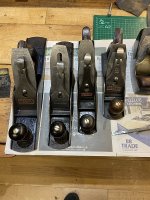
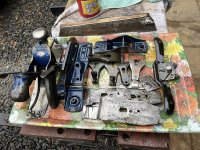
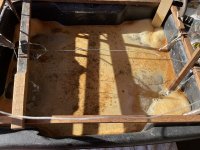
All stripped down and metal parts into electrolysis bath, lightly cleaned with wire brush and 000 wire wool then protected with duck oil, handles lightly cleaned and glued back together then linseed oiled, I've finished 4 planes so far though a couple of blades still to sharpen. Several planes still in bits waiting for attention.

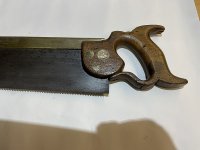
Similar treatment to the tenon saw which still cuts well before sharpening, that might be a while away, :)
 

Attachments

  • IMG_1180.JPG
    IMG_1180.JPG
    56.3 KB · Views: 1,420
  • IMG_1181.JPG
    IMG_1181.JPG
    68.6 KB · Views: 1,420
  • IMG_1182.JPG
    IMG_1182.JPG
    97 KB · Views: 1,420
  • IMG_1159.JPG
    IMG_1159.JPG
    137.9 KB · Views: 1,420
  • IMG_1154.JPG
    IMG_1154.JPG
    135.6 KB · Views: 1,420
  • IMG_1116.JPG
    IMG_1116.JPG
    178.1 KB · Views: 1,420
  • IMG_1100.JPG
    IMG_1100.JPG
    210.9 KB · Views: 1,420
  • IMG_1099.JPG
    IMG_1099.JPG
    119 KB · Views: 1,420
  • IMG_1095.JPG
    IMG_1095.JPG
    241.9 KB · Views: 1,420
Lons":2covfm0u said:
All stripped down and metal parts into electrolysis bath, lightly cleaned with wire brush and 000 wire wool then protected with duck oil

I've always been amazed by how much oil can be pressed out of a duck, much more than a peacock. I've been told it's the oiliness of the duck that allows them to float on water so easily.
 
I reckon that lot are looking exactly right. No longer neglected, but well cared for, without taking away all the signs of respectable age.
 
Excellent!
Nothing is more satisfying than giving old rusty tools a new life.
I assume that you will be showing these to the lady who gave them to you?
 
I have a saw that looks just like yours, I filed it for rip and hardly use my others these days.
 
Thanks guys I'm pleased with them and still a few more to finish including the compass plane, I saw the old lady just before Christmas but she can barely remember the planes as she seems to have signs of early dementia sadly.
 
That's a very resto job! I've not tried electrolysis for rust removal. Will have to give it a try!

Sent from my Pixel 4a using Tapatalk
 
That's a fine job done. It constantly amazes me how many good old tools are out there, even with all the renewed interest in hand tools.

Not tried electrolysis before, I'll have to try it out.

Sent from my Pixel 4a using Tapatalk
 
MrH":1j5pjktc said:
That's a fine job done. It constantly amazes me how many good old tools are out there, even with all the renewed interest in hand tools.

Not tried electrolysis before, I'll have to try it out.

It's fairly easy to do and very, very effective at getting rid of rust, even when the rust is very thick. There are some pictures of some electrolytic derusting I did here: https://www.cgtk.co.uk/metalwork/bandsa ... /baseframe - if you click on the first photo and look closely at the join, you can see how thick the rust was.

For most more civilised levels of rust, I find citric acid to be much less hassle (it's very cheap to buy as powder). Mix the powder with some hot water (doesn't have to be hot, but the reaction is quicker with hot water) and dunk your rusty part in the liquid. Leave for a length of time that depends on the thickness of the rust, the water temperature and the concentration of citric acid but let's say an hour. Then brush it off, dry it and oil it.
 
Thanks! I've done the vinegar trick with success, coca cola too. I like the science bit with the electrolysis, might be able to get the kids interested.

Sent from my Pixel 4a using Tapatalk
 
MrH":115m3g4z said:
Thanks! I've done the vinegar trick with success, coca cola too. I like the science bit with the electrolysis, might be able to get the kids interested.

Sent from my Pixel 4a using Tapatalk

Yep, vinegar works too (but smells a lot worse than citric acid and is arguably a bit harder to heat compared to pouring a kettle of boiling water over citric acid).

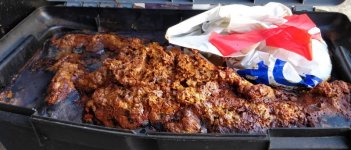
Vinegar also seems to produce a lot more in the way of nasty gunk - this was a vice that I was in the process of derusting with vinegar:

vinegary_gunk.jpg

(the plastic bag is full of bricks just as a space filler to reduce the volume of vinegar needed to cover all the bits).
 
Wow! That's messy!

Sent from my Pixel 4a using Tapatalk
 
Back
Top