• Hi all and welcome to TheWoodHaven2 brought into the 21st Century, kicking and screaming! We all have Alasdair to thank for the vast bulk of the heavy lifting to get us here, no more so than me because he's taken away a huge burden of responsibility from my shoulders and brought us to this new shiny home, with all your previous content (hopefully) still intact! Please peruse and feed back. There is still plenty to do, like changing the colour scheme, adding the banner graphic, tweaking the odd setting here and there so I have added a new thread in the 'Technical Issues, Bugs and Feature Requests' forum for you to add any issues you find, any missing settings or just anything you'd like to see added/removed from the feature set that Xenforo offers. We will get to everything over the coming weeks so please be patient, but add anything at all to the thread I mention above and we promise to get to them over the next few days/weeks/months. In the meantime, please enjoy!

Making an iron for a moulding plane

rxh

Sapling
Joined
Nov 29, 2020
Messages
270
Reaction score
370
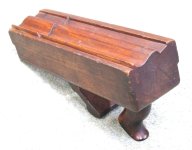
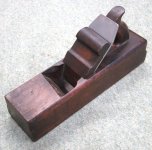
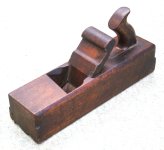
The owner of this plane likes to collect Irish tools or tools with an Irish connection. It is marked “Booth – Dublin” but sadly it had no iron. It is quite a beast as the mouth opening is a little more than 2 5/8” wide (~67mm). I offered to make a new iron and this is how I did it.
IMG_8436.JPGIMG_8437.JPG

The boxing of the plane was loose and I secured it back in place using liquid hide glue.
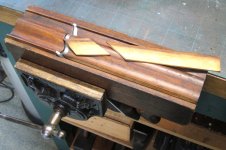
IMG_8457.JPG

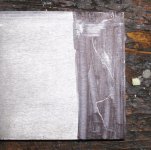
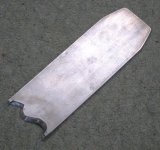
I cut a piece of 70mm x 4mm O1 steel to a suitable length then ground it to the required width, then shaped the upper end with hacksaw and file. I blackened the “cutting” end of the blank with a marker pen and secured it in the plane using the wedge, projecting about 5mm from the lowest part of the sole. Then I scribed a line, following the contour of the plane.
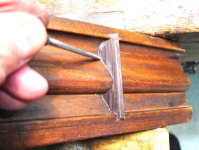
IMG_8438.JPG
IMG_8439.JPG

Next, I repositioned the iron with almost no projection below the lowest part of the sole and scribed a second line.
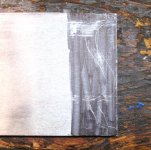
IMG_8440.JPG

I removed as much as possible of the waste with a hacksaw.
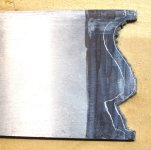
IMG_8441.JPG

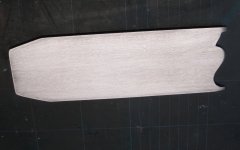
Then I filed to the second scribed line.
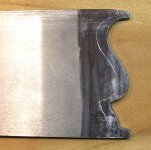
IMG_8442.JPG

This is how it now looked in position in the plane.
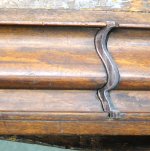
IMG_8443.JPG

Using files, I shaped the chamfer, taking care not to come quite to a sharp edge at this stage.
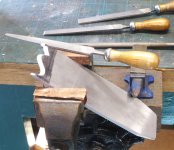
IMG_8444.JPG
IMG_8445.JPG
IMG_8446.JPG

I used a charcoal barbecue urged on with a hot air gun to raise the iron to red heat. When a magnet would no longer stick to it (i.e. the Curie point had been reached) I quenched it in cooking oil. Then, I cleaned it up and tempered it in the domestic oven at 200 deg. C for an hour.

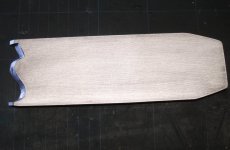
The final shaping and sharpening operations were done with a Dremel tool, diamond needle files and oilstone slips.
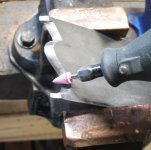
IMG_8456.JPG
IMG_8461.JPG

Here, the sharpened iron is in place in the plane.
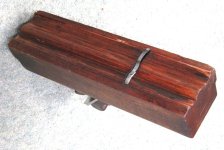
IMG_8458.JPG

As I had no suitable wood of the right thickness to hand, I cramped three pieces of wood together in the vice in order to try cutting a moulding.
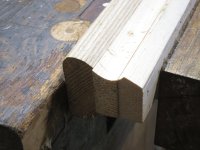
IMG_8462.JPG

The finished plane.
IMG_8459.JPG
 
Wow, what a tremendous job! Though I can't quite believe it's as easy as you make it sound.

And you really need an RXH maker's mark on the top of the iron, then it would be perfect...
 
  • Like
Reactions: rxh
Wow, what a tremendous job! Though I can't quite believe it's as easy as you make it sound.

And you really need an RXH maker's mark on the top of the iron, then it would be perfect...
Thanks Andy - it was mainly a matter of careful filing and grinding.
 
Never thought a charcoal barbecue could be used as a forge.
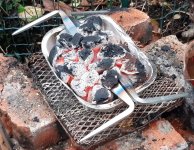
Yes, it can work very well. The hot air gun really gets it going. I prefer to use real charcoal rather than the briquettes as I feel it burns hotter (I have no scientific evidence for this). Here is a photo of a small barbeque being used to heat treat drawknife irons.
20201112_132011A.jpg
 
I've seen Pete Maddex do that, at Lurkers, IIRC. Or it might have been mine, I can't remember. He can be a bit of a fire demon when he has to be...
S
 
  • Like
Reactions: rxh
I've seen Pete Maddex do that, at Lurkers, IIRC. Or it might have been mine, I can't remember. He can be a bit of a fire demon when he has to be...
S
Yeah you are correct, we used her majesty’s hair dryer* as a blower.

Done the same thing many times since, usually whilst she cooks the roast, so as to utilise the cooling oven to temper.

*was an old one…..I’m not that stupid!
 
As it looks like you've used ground flat stock, was the original iron flat rather than tapered, or did you need to adjust the wedge, or is the difference not enough to worry about ? Most of my molding planes (none as fancy as this) have an iron with a tapered tang, I assumed a cheaper grade steel with a bit of good stuff welded to the end ?

My friend Jim wrote an article for the Bodger's Gazette describing his "forge" using a wheel hub and a hot air paint stripper gun; it serves for air flow, and also is hot enough to light the charcoal ! IIRC it needs to be a good one to stand continuous running. He had it connected by a length of pipe into the wheel hub forge.

Concerning charcoal, in the forge at Wimpole they also used quite fine grade natural charcoal, which lights easily (too easily, watch the bag is out of range of sparks) and burns hot.

Edited to add: I dare not use the oven. I used it to make some drape formed clear acrylic trays as a liner for some wood corner shelves in the bathroom to avoid water damage to the wood. It took ages for the smell to dissipate. Now, we do have an oven at work intended for things like reflow soldering. The dial goes a lot hotter than 200C, looks perfect for this sort of job.
 
Yep a barbecue is the best thing for bigger blades, smaller stuff a MAPP torch works well.
If you are feeling brave you can also use a MAPP torch to temper heat away from the edge and watch the colours move towards the edge and quench when it is straw colour, but don't go too far or back to square one.

Pete
 
  • Like
Reactions: rxh
As it looks like you've used ground flat stock, was the original iron flat rather than tapered, or did you need to adjust the wedge, or is the difference not enough to worry about ? Most of my molding planes (none as fancy as this) have an iron with a tapered tang, I assumed a cheaper grade steel with a bit of good stuff welded to the end ?

My friend Jim wrote an article for the Bodger's Gazette describing his "forge" using a wheel hub and a hot air paint stripper gun; it serves for air flow, and also is hot enough to light the charcoal ! IIRC it needs to be a good one to stand continuous running. He had it connected by a length of pipe into the wheel hub forge.

Concerning charcoal, in the forge at Wimpole they also used quite fine grade natural charcoal, which lights easily (too easily, watch the bag is out of range of sparks) and burns hot.

Edited to add: I dare not use the oven. I used it to make some drape formed clear acrylic trays as a liner for some wood corner shelves in the bathroom to avoid water damage to the wood. It took ages for the smell to dissipate. Now, we do have an oven at work intended for things like reflow soldering. The dial goes a lot hotter than 200C, looks perfect for this sort of job.
Yes, I used ground flat stock. I didn't need to make any adjustments to the wedge so I believe that the original iron was not tapered. I have not tried to make a tapered iron so far - the only way I have thought of would be to use a surface grinder machine (which I do not have).
 
How many hours do you reckon that took, RXH? It looks like a lot of work.
 
  • Like
Reactions: rxh
How many hours do you reckon that took, RXH? It looks like a lot of work.
Mike, I didn't count the hours - it was gift and an interesting challenge. Maybe not as many as might be imagined - I work quite quickly with hacksaw and file :)
 
Back
Top