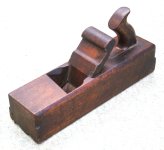
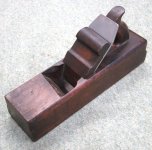
The owner of this plane likes to collect Irish tools or tools with an Irish connection. It is marked “Booth – Dublin” but sadly it had no iron. It is quite a beast as the mouth opening is a little more than 2 5/8” wide (~67mm). I offered to make a new iron and this is how I did it.
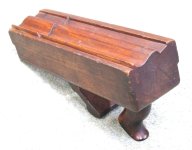
The boxing of the plane was loose and I secured it back in place using liquid hide glue.
I cut a piece of 70mm x 4mm O1 steel to a suitable length then ground it to the required width, then shaped the upper end with hacksaw and file. I blackened the “cutting” end of the blank with a marker pen and secured it in the plane using the wedge, projecting about 5mm from the lowest part of the sole. Then I scribed a line, following the contour of the plane.
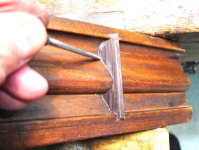
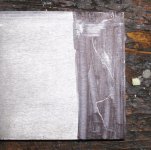
Next, I repositioned the iron with almost no projection below the lowest part of the sole and scribed a second line.
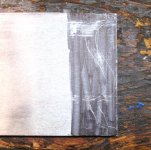
I removed as much as possible of the waste with a hacksaw.
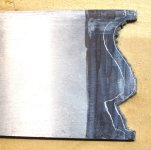
Then I filed to the second scribed line.
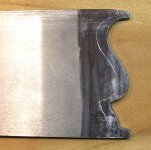
This is how it now looked in position in the plane.
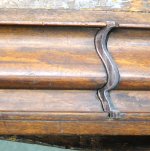
Using files, I shaped the chamfer, taking care not to come quite to a sharp edge at this stage.
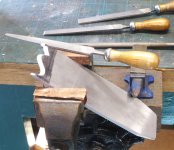
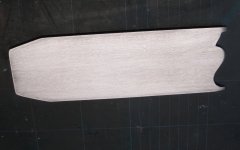
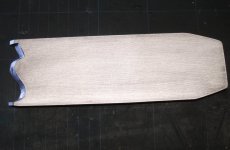
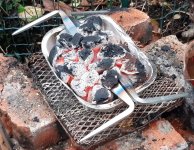
I used a charcoal barbecue urged on with a hot air gun to raise the iron to red heat. When a magnet would no longer stick to it (i.e. the Curie point had been reached) I quenched it in cooking oil. Then, I cleaned it up and tempered it in the domestic oven at 200 deg. C for an hour.
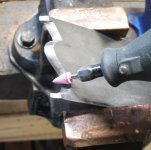
The final shaping and sharpening operations were done with a Dremel tool, diamond needle files and oilstone slips.
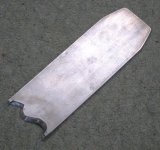
Here, the sharpened iron is in place in the plane.
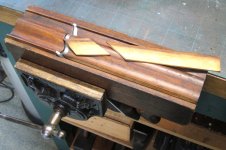
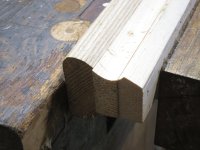
As I had no suitable wood of the right thickness to hand, I cramped three pieces of wood together in the vice in order to try cutting a moulding.
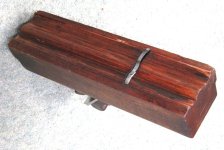
The finished plane.
The boxing of the plane was loose and I secured it back in place using liquid hide glue.
I cut a piece of 70mm x 4mm O1 steel to a suitable length then ground it to the required width, then shaped the upper end with hacksaw and file. I blackened the “cutting” end of the blank with a marker pen and secured it in the plane using the wedge, projecting about 5mm from the lowest part of the sole. Then I scribed a line, following the contour of the plane.
Next, I repositioned the iron with almost no projection below the lowest part of the sole and scribed a second line.
I removed as much as possible of the waste with a hacksaw.
Then I filed to the second scribed line.
This is how it now looked in position in the plane.
Using files, I shaped the chamfer, taking care not to come quite to a sharp edge at this stage.
I used a charcoal barbecue urged on with a hot air gun to raise the iron to red heat. When a magnet would no longer stick to it (i.e. the Curie point had been reached) I quenched it in cooking oil. Then, I cleaned it up and tempered it in the domestic oven at 200 deg. C for an hour.
The final shaping and sharpening operations were done with a Dremel tool, diamond needle files and oilstone slips.
Here, the sharpened iron is in place in the plane.
As I had no suitable wood of the right thickness to hand, I cramped three pieces of wood together in the vice in order to try cutting a moulding.
The finished plane.