
-
Hi all and welcome to TheWoodHaven2 brought into the 21st Century, kicking and screaming! We all have Alasdair to thank for the vast bulk of the heavy lifting to get us here, no more so than me because he's taken away a huge burden of responsibility from my shoulders and brought us to this new shiny home, with all your previous content (hopefully) still intact! Please peruse and feed back. There is still plenty to do, like changing the colour scheme, adding the banner graphic, tweaking the odd setting here and there so I have added a new thread in the 'Technical Issues, Bugs and Feature Requests' forum for you to add any issues you find, any missing settings or just anything you'd like to see added/removed from the feature set that Xenforo offers. We will get to everything over the coming weeks so please be patient, but add anything at all to the thread I mention above and we promise to get to them over the next few days/weeks/months. In the meantime, please enjoy!
You are using an out of date browser. It may not display this or other websites correctly.
You should upgrade or use an alternative browser.
You should upgrade or use an alternative browser.
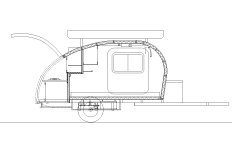
Mike builds a teardrop (cedar detail)
- Thread starter Mike G
- Start date


AJB Temple
Sequoia
- Joined
- Apr 15, 2019
- Messages
- 7,596
- Reaction score
- 1,094
You can't stand up in it?
Just looked on eBay and there are numerous s/h caravans for around £700. Much larger though.
Just looked on eBay and there are numerous s/h caravans for around £700. Much larger though.
SamQ aka Ah! Q!
Old Oak
We saw a small number of these "Teardrop" look-alikes on sites in our touring years. Next step up from a Force Ten, with the advantage of storing in a conventional garage.
Just make sure your gas bottle store has a perforated floor, Mike, and that there is NO possibility of leakage from pipe junctions into your sleeping space. I know, granny, eggs, sorry.
In my trailer tent, I had a waterproof secondary outlet for the gas that allowed me to 'plug in' another bbq 10-15' away from the main tent, to avoid grease spatters or pungent curry odour stinking out the main body. If you look at Pennine 535 models online, you'll see what I mean.
Enjoy!
Just make sure your gas bottle store has a perforated floor, Mike, and that there is NO possibility of leakage from pipe junctions into your sleeping space. I know, granny, eggs, sorry.
In my trailer tent, I had a waterproof secondary outlet for the gas that allowed me to 'plug in' another bbq 10-15' away from the main tent, to avoid grease spatters or pungent curry odour stinking out the main body. If you look at Pennine 535 models online, you'll see what I mean.
Enjoy!

Mike G
Petrified Pine
You can't stand up in it?
No.
Just looked on eBay and there are numerous s/h caravans for around £700. Much larger though.
I'm sure, but we don't want a caravan. Besides, as I said, I need a project.
Mike G
Petrified Pine
Just make sure your gas bottle store has a perforated floor, Mike, and that there is NO possibility of leakage from pipe junctions into your sleeping space. I know, granny, eggs, sorry.
One of the reasons to post threads like this on here is to receive comments like this. Even if I might have thought of things previously, comments are a really important check-list, and can induce really useful conversations (and that applies to most threads, not just this one).
I've just bought 3 CO2 alarms: one for the camper I'm repairing/ modifying for a friend; one for our lounge (woodburner); one for this teardrop. Thanks for the perforated-floor tip.....that's new to me. I shall certainly add a vent or two in the floor. The kitchen will be sealed off from the sleeping compartment, and will be separately vented. The gas pipe routing is external before entering the kitchen.
Last edited:
Talking of which have you looked at poplar plywood. It is supposed to be very light weight yet rigid.
Also these people are quite reliable https://vadania.co.uk/?_kx=u5K0EWKAB12oaLwXZBbTLoZ_b-hBhJtUsM49CKK3WsI.Nq2vTd
Also these people are quite reliable https://vadania.co.uk/?_kx=u5K0EWKAB12oaLwXZBbTLoZ_b-hBhJtUsM49CKK3WsI.Nq2vTd
Mike G
Petrified Pine
Talking of which have you looked at poplar plywood. It is supposed to be very light weight yet rigid.
I had, and I'm getting prices. It's new to me, and I stumbled across it the other day.
Also these people are quite reliable https://vadania.co.uk/?_kx=u5K0EWKAB12oaLwXZBbTLoZ_b-hBhJtUsM49CKK3WsI.Nq2vTd
Thanks. That looks useful.
Cabinetman
Sequoia
- Joined
- Oct 11, 2020
- Messages
- 5,274
- Reaction score
- 1,028
- Location
- Lincolnshire Wolds + Massachusetts
- Name
- Ian
Yes Propane is nasty in smaller confines, and being heavier than air it’s particularly dangerous on boats, no way to put ventilation holes underneath lol.
So you lift the boot lid to cook? That’s a sensible arrangement, for smells and spatter, maybe a roller blind type overhead for when it’s raining?
So you lift the boot lid to cook? That’s a sensible arrangement, for smells and spatter, maybe a roller blind type overhead for when it’s raining?
SamQ aka Ah! Q!
Old Oak
Nae probs Mike. The perforation can be as simple as a VERY wide hole for cables ( and no grommet obviously). It has, repeat has, to be in the floor as most camping gas is heavier than air.Thanks for the perforated-floor tip.....that's new to me. I shall certainly add a vent or two in the floor. The kitchen will be sealed off from the sleeping compartment, and will be separately vent⁹9ed. The gas pipe routing is external before entering the kitchen.
Our gas bottle box was floored with recycled Coke cans - a sheet of spit thin aluminium - but that proved to be a good thing, as the bottom flange on the gas bottles (plural) ate holes into raw ply. DAMHIKT.

Sam
Mike G
Petrified Pine
Yes Propane is nasty in smaller confines, and being heavier than air it’s particularly dangerous on boats, no way to put ventilation holes underneath lol.
So you lift the boot lid to cook? That’s a sensible arrangement, for smells and spatter, maybe a roller blind type overhead for when it’s raining?
The lid covers about 5 feet when it's up, but yes, I have an awning of sorts planned (overhead and sides) to extend the dry kitchen area substantially. Lots of Americans take a gazebo with them, and place it over the tail. But then, most Americans have much bigger cars than we do, and a gazebo can fit in somewhere.
Mike G
Petrified Pine
.....Our gas bottle box was floored with recycled Coke cans - a sheet of spit thin aluminium - but that proved to be a good thing, as the bottom flange on the gas bottles (plural) ate holes into raw ply. DAMHIKT.
Yep, that was my experience in Africa too. No matter how well you strap gas bottles down they chafe a hole in whatever they're standing on.
Last edited:
We have a gazebo that folds down to 4’x1’x1’ you could fit that somewhere.The lid covers about 5 feet when it's up, but yes, I have an awning of sorts planned (overhead and sides) to extend the dry kitchen area substantially. Lots of Americans take a gazebo with them, and place it over the tail. But then, most Americans have much bigger cars than we do, and a gazebo can fit in somewhere.
Mike G
Petrified Pine
Probably. Wait for a few months to see what I have in mind instead.We have a gazebo that folds down to 4’x1’x1’ you could fit that somewhere.
MattS
Nordic Pine
When you get to that stage… I’ve been treating the underside of my Eriba this year, I’ve always used this on the underside wood - Dekalin Dekaphon 9735 Underbody Protection 500ml BLACK Motorhome Caravan
Cabinetman
Sequoia
- Joined
- Oct 11, 2020
- Messages
- 5,274
- Reaction score
- 1,028
- Location
- Lincolnshire Wolds + Massachusetts
- Name
- Ian
Now I thought that phenolic ply was the stuff, but on a trailer base it only lasted a year, turns out there are very different qualities.I'm going to be using phenolic ply for the undersides, if it doesn't come in too expensive. I've a couple of areas where that underbody paint might be useful, though, so thanks.
There was a period quite a few years ago now in the Caravan world where the ply floors delaminated! Cost a whole lot to fix.
Caution is the order of the day Mike.

Lons
Old Oak
+1 to what Sam said re the gas compartment ventilation and they're usually lined floor and back with sheet alloy. You can buy a screw on clamp for a single or double lightweigh propane bottles same as the manufacturers use and the bottles don't move at all. Just a point on the floor ventilation Mike, make sure you cover them with anti rodent mesh as the little bu**ers love caravans.
I'm sure you already know that as well as butyl tape you need oodles of STP adhesive/sealant the best of which is Sikaflex in my experience. 522 is what we use for reseal and it's excellent stuff. I fitted a solar panel a few years ago to a mate's motorhome roof held on only by the four brackets stuck down and it would have wrecked the roof to get it off. I also used it years ago to fit a boot spoiler to my BMW with a similar result.
Sorry in advance if that's granny and eggs stuff as well
I'm sure you already know that as well as butyl tape you need oodles of STP adhesive/sealant the best of which is Sikaflex in my experience. 522 is what we use for reseal and it's excellent stuff. I fitted a solar panel a few years ago to a mate's motorhome roof held on only by the four brackets stuck down and it would have wrecked the roof to get it off. I also used it years ago to fit a boot spoiler to my BMW with a similar result.
Sorry in advance if that's granny and eggs stuff as well
Mike G
Petrified Pine
My local builders merchant had a dispute with Sikaflex a year or two back, and ended up clearing them from the shelves. They started stocking Hippo products instead. Hippo Pro 3 is very much the same sort of thing as Sikaflex, and I've had really good results with it, so I expect to get through one or two cartridges in this build. Essentially anywhere where timber meets steel Hippo Pro 3 will be the adhesive. Like Sikaflex, it's low-modulous, and a filler as well as an adhesive.
Mike G
Petrified Pine
Oooh, that's not good news. I'd not heard that. I'll look into that. Thanks Ian.Now I thought that phenolic ply was the stuff, but on a trailer base it only lasted a year, turns out there are very different qualities.
There was a period quite a few years ago now in the Caravan world where the ply floors delaminated! Cost a whole lot to fix.
Caution is the order of the day Mike.
I essentially wanted it just for the phenolic covering for the underside of the trailer. That's a bit different to a trailer bed where the edges are exposed, and water can pool on the top. But I'll have a re-think. Underbody paint or one of those high-build bed-liner type paints is the alternative, I guess.
duke
Old Oak
Hey Mike, I am not an expert on trailer construction but over here the major problem is the deck construction . When my son was looking to buy a used trailer I said to get under it and inspect the underside. Eight out of the ten he looked at had rot . What I am saying is the deck construction is important to prevent this. I'm sure you have considered this, just had to add my two cents.
duke
Old Oak
Your plan is very attractive and I think a cedar stripped canoe in the future is great.
Mike G
Petrified Pine
I've had a good read of all I can find on this subject. It's quite interesting. Firstly, there are two types of phenolic board (which is a resin-based product): pure phenolic all the way through, and phenolic ply. Pure phenolic is bomb-proof, but very, very heavy and expensive. The most commonly used version is the other type: phenolic ply. This is phenolic-coated ply, coated both sides with the phenolic. Here, the quality varies with the quality of the ply, and the durability varies with workmanship. A quality WBP ply will last much longer than a sheathing-type ply, no matter what it is coated with. Workmanship relates to edge-treatment. With the phenolic coating being on the top and bottom faces, but not on the edges, phenolic ply is vulnerable to delamination if the edges get wet. The best solution, it seems, is to use a CPES (clear penetrating epoxy sealant) on any edges. This is a real Rolls Royce solution.Now I thought that phenolic ply was the stuff, but on a trailer base it only lasted a year, turns out there are very different qualities.
The edges of my flooring are sealed in under/ behind other structure. They won't be exposed to water at all. The one exception is around the "well" (for the water tank and battery/ies), where there will be vertical joints around the box sides, and between the sides and the floor. I'll have a good think about this detail, but a combination of CPES and an under-body paint seems like a good starting point. I won't be able to turn the trailer upside down, so I doubt I could seal with fibreglass. The underbody is exposed to water thrown up by tyres, but never to water pooling on it.
It seems that all the issues with phenolic ply relate to its use in trailer floors, and in particular, where trailers are just left out in all weathers, with water pooling and penetrating the ply at the edges. This won't apply to my teardrop, so, I think I'm going to stick with my original plan.
Lons
Old Oak
Hi Mike
Just as an example, the floor of my Ifor Williams trailer is 18mm phenolic-coated ply and presumably was good quality but the back corners under have softened a little and the top has now lifted though not much. I bought the trailer when it was 4 years old and I fitted alloy treadplate on the top but that was offcuts in 4 pieces screwed down and just with silicone in the joints so water got through under that and stayed on the ply presumably and caused the delamination. I did that because it was heavily abused with bricks, rubble, concrete etc being thrown in, often loads of 2 tonnes.
But.... I've owned it since 1998 during which time it's been standing outside neglected in all weathers so I'd say more than 30 years isn't a bad life and if your's is well sealed it will probably outlive you or at least as long as you want to use it. (that could be as little as 12 months of course if your wife doesn't like it ).
).
To seal it you'll be able to turn the trailer with the floor fitted on to it's side with suitable spacers to protect the wheel or hub or as I did with mine once, hook a rope with pulleys on to the hitch with the other end to a tree and pull it upright. A winch would be even easier. Otherwise it's a simple job to make up some temporary high wooden ramps and get under it to fibreglass it. It's only a few hundred kg without the fixtures and fittings.
BTW Mine has a load area of 8' x 4' so nearly 12' long overall and weighs 500kg empty. Yours should be easier to turn on it's side.
Just as an example, the floor of my Ifor Williams trailer is 18mm phenolic-coated ply and presumably was good quality but the back corners under have softened a little and the top has now lifted though not much. I bought the trailer when it was 4 years old and I fitted alloy treadplate on the top but that was offcuts in 4 pieces screwed down and just with silicone in the joints so water got through under that and stayed on the ply presumably and caused the delamination. I did that because it was heavily abused with bricks, rubble, concrete etc being thrown in, often loads of 2 tonnes.
But.... I've owned it since 1998 during which time it's been standing outside neglected in all weathers so I'd say more than 30 years isn't a bad life and if your's is well sealed it will probably outlive you or at least as long as you want to use it. (that could be as little as 12 months of course if your wife doesn't like it
).To seal it you'll be able to turn the trailer with the floor fitted on to it's side with suitable spacers to protect the wheel or hub or as I did with mine once, hook a rope with pulleys on to the hitch with the other end to a tree and pull it upright. A winch would be even easier. Otherwise it's a simple job to make up some temporary high wooden ramps and get under it to fibreglass it. It's only a few hundred kg without the fixtures and fittings.
BTW Mine has a load area of 8' x 4' so nearly 12' long overall and weighs 500kg empty. Yours should be easier to turn on it's side.
Last edited:
A client of mine that uses vast amounts of high quality marine ply tells me the best ply is produced in Russia.
So with the sanctions on Russia we no longer have access to quality ply.
Mike I’ve used the Formica faced popular ply that has been mentioned and it’s a pleasure to work with, big shock first time I lifted it up as it was very light.
So with the sanctions on Russia we no longer have access to quality ply.
Mike I’ve used the Formica faced popular ply that has been mentioned and it’s a pleasure to work with, big shock first time I lifted it up as it was very light.

Phil
Old Oak
SamQ aka Ah! Q!
Old Oak
Phenolic ply? Sell.a kidney.
I've had three trailer tents, aspiring ever upward to the Pennine 535. On one of them, no manufacturer named, the underside was protected by that same 40 micron aluminium. One sheet, glued to the ply underside. It occurs to me Mr G., that, in the face of much spondulicks and/or hens' teeth availability for phenolic and the (relative) cheapness and durability of "Al Loominum" you could swop.out phenolic for ali?
I perzoom that you will.be sheathing the upper casing in ali? My proposed undersheathing would be the same width, from the same manufacturer, and be (see discussion above) more durable to "screenings" and sundry projectiles thrown up by the wheels?
Just a thought, from the lateral thinking and perpetually cash-pressured department.
Sam
I've had three trailer tents, aspiring ever upward to the Pennine 535. On one of them, no manufacturer named, the underside was protected by that same 40 micron
aluminium. One sheet, glued to the ply underside. It occurs to me Mr G., that, in the face of much spondulicks and/or hens' teeth availability for phenolic and the (relative) cheapness and durability of "Al Loominum" you could swop.out phenolic for ali?I perzoom that you will.be sheathing the upper casing in ali? My proposed undersheathing would be the same width, from the same manufacturer, and be (see discussion above) more durable to "screenings" and sundry projectiles thrown up by the wheels?
Just a thought, from the lateral thinking and perpetually cash-pressured department.
Sam
Mike G
Petrified Pine
.......It occurs to me Mr G., that, in the face of much spondulicks and/or hens' teeth availability for phenolic and the (relative) cheapness and durability of "Al Loominum" you could swop.out phenolic for ali?
It's a thought, certainly. However, if phenolic isn't available (I'll be getting prices next week) then I will probably do some combination of soaking some good ply with an epoxy and then coating with a under-body paint, or, a "bed-liner" -type coating.
I perzoom that you will.be sheathing the upper casing in ali?....
No, no. It's going to be cedar-strips covered in a clear epoxy (fibreglass), then a 2-pack varnish. It should look something like the canoes I posted on the first page.
Last edited:
Mike G
Petrified Pine
Mike I’ve used the Formica faced popular ply that has been mentioned and it’s a pleasure to work with, big shock first time I lifted it up as it was very light.
Very useful to have a first-hand recommendation. Thanks.
Mike G
Petrified Pine
Fabrication will be done the end of next week, and galvanising the week after. It should be back with me W/C 11th August. I'd better get some stuff ordered......What's the fabrication time estimate Mike?
AJB Temple
Sequoia
- Joined
- Apr 15, 2019
- Messages
- 7,596
- Reaction score
- 1,094
Just on Phenolic ply - very good post that Mike.
My industrial scaffold tower uses Phenolic ply for the platforms. It is kept in my building materials area so exposed to the elements. Last year one of the platforms gave way in use - failing around the rivet points. Gave me a fright. As far as I can see it was not edge sealed.
My industrial scaffold tower uses Phenolic ply for the platforms. It is kept in my building materials area so exposed to the elements. Last year one of the platforms gave way in use - failing around the rivet points. Gave me a fright. As far as I can see it was not edge sealed.
Mike G
Petrified Pine
I'm glad that happened AFTER I clambered around on it!!!...My industrial scaffold tower uses Phenolic ply for the platforms......Last year one of the platforms gave way in use -

AJB Temple
Sequoia
- Joined
- Apr 15, 2019
- Messages
- 7,596
- Reaction score
- 1,094
Indeed. My thoughts exactly.
AJB Temple
Sequoia
- Joined
- Apr 15, 2019
- Messages
- 7,596
- Reaction score
- 1,094
I've replaced them now and the platforms are kept under cover.
Lons
Old Oak
The platforms / Newman boards I have were only 9mm thick. When they rotted, I replaced with 12mm standard ply, glued in some extra bracing as belt and braces and gave them a few coats of varnish. I keep them under cover as well now but the damage was caused being on site for extended periods.
Mike G
Petrified Pine
I would use a reputable plywood manufacturer.A client of mine that uses vast amounts of high quality marine ply tells me the best ply is produced in Russia.
So with the sanctions on Russia we no longer have access to quality ply.
Mike I’ve used the Formica faced popular ply that has been mentioned and it’s a pleasure to work with, big shock first time I lifted it up as it was very light.
Wisa or Brunzneal comes to mind.
I got hold of some softwood wisa ply and build a sand pit. Just painted it lasted 10yrs!
SamQ aka Ah! Q!
Old Oak
"Whale" pumps used to be the accepted choice Mike. You can get floor mounted foot-powered ones, but for your purposes, an electric one would be more sensible.Whislt you're here, Bob (@Lons), can you give your experience of the various ways of getting water into and out of a tank in a caravan. And of course, anyone else who has a thought on the matter. I'll have a sink, a tap, and a cold water tank. After that, I'm just guessing.
As to tanks, you might like the 'standard' portable fresh water one. Rollable barrel or suitcase-on-wheels variety. The latter can be slipped underneath when the legs are down. You are using legs?
You'll need a second for 'grey' water, or....we managed a family of five on two 10L placky tubs with taps for drinking and cooking water. Washing up.went into a standard basin and off to the campsite sink.
The loo for nighttime jaunts was strictly No1's and two bottles of 'blu loo' in the Portapottie covered about a fortnight. Your bladder may vary...
Mike G
Petrified Pine
The tank will be built in, and awkward to access, Sam. It's under the bed. So, it will have to be fillable via a hose and a filler-cap. I'm worried about how to prevent overfilling.....
Whilst a submersible pump seems the obvious answer to getting water out, it is a shallow tank without a sump, so there's a danger of not being able to get the last 5 litres out, and the pump running dry. Pressurising the tank might get over that issue, but is that easily done?
Whilst a submersible pump seems the obvious answer to getting water out, it is a shallow tank without a sump, so there's a danger of not being able to get the last 5 litres out, and the pump running dry. Pressurising the tank might get over that issue, but is that easily done?
SamQ aka Ah! Q!
Old Oak
Ah. Dozy me. Should have picked that up, sorry.It's under the bed
Pressurising the tank might get over that issue, but is that easily done?
 ...I don't know, never heard of same. Bob (Lons) might know.