• Hi all and welcome to TheWoodHaven2 brought into the 21st Century, kicking and screaming! We all have Alasdair to thank for the vast bulk of the heavy lifting to get us here, no more so than me because he's taken away a huge burden of responsibility from my shoulders and brought us to this new shiny home, with all your previous content (hopefully) still intact! Please peruse and feed back. There is still plenty to do, like changing the colour scheme, adding the banner graphic, tweaking the odd setting here and there so I have added a new thread in the 'Technical Issues, Bugs and Feature Requests' forum for you to add any issues you find, any missing settings or just anything you'd like to see added/removed from the feature set that Xenforo offers. We will get to everything over the coming weeks so please be patient, but add anything at all to the thread I mention above and we promise to get to them over the next few days/weeks/months. In the meantime, please enjoy!

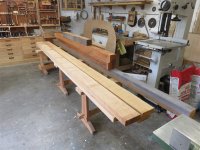
Mike builds a teardrop (cedar detail)

I've some experience of 12V DC water pumps. For a few years now I've been doing hydroponic veg growing and the nutrient water is supplied using 12v pumps.

When I started out I bought submersible pumps (I have 2 systems running) one was whale brand the other some chinese no name. neither lasted very long before leaking water into the motor - 6 months or less.

next i tried self priming diaphragm pumps. These ones have a pressure switch that turns the pump off when there is pressure in the pipe. No use to me as my pumps just do watering but may be for you.

I started with 2 of these - https://www.amazon.co.uk/dp/B072MWNJL1?th=1
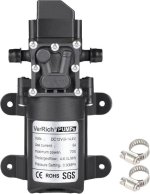
71xjeJAZwyL._AC_SL1500_.jpg

One of them is out in the open on top of a tank and has a plastic cover over it to keep the worst of any rain off. It has worked reliably for nearly 3 years now. The other one is inside a garden furniture cushion box with its tank and lasted 18 months or more before i had to replace it.

They put out huge pressure and decent volume but they are noisy. The noise can be greatly reduced by running it at 9 or 10V instead of 12. A simple cheap buck converter will do that.

I have a couple of spares for when they do fail. Amazon warehouse (used but usually not actually used) have them at times for prices like £8 each instead of 20 odd.
 
I know nothing about caravans but you might want to consider if you ever need to sterilise the water tank how you would do that if it’s inaccessible

Mark
 
.....next i tried self priming diaphragm pumps. These ones have a pressure switch that turns the pump off when there is pressure in the pipe. No use to me as my pumps just do watering but may be for you.....

Thanks Robert. I can see how that would work for me, although I can't see why it doesn't work for you.
 
I know nothing about caravans but you might want to consider if you ever need to sterilise the water tank how you would do that if it’s inaccessible

Mark
It's accessible, but you have to lift the mattress. No problem at all when back home and empty of bedding etc, but a pain when out on the road.
 
The tank will be built in, and awkward to access, Sam. It's under the bed. So, it will have to be fillable via a hose and a filler-cap. I'm worried about how to prevent overfilling.....

Whilst a submersible pump seems the obvious answer to getting water out, it is a shallow tank without a sump, so there's a danger of not being able to get the last 5 litres out, and the pump running dry. Pressurising the tank might get over that issue, but is that easily done?
Can you not have it sealed to the inside but have a external fill point?
Maybe out of 22mm push fit so you can get a hose down it?
 
Mike, the little electric submersible pump in my camper tank sits on the flat bottom of the tank and stops supplying water but still runs when empty.
Add water and it's back in action with nothing more than pressing the foot switch.
If I remember one of the tank suppliers mentioned on the camper forum are CAK ?
https://www.caktanks.co.uk/

Cheers Andy
 
Thanks Robert. I can see how that would work for me, although I can't see why it doesn't work for you.
Mine is pumping to an open pipe so never sees pressure build up from a tap being closed so it would never turn itself off. I use a timer for on and off.
 
Mine is pumping to an open pipe so never sees pressure build up from a tap being closed so it would never turn itself off. I use a timer for on and off.
So it's the built-in pressure switch which is the problem for you. If there was a switch in (or instead of) the tap, I wouldn't need a pressure switch either.
 
Can you not have it sealed to the inside but have a external fill point?
Maybe out of 22mm push fit so you can get a hose down it?
Yes, but the issue I can foresee is that the person standing outside with a hose in their hand won't know when the tank is full until it leaks out of the filler tube. No big deal really.
 
Sorry Mike I've only just seen your post this morning.

basically what Sam said re pump between tank and tap, you can get very small ones so it doesn't leave much water in the bottom, for example the pump in my last mororhome was just a small cylindrical typeon a flexi pipe and laid flat. I wouldn't worry to much about running dry, you'll realise that very quickly (no water :ROFLMAO:). You hear to tone of the pump change noticeably and running dry for a short time wont harm it.
Of more concern to me would be water left to stagnate in the bottom of the tank while not in use so ideally if you can adapt the tank so you can drain it is worth doing. It will mean a connector glued in and a pipe though the floor with a simple tap usually.

As far as filling, I assume you will lead a pipe through the sidewall, you can buy specific recessed panels which glue in and without adding another overflow pipe again leading out through the floor there isn't an easy way to stop overfill though it shouldn't be an issue.

One question. Why an inboard tank on a lightweight van? Water weighs 1kg for every litre so will eat up into your spare capacity. If it was me I'd seriously think about an Aquaroll or similar which hold around 40 litres, dead easy to fill on site and you just buy a drop in pump. Instead of tank connection you put an input in the outside wall leading to the tap and of course will need a 12v socket. many caravans are fitted with a combined unit with a door, quite small and weatherproof. The pumps are activated buy water flow so turn the tap on and the pump works.
I've never personally fitted a unit but don't think it's difficult. I'll have a look when I get a chance tonight.

Aquaroll and handle is carried empty in the van or car and a bonus is that the wife usually doesn't mind filling it from the site taps.;)

EDIT
I missed the posts from the other guys as well - dozy git. :rolleyes:
 
Mike

just a very quick look as I'm on my way out. here is an example of w built in connector for water and 12v.

And here's the pump and connector

Others are available and I haven't checked if these are compatible, should be. Just maybe an option to consider.

 
Do you think you’re over complicating the water set up Mike? Assume given the space available it will be cold water only? Both my Eriba and our basic campervan have a similar set up. Simple tap and submersible pump from a removable water container. Super easy to empty and keep clean. Our camper has a second bottle in the cupboard for waste but the Eriba set up is a straight pipe through the floor into a waste container. If you don’t want to loose cupboard space you could have external fresh water like most caravans? Downside versus our Eriba set up you don’t go away ready with water but assume without any onboard facilities you’ll be on sites with water points, toilets etc?
 
(y) That's as I said above Matt, it's a well tried, proven system with many pros and very few cons. There's nothing to stop anyone carrying water if they need it and an advantage on the occasion that might be necessary is the container can be positioned to balance weight distribution or even better, in the car.
The 120 litre on board tank in the motorhome was useful but it was a big van with shower and direct supply to flush the loo and even then the advice was to travel with no more than 20 litres on board. I carried a small Aquaroll as backup when I needed to fill on site. When I had a caravan it used the system described, as do the vast majority of others.
 
Hmmmm...... You may well be right. However, the chassis with well is under construction as we speak, so I think I'm committed to this path. I wonder if this stems from my camping experience, which has all been in Africa, where having your own stash of clean water is critical almost everywhere. The thought of going camping without 20 litres of water gives me the heebie-jeebies. But, the logic is that in Britain and Europe, there is water everywhere.
 
Is this a stainless steel tank - I looked above but couldn't find it. On boats, even if you have a purifier on board, it's essential to have plenty of clean water too. What you are supposed to do is add a purification tablet to a full tank at least once a year, leave for the prescribed time, then drain it (there is usually a drain valve or siphon). Kills the bugs and gets rid of slime. Quite a lot of boats have a manual pump action tap in case the electrics fail. This does seem to empty the tank effectively - I don't know how the set up is made though.
 
Mine would be a plastic tank, and yes, purified before and after each "season"and drained down each winter.
 
Hmmmm...... You may well be right. However, the chassis with well is under construction as we speak, so I think I'm committed to this path. I wonder if this stems from my camping experience, which has all been in Africa, where having your own stash of clean water is critical almost everywhere. The thought of going camping without 20 litres of water gives me the heebie-jeebies. But, the logic is that in Britain and Europe, there is water everywhere.
Your camping experience is quite different to mine, even when camping in "rougher" conditions, which we do do fairly regularly, there's still always a fresh water supply in walking distance :ROFLMAO:
 
As a neutral observer with no interest in camping or caravans, it is weight you do not need in UK or Europe. However as you are building the tank into the frame it would help keep the centre of gravity low. The downside is any volume of water that can move around would risk stability.
If it were me the faff of filling, purification and emptying the tank would be the decider.
 
Is 20kg critical? Especially if between the axles.
It's all depending on what else you need to carry. The trailer is limited to a gross weight of 750kg as it's not braked, Mike stated a design weight of £650kg. I don't know exactly what that includes (2 bikes for example?) but 100kg is not a lot for 2 people although any excess should go in the car.

So if that 20kg had to come out of a 100kg payload for example then yes it would be significant. S suspect that Mike has included that in his design weight however.

Mike I'm puzzled by you saying the fabricators are including the well so it's too late. If not for a water tank then surely the space under the bed can be used for other items? Just curious.
 
Mike I'm puzzled by you saying the fabricators are including the well so it's too late. If not for a water tank then surely the space under the bed can be used for other items? Just curious.

It's just that there's nothing else that can sensibly go in there. It's a difficult-to-access location, so is great for things like batteries, pumps, tanks etc which you don't need regular access to, but would be hopeless for things like chairs, or awning walls etc. I've already got a space for the other electric gismos to go. I'll have a 1050 x 750 x 225 space for just a battery if I left the tank out. That isn't a good reason, though, to fit a tank. I'm probably going to keepit simply because having a loose tank stored in the car to wheel across a campsite brings it's own set of problems, and potentially takes space otherwise allocated to the pooch.
 
It's just that there's nothing else that can sensibly go in there. It's a difficult-to-access location, so is great for things like batteries, pumps, tanks etc which you don't need regular access to, but would be hopeless for things like chairs, or awning walls etc. I've already got a space for the other electric gismos to go. I'll have a 1050 x 750 x 225 space for just a battery if I left the tank out. That isn't a good reason, though, to fit a tank. I'm probably going to keepit simply because having a loose tank stored in the car to wheel across a campsite brings it's own set of problems, and potentially takes space otherwise allocated to the pooch.
Makes sense, sort of. Many caravens and motorhomes have an external door to access awkward under bed storage. Just another idea to throw into the mix. They are available in loads of sizes, you usually get just the frame and fill the centre of the door with the offcut from the van wall. If of interest search caravan locker access doors.

Aquarolls are very easy to pull even when full. My missus is 5ft and a moderate breeze would blow her away but she found them easy. You could harness the pooch to an aquaroll handle though. :ROFLMAO: Our old Labrador would just lie down and look as if to say don't be stupid.
 
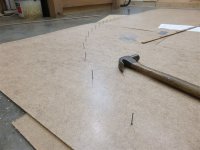
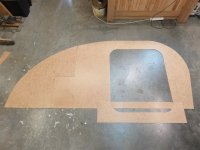
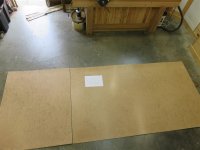
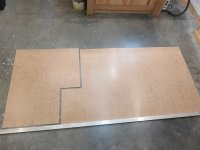
I started work today. I picked up a couple of sheets of 3mm hardboard from which to make a template of the inner skin. Note this, because this is a fundamental difference from any teardrop you can find on Youtube, who all make the OUTER shape first. I think this leads to some very poor detailing. My shape is therefore going to be the shape of the interior. Unusually, again, It's bigger than a single sheet of ply:

IMG_8108.jpg

I spent a couple of hours on my hands and knees, doing a form of lofting. The join is like this because it will be hidden behind the partition between the sleeping area and the galley (kitchen):

IMG_8109.jpg

IMG_8110.jpg

IMG_8111.jpg

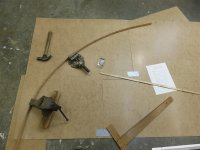
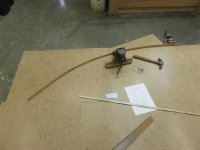
I had to put some off-cuts under the main sheets because it was too thin for the nails to get enough grip to resist the forces of a spline. Unfortunately, I couldn't find a scrap long enough to make a spline long enough to do the whole curve in one go:

IMG_8112.jpg

IMG_8113.jpg

I had to keep reminding myself that reproducing exactly what I had drawn would be nice, but not critical. More important was making a fair curve. Luckily, my drawing was pretty much spot on. I cut it out mainly with a hand-saw, but also using a jigsaw:

IMG_8114.jpg

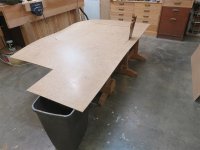
Note the strategic deployment of the bin! This board is very floppy. It's also pretty weak, so I couldn't do the entire door cut-out, and had to leave a reinforcing strip connecting the bottom:

IMG_8115.jpg

A couple of things to note. Firstly, the door is huge. It's 900mm wide. Believe it or not, I measured how I get into bed, and as I am making the door and not relying on what is commercially available, I've ended up with something I'll be able to easily climb in to in the dark without folding myself up too much. Secondly, the bottom of this template sits quite a long way above the chassis and the floor of the finished camper. You'll see a very unorthodox build-up below the bottom edge, mainly to gain height inside and prevent claustrophobia without resorting to over-sized sheets of ply, which are extortionate.

This is a template, and I'll use a router with a bearing guided trimming cutter to cut out the two sides
 
Last edited:
I reckon Leo Goolden will be following this build as closely as the rest of us!
 
Mike..what makes your arc/shape, different.
Obviously, here in the colonies, I have seen many 'teardrops'.
Agree on keeping the water tank, the weight penalty, is not that great. My last RV, had a 50 gallon tank. Serious weight.
Enjoying this WIP, for sure.

stay safe
 
Couple of years ago I priced-up the cost of cedar-strip to do a one-off roof (just the roof - not the sides) on a PhieldBug. Price was so eye-watering that I gave up on that, lovely though it would have been.
Beware in UK that you'll need an IVA for a new trailer. And if brakes are fitted they'll be tested - even if the weight/class of trailer doesn't mandate brakes. What the inspector will make of brakes part-fitted I don't know (in 20-odd IVA's I never tried that permutation)... but they have a rule-book and they stick to it rigidly. I'd give the IVA office at DVLA a ring - I've found them pretty helpful on tech matters.
Your experiment with the sus units, to gauge the loaded height, is wise. But rubber-filled units will sag quite a bit after a few months with the trailer weight on them. I had to re-position upwards the mudguards, to compensate.
 
Last edited:
Couple of years ago I priced-up the cost of cedar-strip to do a one-off roof (just the roof - not the sides) on a PhieldBug. Price was so eye-watering that I gave up on that, lovely though it would have been.

I'm picking up the WR Cedar tomorrow. In materials terms, it's not too bad. If you were pricing it up for a customer, then you'd have included labour, which isn't applicable in my siutation.

Beware in UK that you'll need an IVA for a new trailer. And if brakes are fitted they'll be tested - even if the weight/class of trailer doesn't mandate brakes. What the inspector will make of brakes part-fitted I don't know (in 20-odd IVA's I never tried that permutation)... but they have a rule-book and they stick to it rigidly. I'd give the IVA office at DVLA a ring - I've found them pretty helpful on tech matters.
Your experiment with the sus units, to gauge the loaded height, is wise. But rubber-filled units will sag quite a bit after a few months with the trailer weight on them. I had to re-position upwards the mudguards, to compensate.

Interesting. I'll give them a buzz, thanks. It's only an empty hub, so I doubt that they'll consider it a braked unit.......but, they're bureaucrats, so you never know.

I'll have corner steadies (jacks) built onto the back corners, so the trailer won't be sitting on the suspension other than when it's on the road. Hopefully that will reduce the tendency to sag.
 
Mike..what makes your arc/shape, different.
Obviously, here in the colonies, I have seen many 'teardrops'.
Agree on keeping the water tank, the weight penalty, is not that great. My last RV, had a 50 gallon tank. Serious weight.
Enjoying this WIP, for sure.

stay safe
Oh, I don't think the shape is particularly novel. In fact, I know it's not. However, it doesn't just sit on the chassis or the floor, as most do. There's an unorthodox detail there to lift the whole thing upwards, but also to help really strengthen up the junction with the floor and the chassis.
 
......the Cedar’s having T&Grooves?......

No, it will be ripped and planed down to a finished size of 20x6mm and edge-jointed, glued and pinned onto the frame. I've got 10 days or so until the chassis turns up, so in the interest of staying productive, I thought I could do the donkey-work in preparing the wood.

Annoyingly, the Douglas fir is 152 x 51. My insulation is going to be 25mm thick (it's pretty accurate), so my timbers have to finish 25 thick. I can't get two 25s out of 51 so I'll be ripping it the other way, and end up with five 25x 45/47 per board. That means that the few bits of 100x25 I need will have to be edge-joined 50x25s. I'll have to remember to join them before I plane everything to final thickness.

The beauty of DF is that it is all beautifully straight and clear, and I've chosen the grain such that I'll end up with near vertical grain (a la quarter sawn) in most of the 2x1s.
 
I've just received a quote of £43+VAT per sheet for 12mm. I'm suspicious because it's so cheap, and am checking out the spec.

Edit:.......and it's crap. Chinese ply. I've gone for the better stuff at £89.00
The ply is turning into something of a saga. The supplier couldn't get any 6mm poplar plyto us before September. I hunted around on my Builder's Merchants behalf and found an alternative who had the 6mm in stock in good quantities. Turns out, they had everything else too, at better prices than the original supplier, despite having a delivery charge. The downside is that I haven't seen samples, and it's taken 3 days to order a dozen or 15 sheets of ply!
 
Last edited:
No, it's fine Ian. I've picked bits which give me good grain cutting it the other way. 95% of the bits I need from it are 2x1s, which works perfectly. It's just that I can't do 4x1s in one piece without wasting an awful lot of wood. So, I'll glue two 2x1s together.
 
Back
Top