• Hi all and welcome to TheWoodHaven2 brought into the 21st Century, kicking and screaming! We all have Alasdair to thank for the vast bulk of the heavy lifting to get us here, no more so than me because he's taken away a huge burden of responsibility from my shoulders and brought us to this new shiny home, with all your previous content (hopefully) still intact! Please peruse and feed back. There is still plenty to do, like changing the colour scheme, adding the banner graphic, tweaking the odd setting here and there so I have added a new thread in the 'Technical Issues, Bugs and Feature Requests' forum for you to add any issues you find, any missing settings or just anything you'd like to see added/removed from the feature set that Xenforo offers. We will get to everything over the coming weeks so please be patient, but add anything at all to the thread I mention above and we promise to get to them over the next few days/weeks/months. In the meantime, please enjoy!

Mike builds a teardrop (doors, cedar strips, ironmongery)

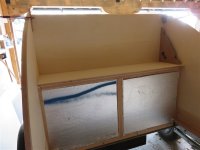
Here's the completed frame of the well cover:

IMG_8384.jpg

IMG_8385.jpg

By now the Hippo 3 had dried in the well box, so I slapped some waterproofing Black Jack on the joints:

IMG_8386.jpg

I'll be bedding some angle over those joints later:

When that dried, I offered it up in place:

IMG_8387.jpg

It didn't fit because of some welds in the corners of the chassis opening. That meant rounding over the corners with a belt sander:

IMG_8389.jpg

.....and then re-Black-Jacking. I offered it in place again, but prevented it from going down more than an inch or two, as I realised it would be virtually impossible to get it back out again. I was only slightly confident it would fit, but nonetheless, gunked up all of the steel with Hippo 3, and dropped it in place:
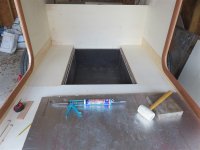
IMG_8391.jpg

Yay!!

There were some funny little gaps between the box and the support straps:

IMG_8392.jpg

I loaded up the box with half a dozen 2" paving slabs:

IMG_8393.jpg

And then wedged the straps up tight to the underside of the box:

IMG_8394.jpg

It's still like that now. I test fitted the well hatch:

IMG_8390.jpg

That was actually out of order, as I test fitted that prior to fitting the well box.........otherwise the astute of you would have worked out that removing the lid would be a hell of a task. Anyway, all was well.

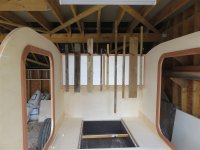
The next frame was the horizontal element of the bulkhead:
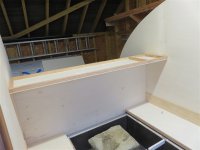
IMG_8398.jpg

IMG_8399.jpg

That's very carefully glued and screwed. One of the purposes of this bulkhead is to isolate the sleeping area from the kitchen both for smells, and for potential gas leaks, so there was lots of PU glue everywhere to make sure that there was no air path through anywhere. I then insulated it:

IMG_8400.jpg

And that's where we're at this evening. My primary task at the moment is limewashing the house, so I fit in a bit of work on the teardrop as-and-when.
 

Attachments

  • IMG_8388.jpg
    IMG_8388.jpg
    170 KB · Views: 6
Last edited:
Coming on nicely Mike. (y)

It's a moot point now but I'm curious why you built the box out of phenolic ply when it would have been easy to fabricate one out of aluminium sheet. Lighter, just as strong with support straps and as easy to weatherproof the joints?

Just the way I'd have approached it.
 
Coming on nicely Mike. (y)

It's a moot point now but I'm curious why you built the box out of phenolic ply when it would have been easy to fabricate one out of aluminium sheet. Lighter, just as strong with support straps and as easy to weatherproof the joints?

Just the way I'd have approached it.

It's only because it's what I have, and what I know, Bob. Doing it again, I would almost certainly get someone to fold something up for me in aluminium.
 
It's only because it's what I have, and what I know, Bob. Doing it again, I would almost certainly get someone to fold something up for me in aluminium.
What I have and what I know, how often that affects our thinking. But in this case not bad to have a bit of low down weight? I don’t think your Teardrop is going to weigh very much at all so anything to stop it bouncing down the road is good.
Terrific wip on the build Mike, following with great interest when time allows.
 
...... in this case not bad to have a bit of low down weight.....

Exactly what it's there for: to put the heaviest stuff on the trailer low down over the axle (well, notional axle in this instance).
 
I didn't get a lot of time on the teardrop this week, but made some good progress nonetheless. I completed the bulkhead by applying the top sheet of ply to the shelf element, and then framing up the remaining vertical piece, gluing and screwing it in place, then insulating and ply-ing it:

IMG_8401.jpg

IMG_8403.jpg

IMG_8404.jpg

IMG_8405.jpg

I then glued on the remaining face of 6mm ply:

IMG_8409.jpg

IMG_8410.jpg


On to the roof!!!

I started by using a spline (an offcut from the endless piles of Douglas fir I ripped up months ago) to mark out the key positions of the profile, like where curves started and stopeed, and where the bulkhead was located, so that I could plan the ply locations for the roof. What I really wanted to avoid was joints between sheets on the tightest curve. So, here's the spline:

IMG_8406.jpg

IMG_8407.jpg

I then took this to a scaffold board, just because it was convenient, and played with it a bit until I was happy:

IMG_8408.jpg

I realised that I would lose easy access to the sleeping area when the roof went up, which could make bolting the floor down a more awkward job.......so I spent a while under the trailer drilling up through all the various holes. Some of them were too close to the chassis to allow use of a cordless, so I ended up using a brace. I also gunked up around the well whilst I was under there:

IMG_8411.jpg

I also realised it would be easier to do the roof if I could stand inside, so I needed the well lid in place. To that end, I fixed on some nylon strap handles. They'll do until I think of something better:

IMG_8412.jpg

IMG_8413.jpg

Back to the roof.....

From 6mm ply of the walls and bulkhead, all the action now involves 3mm ply. I clamped 3 sheets together and cut them all to the same length. This is one of those moments where you check the measurement and marking out obsessively, 3 or 4 times. Once you get this far you are committed:

IMG_8414.jpg

If there was any one moment in the build of this teardrop that I have thought about over and over, and perhaps worried about a little, it was bending the roof over the tight curve. I hadn't bought expensive bendy ply......just normal 3mm poplar ply........so trying it around the bend was quite tense.

IMG_8415.jpg

Phew!! It didn't even creak.

I cut a few of the roof timbers to length, drilled a screw hole at each end sinking the head some 25 or 30mm, and began the glue-up of the first couple of bits of ply. I had 2 roof timbers which were wider than the normal 25mm, to deal with joins between the ply sheets:

IMG_8416.jpg

I glued and pinned, and fixed the first roof timbers....by braille. I think it went well, but I'll let you know tomorrow if it didn't:

IMG_8417.jpgIMG_8418.jpg

That feels like quite a moment. I even got to lie inside it for the first time. It felt very roomy.
 
Just another week or so work at your pace Mike. ;)
Where does the dog sleep? Does the poor mutt get shoved out into a cold uninsulated car? :)
 
Where does the dog sleep? Does the poor mutt get shoved out into a cold uninsulated car? :)

The pooch, if she survives that long (she's 14+), will sleep in the awning.
 
The pooch, if she survives that long (she's 14+), will sleep in the awning.
The best place for them. (y) Our 11 year old Labrador didn't bother my wife as she haas a poor sense of smell but I hated the stink of a wet dog in a confined space and ours was a decent sized motorhome.
 
Just going back to the construction of the roof and the junction with the walls for a sec........

Most teardrops (home-made and commercial), are built with the OUTER skin being cut to a pattern and framed up first, and the roof timbers are then fitted in between. Yep, even in big-selling commercial trailers in the USA, the roof timbers are simply fixed with a screw through the external wall into the end grain! People pay $40,000 for fancy teardrops straight from the factory where everything is pocket-screwed, and the roof is just a single screw into end-grain. I find that pretty close to unbelievable. I don't think I've seen one where it is the INNER skin which is framed and shaped, and the roof sits on top. I believe mine is fundamentally stronger for doing it this way.
 
Well I’m sure yours will be much stronger and withstand the twisting and wrenching as it moves. Of one thing I’m sure if there’s an easier cheaper way that can be successful most of the time for enough years it will definitely be used.
 
I still remember our school maths teacher spending quite some time explaining why he thought our brand new desks were poorly made, pointing out the screws into end grain that had been used. In retrospect, it was a more useful lesson than learning how to solve quadratic equations!
 
I've been abroad for 10 days, so no great progress to report on anything. Here's a couple of photos left over from last time, to catch up:

The roof timbers on the tightest part of the curved roof needed (I felt) a little relief in the middle to help them sit flat. I roughed out (and I mean ROUGH) a shallow groove up the middle so that they had 2 points of registration rather than one:

IMG_8419.jpg

A couple of the "joists" (spars?) were a little difficult to mark on the inside to give me a clue as to where to fire the nails. Turns out, if you park it under the light, there is no issue:

IMG_8420.jpg

We ran out of shavings for lighting our fire, so I needed a quick planing project. The bottom roof timber, where it meets the floor and the frame, provided an ideal candidate, so I bent one of the Cedar finishing strips into place and held it however I could:

IMG_8423.jpg

......and used it to mark up the pair of timbers at the bottom front edge of the roof:

IMG_8422.jpg


IMG_8425.jpg

Then started planing:

IMG_8440.jpg

IMG_8441.jpg

A quick glue-up ensued:

IMG_8442.jpg

Much more importantly than that..........we'll have another good fire this evening.
 

Attachments

  • IMG_8424.jpg
    IMG_8424.jpg
    164.9 KB · Views: 13
I didn't get a lot of time on the teardrop this week, but made some good progress nonetheless. I completed the bulkhead by applying the top sheet of ply to the shelf element, and then framing up the remaining vertical piece, gluing and screwing it in place, then insulating and ply-ing it:

View attachment 36097

View attachment 36098

View attachment 36099

View attachment 36100

I then glued on the remaining face of 6mm ply:

View attachment 36104

View attachment 36105


On to the roof!!!

I started by using a spline (an offcut from the endless piles of Douglas fir I ripped up months ago) to mark out the key positions of the profile, like where curves started and stopeed, and where the bulkhead was located, so that I could plan the ply locations for the roof. What I really wanted to avoid was joints between sheets on the tightest curve. So, here's the spline:

View attachment 36101

View attachment 36102

I then took this to a scaffold board, just because it was convenient, and played with it a bit until I was happy:

View attachment 36103

I realised that I would lose easy access to the sleeping area when the roof went up, which could make bolting the floor down a more awkward job.......so I spent a while under the trailer drilling up through all the various holes. Some of them were too close to the chassis to allow use of a cordless, so I ended up using a brace. I also gunked up around the well whilst I was under there:

View attachment 36106

I also realised it would be easier to do the roof if I could stand inside, so I needed the well lid in place. To that end, I fixed on some nylon strap handles. They'll do until I think of something better:

View attachment 36107

View attachment 36108

Back to the roof.....

From 6mm ply of the walls and bulkhead, all the action now involves 3mm ply. I clamped 3 sheets together and cut them all to the same length. This is one of those moments where you check the measurement and marking out obsessively, 3 or 4 times. Once you get this far you are committed:

View attachment 36109

If there was any one moment in the build of this teardrop that I have thought about over and over, and perhaps worried about a little, it was bending the roof over the tight curve. I hadn't bought expensive bendy ply......just normal 3mm poplar ply........so trying it around the bend was quite tense.

View attachment 36110

Phew!! It didn't even creak.

I cut a few of the roof timbers to length, drilled a screw hole at each end sinking the head some 25 or 30mm, and began the glue-up of the first couple of bits of ply. I had 2 roof timbers which were wider than the normal 25mm, to deal with joins between the ply sheets:

View attachment 36111

I glued and pinned, and fixed the first roof timbers....by braille. I think it went well, but I'll let you know tomorrow if it didn't:

View attachment 36112View attachment 36113

That feels like quite a moment. I even got to lie inside it for the first time. It felt very roomy.
Mike, what material will you use to insulate the ceiling roof cavity etc.?
One intricate and impressive design build!
 
I'll be using the same PIR insulation ("Celotex"), but because of the curves I will use 40mm thick boards in the 50mm space I've got, and filling the gaps with spray foam. There'll be lots of scoring-and-breaking to get the Celotex to follow the curves as best it can. I'm still working on the house at the moment whilst the scaffolding is up, so nothing is happening on the teardrop.
 
I've spent the lasty 7 or 8 weeks on the scaffolding around my house (I'll post on that next week when the scaffold is taken away), so I've not been able to do any work on the teardrop. Well, I finished the outside work on the house a couple of days ago, and between doing some actual drawing work (I'm easing down towards retirement), I managed to get some time in the garage.

My focus has moved to the galley (kitchen). Here's where I started:

IMG_8480.jpg

The galley floor isn't a simple thing, because I had decided on a fairly substantial, but shallow, storage area below the floor proper. This was to throw up some awkward details and junctions. I started with my last pieces of phenolic ply, and made a very simple box/ tray:

IMG_8479.jpg

The big deal with this detail is the presence of the "corner steadies" (jacks). The storage had to allow them to work unimpeded. Here's a dry fit:

IMG_8481.jpg

That allowed me to accurately measure the depths, and make a central divider:

IMG_8482.jpg

Its walls, and particularly the central divider, act as support for the proper floor. So, the next task was to cut out the floor itself from some 12mm ply, and create two access hatches:

IMG_8483.jpg

Those hatches aren't the same size. By making one bigger than the other, I was able to take the off-cut from the bigger hatch and trim it to act as the hatch for the smaller hole. I didn't order much spare ply, so can't afford unnecessary wastage. Here it is dry-fitted in situ:

IMG_8484.jpg

I glued some strips along the long edges and left them clamped overnight. These will support the lids:

IMG_8485.jpg

Here's the "after" photo:

IMG_8486.jpg

I did a quick check of the fitting of the fridge, which determines the rest of the kitchen layout:

IMG_8488.jpg

In particular, I wanted to look at the cable and plug, and see how this was going to work with the wood covering the chassis:

IMG_8489.jpg

That's not very revealing to you, but it shows that although things are tight, they're going to fit. I also gave me the thickness of the pieces of wood needed to cover the steel:

IMG_8487.jpg

Now, if all of the nuts had just spun off the bolts, then fitting the cover pieces, and gluing, bolting and fitting all of the rest of the floor build-up, would have been a doddle. Unfortunately, one of the nuts wouldn't come off, and with it being a sunken dome-headed coach bolt, I had problem. Here you can see the results of me trying everything I knew to undo the nut:

IMG_8490.jpg

Butchery!!

In the end, I took an angle grinder to it:

IMG_8491.jpg

That was an hour wasted, and caused me to deepen the hole for the coach screw head by 3mm...which will knock-on to a 3mm reduction in drawer width. That's fine, but annoying. Space is at a premium in these little things. Anyway, I eventually got the cover pieces made, and everything glued, bolted, pinned, screwed, and sealed:

IMG_8492.jpg
 
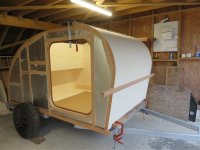
It was a particular relief to get the roof back on just days before storm Claudia arrived!
 
Mike, faced with a similar issue but on seized nuts I have taken to drilling a hole down the nut wall parallel to the bolt.
The right size drill bit leaves just enough to keep the bit captive and then you cold chisel away the nut.
Results in minimum damage to the bolt threads and just a replacement nut is required.
Cheers. Andy
 
Last edited:
I have in the past used a nut cracker. All depends if you have enough room to fit the tool.
 

Attachments

  • IMG_5037.png
    IMG_5037.png
    198.9 KB · Views: 3
I haven’t encountered stuck nuts too often, but I had one that was temperature related and one that was caused by pressure from the material through which the bolt passed. On the second of these, using a spreader to exert pressure on the material either side of the nut allowed it to rotate again.
 
Mike, faced with a similar issue but on seized nuts I have taken to drilling a hole down the nut wall parallel to the bolt.
The right size drill bit leaves just enough to keep the bit captive and then you cold chisel away the nut.
Results in minimum damage to the bolt threads and just a replacement nut is required.
Cheers. Andy
I'll give that a try in a different circumstance, Andy, but the problem here was that the coachbolt was spinning, and I didn't want to damage the galvanising of the chassis.
 
Initially, Phil, I'd planned on the left hand one being where all the electrical connections would happen, so consumer units, solar controller, isolating switches etc. It now looks like most of that is going to happen in the well under the sleeping area. So, I imagine it will be for infrequently used items like tool rolls, spares, and so on. The other, under the fridge, is more accessible, and will likely be for hook-up cable, ropes, pegs, and so on, as well as dust pan & brush, bin bags etc.
 
I spent half a day doing a series of mundane and un-photographable tasks, such as changing all the temporary nuts with Nyloc nuts (and gunking up under the washers with a sealant). I also bolted up the well for the first time. One of the more exciting elements of this was being unable to access two of the holes in the frame from the frame side, and having to drill into the ply and hope to hit the holes! Add to this that marking on phenolic ply is all but impossible, and it turned into quite a good game. It makes an awful photo:

IMG_8493.jpg

.......but I succeeded perfectly with one, and with a slightly oversized hole for the other.That's something else I would change were I ever to go through this process again.

I ply-ed the kitchen side of the bulkhead between the kitchen and the sleeping area:

IMG_8494.jpg

IMG_8495.jpg

IMG_8496.jpg

At just about that precise moment I received a delivery. It was the camping table which is going to live aboard the teardrop. It's a nasty piece of cheap Chinese crappery, but it's the right size, and very light. It's arrival meant I could do a quick check as to whether everything would fit in place:

IMG_8497.jpg

.........because that's where it will live. And yes, it all works. Having been burnt too often, I've come to distrust dimensions given on the internet, so that was something of a relief.

I am now spending the evening trying to find the right hob and sink, because their dimensions also have consequences for stuff I want to be building soon.

Who here likes Gaudi?
 
Last edited:
Mike, not a fan of Gaudi. I find his style disturbing, similar to the artist Edvard Munch.
Guess we’re all different, it’s what makes this world interesting
 
Not a fan but we certainly found the various works in Barcelona more than interesting, especially the Familia. It was a long time ago and I can't remember the names but the images stay with me.
 
I suspect you're will be a tad better built and better looking than this one on facebook Mike....
I hope so!! That shape are known as a "square-drop", rather than a teardrop. That looks like a typical single skin ply box, with a bed-liner paint finish (or maybe "poor man's fibreglass"). Which is great, for what it is (ie a quick and cheap way to get out camping). I just can't see how a single door can work. If there's two of you, one will have to climb over the other at some point.
 
Why do you ask? Isn’t he most famous for designing things that take 100s of years to finish?
Ooooh...he's only got one unfinished building, and that should finish in the next 2 or 3 years. And it's vast.

Take a look at some of his furniture, and interiors, particularly the doors and screens. In particular, the interiors of Casa Batlla and Casa Mila.
 
Back
Top