• Hi all and welcome to TheWoodHaven2 brought into the 21st Century, kicking and screaming! We all have Alasdair to thank for the vast bulk of the heavy lifting to get us here, no more so than me because he's taken away a huge burden of responsibility from my shoulders and brought us to this new shiny home, with all your previous content (hopefully) still intact! Please peruse and feed back. There is still plenty to do, like changing the colour scheme, adding the banner graphic, tweaking the odd setting here and there so I have added a new thread in the 'Technical Issues, Bugs and Feature Requests' forum for you to add any issues you find, any missing settings or just anything you'd like to see added/removed from the feature set that Xenforo offers. We will get to everything over the coming weeks so please be patient, but add anything at all to the thread I mention above and we promise to get to them over the next few days/weeks/months. In the meantime, please enjoy!

New garage shop

Repairs under way. The electrics sitting on the dust bin are garage door sensors that trigger a flashing light when the bin is full.


DADDC754-8488-463C-8F24-E5A83F2592B2.JPG
 
Now that is a really cool idea, no doubt the light comes on as the shavings pass between but you probably just ignore it.
My setup will have the extractor in the “attic” above my combo mc and it will be too easy not to check how full it is, I got into an unbelievable mess once when I didn’t check my big three bag extractor!
Is it hard to use the detector as a light switch?

IMG_1210.jpeg
 
There is a logic board controller that includes a built in 10 second delay before it triggers the light. Dust swirling down the cyclone doesn't block enough light to trigger it. I bought the controller about 15 years ago from some woodworker and it has worked flawlessly since. Saved me several times from filling the filters.

If I was getting a sensor today I think I'd build this one:

 
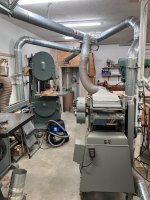
All done with the ducting except for the last connection to the band saw. The ducting to the planer/thicknesser is a quick disconnect so I can move the machine out of the way when not in use.

723F2BB9-812E-48B4-A403-F70C0DAC6F0C.JPG

I'm also working on the closet door. This is an experiment: a sand filled door. I read about these on a soundproofing forum. It is a DIY solution for those who are building home sound studios. 1/4" ply, construction pine, clean sand. The front face is glued to the frame. The back plywood face is attached with sound dampening compound and screws. It is a heavy beast. I hope four ball bearing hinges will be enough. I have extra long hinge screws to drive into the tripled closet framing studs.

6CD907AE-86C8-49BF-B56C-44D74F90432D.JPGAEF4E181-44CE-4321-86E0-4C3F669FFC6D.JPGD0AC5973-01FF-43DE-A388-331E0354EB30.JPG
 
It is mostly masons sand since I had some around. But that wasn't enough. The rest all-purpose sand since that is what the local hardware store had available. I don't think the type of sand matters much as long as it is clean and dry.
 
For acoustic dampening, you want it to be as heavy as possible. Thermal insulation is generally as light as possible, and wouldn't have the same effect at all.
 
Yes, I was going for dense mass, similar to the walls. The plywood might belly out a little and that may leave some empty space at the tops of the voids. But the ply is held securely all along the edges of the voids. I don't think it will bend much.
 
Plaster day. The work sequence was to trim the wall first and plaster up to the trim border. The trim is unfinished American black cherry, hand planed to remove milling marks. The plaster is a 1: 0.5: 0.6 weight ratio of earth from my back garden : toilet paper: hydrated lime. The toilet paper was pulped with a paddle mixer in water and that pulped slurry was added to the earth and left to ferment for three weeks. Nothing magical about three weeks, but letting it ferment for a while does make the consistency smoother. I added the lime this morning, mixing with additional water to get a spreadable consistency.

It isn't dry yet and will still get a couple more rounds of compressing and polishing to remove trowel marks before it sets completely.D8F5A205-10A2-43CB-A7D6-F830C7B73D9A_1_105_c.jpeg01DE71C9-DE9A-42DE-9AC9-AF5FFE4897CC_1_105_c.jpeg

8985D56E-9B1D-44CE-B6B6-CC40579E333E_1_105_c.jpeg
 
Earth plaster is widely available, non-toxic, easily repaired, completely re-usable (if you don't add lime), and is literally dirt cheap. It also can be done in a variety of natural colors that don't fade.

I also like the idea of working with a building material that has been used all over the world for thousands of years. A timeless way of building.
 
Earth plaster is widely available, non-toxic, easily repaired, completely re-usable (if you don't add lime), and is literally dirt cheap. It also can be done in a variety of natural colors that don't fade.

I also like the idea of working with a building material that has been used all over the world for thousands of years. A timeless way of building.
Brill thanks, I like all those qualities!
 
The plaster looks great. Is that the the same technique you learned on the course you wrote about?
Yes, it is one of the finishes we learned about.
Brill thanks, I like all those qualities!
I will say that it has several disadvantages: being rather soft it is relatively easily damaged and it is labour intensive and time consuming.
 
The plaster is mostly dry and the lime is at least partially set. It looks a little blotchy I think because of the excessively short strokes we used when leveling and smoothing the surface. But I'm ok with some variagation. Makes it look hand made rather than a perfect industrial finish. The surface resists a fingernail. I've gone ahead mounted the saw till and a drill bit cabinet, held on by French cleats screwed through to the resilient channel. I have the door provisionally mounted and I'm working on the rest of the trim boards.

AF7124BF-2529-4979-BFCC-F8D4C10A7BC4_1_105_c.jpeg0A53CA82-55F1-40AA-9D69-27D8E9C470E5_1_105_c.jpeg
 
Good word Variagation.
You are definitely upsetting me Gary with all your workshop fitting out, mine is untouched in weeks due to moving etc, I have three windows to fit when I get back to Boston, just hoping the Beast from Indiana doesn’t drop too much snow which will really mess things up!
Doesn’t help that I’m back in the uk for a visit, timing Ian!
 
More progress. The door is fit and weather sealed and the closet is functional. I measured the noise level at my bench using an app on my phone. With no closet it was about 95 decibels. With closet but no door it was about 85 db. With the door closed and sealed it is 75 db. Once I fit a proper cover for the space above the door I hope to get it down to 70. More plastering to come, too.


A5C88BDC-8E80-4103-941B-44CEFBDF6C5C_1_105_c.jpeg
 
@GaryR, how large is the opening from the closet to the attic space for the return air?

When I built my basement shop dust collection closet, I underestimated the size of the door vent to return the filtered air back into the shop. I tried to size the opening such that it wouldn't restrict the airflow and wouldn't create a mini wind storm in the shop. Unfortunately, the single 250 x 430mm expanded metal grate is too small for the volume of air passing through the filters.

DC-Closet-Vent.jpeg

With the blower motor running, the door on the left will stay open about three inches if I try to close it. When I close the door, I can also see a slight increase in the Oneida backpressure gauge I use to monitor the filter efficiency. Leaving the door open reduces the backpressure. When I have time, I will either enlarge the existing opening to twice its size, or add a larger vent opening in the left door.

I'm not concerned about noise since I always wear hearing protection when using any of the machines. None of the shop noise can be heard in the rest of the house.
 
I have read that the exhaust sectional area should be at least twice that of the inlet. The inlet here is 6" duct (about 28 inches square) and the exit is 5" x 15" or 75 inches square. I haven't measured the static pressure yet.
 
I have read that the exhaust sectional area should be at least twice that of the inlet. The inlet here is 6" duct (about 28 inches square) and the exit is 5" x 15" or 75 inches square. I haven't measured the static pressure yet.
Based on my experience, this is not adequate. In my 3HP cyclone system, assuming no more than 50-percent of the expanded metal screen is open, this is about 83 square inches for the exhaust. The inlet pipe is 120mm, or about 18 square inches. A factor of four is not enough to eliminate the backpressure in the closet.

One way to check if the exhaust area is adequate is to close the closet door to the point just before it latches, but still swings freely, and turn on the DC. If the door remains closed, then the exhaust port is adequate. If the door opens, as in my case, then the exhaust is not adequate.
 
Last edited:
I think you are right about the venting but there are tradeoffs. For example if you have to buy ducting for the exhaust. Large diameter ducting gets expensive.
In my previous shop I also had a 6 inch inlet duct and used an 8 inch exhaust duct. I had a manometer connected to the setup and the static pressure (with clean filters) was I think three inches of water. Most of that was from the filters. I don't have the gauge connected to my new system yet.

Almost done with the plastering. For the front I set a layer of just earth/sand plaster first, followed by the earth/lime mix.

7FCD0304-0FC2-4E97-8DAE-DABB54960D73.JPG


Earth/sand, still wet:
51F891CB-5C66-4DB5-9328-4989AB5BDE5E.JPG


Earth/lime, starting to set up.
195B0BF5-1AA0-44B8-AD60-32886C41D472_4_5005_c.jpeg
 
All done plastering. It isn't completely dry but the lime has set. Now I just have to mount the access panel, the bin full warning light, and the manometer.


AFB7906E-8774-467B-B70E-8F54C101CDAF_1_201_a.jpeg
And here is what the finish looks like. Some hairline cracks. I think I had the mix a little too wet. But I it does add some interest to the look. More character than a film of paint.

27389732-9DAC-4B33-9DB8-C184DE130557.JPG
 
All done with the closet. The earth plaster access panel will finish drying in place. Sealing around the duct looks kludgy but it works.

The only other major shop task is to install a sink. That's for next year.

Enclosing the dust collector took its sound level measured from my workbench from 95 decibels (painful) to 71 decibels (tolerable).

31C34A32-4168-4E7A-AC8E-C767FA9EDFFD_1_201_a.jpeg
 
Looks great Gary, the ducting is a work of art! I remember the first time I set to designing a duct layout it wasn’t at all easy and took a bit of lateral 3d thinking to get it right.
Lovely work space,
I can but dream at the moment with the floor nearly finished lol.
 
Back
Top