kirkpoore1
Old Oak
I got other projects done, and with all the Covid-19 hooey going on it's good to have a project at home.
The C.O. Porter Machinery Company started in the late 19th century as C.O. & A.D. Porter. They made a wide variety of heavy industrial woodworking equipment, and lasted well into the 1980's before being finished off by a product liability lawsuit. Based on the surviving machines displayed on the Vintagemachinery.org website, their most popular products seem to have been jointer (i.e. planers), shapers (spindle molders), and overarm routers.
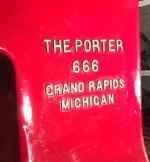
This particular machine is a Model 666. It was probably built between 1930 and 1960, most likely in the middle of that range. This is the sales photo:

This machine is about as small an OAR as Porter (or most industrial manufacturers) made. It has a 15" throat and the vertical table travel is about 3" (the table lifts the work into the bit). It has a 3 hp 3ph motor, and the spindle runs about 20000 rpm. It has a 1/2" collet. The router is dirt simple. A foot pedal raises the table. The pedal and table can be adjusted to change the top and bottom of the lifting range, so that you can drop the table and machine a thicker piece of wood, for example. Aside from the table, only the motor, spindle, and belt move. It has a magnetic starter with a remote push button station mounted on the front of the table.
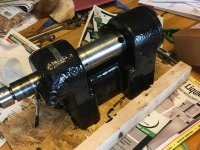
I don't know the history of the machine. I bought it from a machinist who lives near Bloomington IL. He used it to machine aluminum for some musical instruments. When I got it I knew the bearings were shot, but we checked and found that the old collet was also wallowed out and the bit was spinning nearly .01 out of round. He offered to just give me the machine. Instead, I hired him to put in new bearings and replace the collet. New, high speed bearing for this machine were Not Cheap. I wound up spending nearly $300 each for the bearings, $400 for machining and shipping the spindle, and another $100 for the belt. So I'm at about $1100, and I'm not done yet with the little stuff.
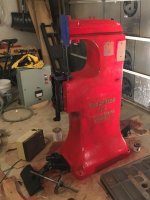
The plan on this machine is a "rattle can resto", meaning a general cleanup and paint job. I'm going to take some of the easy stuff off, clean as much as I can, repaint, and reassemble. The motor runs well and doesn't seem to need bearings yet. Table travel is as smooth as a baby's butt.
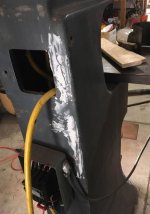
The router came to me in it's original blue-gray colors. There are various dings in the body filler on the main cast pedestal, so I figured I would fill them in. I got some bondo from a friend and filled up a number f the scratches in the surface, then sanded down the filler.

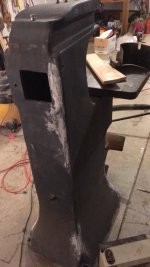

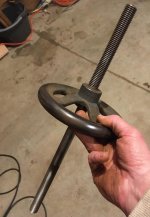
I removed a few parts, including the table, the pin (for use with patterns), and the handwheel for setting the pedal travel.
I sanded and brushed down the whole machine to remove dirt, and then started with a spray can of primer. I barely got started when the can of paint, admittedly over 5 years old, decided to clog up. That was it for tonight.

Tomorrow I'll buy another can of primer and go at it again, following up with the outer coat of paint after the primer is dry.
Kirk
The C.O. Porter Machinery Company started in the late 19th century as C.O. & A.D. Porter. They made a wide variety of heavy industrial woodworking equipment, and lasted well into the 1980's before being finished off by a product liability lawsuit. Based on the surviving machines displayed on the Vintagemachinery.org website, their most popular products seem to have been jointer (i.e. planers), shapers (spindle molders), and overarm routers.
This particular machine is a Model 666. It was probably built between 1930 and 1960, most likely in the middle of that range. This is the sales photo:
This machine is about as small an OAR as Porter (or most industrial manufacturers) made. It has a 15" throat and the vertical table travel is about 3" (the table lifts the work into the bit). It has a 3 hp 3ph motor, and the spindle runs about 20000 rpm. It has a 1/2" collet. The router is dirt simple. A foot pedal raises the table. The pedal and table can be adjusted to change the top and bottom of the lifting range, so that you can drop the table and machine a thicker piece of wood, for example. Aside from the table, only the motor, spindle, and belt move. It has a magnetic starter with a remote push button station mounted on the front of the table.
I don't know the history of the machine. I bought it from a machinist who lives near Bloomington IL. He used it to machine aluminum for some musical instruments. When I got it I knew the bearings were shot, but we checked and found that the old collet was also wallowed out and the bit was spinning nearly .01 out of round. He offered to just give me the machine. Instead, I hired him to put in new bearings and replace the collet. New, high speed bearing for this machine were Not Cheap. I wound up spending nearly $300 each for the bearings, $400 for machining and shipping the spindle, and another $100 for the belt. So I'm at about $1100, and I'm not done yet with the little stuff.
The plan on this machine is a "rattle can resto", meaning a general cleanup and paint job. I'm going to take some of the easy stuff off, clean as much as I can, repaint, and reassemble. The motor runs well and doesn't seem to need bearings yet. Table travel is as smooth as a baby's butt.
The router came to me in it's original blue-gray colors. There are various dings in the body filler on the main cast pedestal, so I figured I would fill them in. I got some bondo from a friend and filled up a number f the scratches in the surface, then sanded down the filler.
I removed a few parts, including the table, the pin (for use with patterns), and the handwheel for setting the pedal travel.
I sanded and brushed down the whole machine to remove dirt, and then started with a spray can of primer. I barely got started when the can of paint, admittedly over 5 years old, decided to clog up. That was it for tonight.
Tomorrow I'll buy another can of primer and go at it again, following up with the outer coat of paint after the primer is dry.
Kirk