• Hi all and welcome to TheWoodHaven2 brought into the 21st Century, kicking and screaming! We all have Alasdair to thank for the vast bulk of the heavy lifting to get us here, no more so than me because he's taken away a huge burden of responsibility from my shoulders and brought us to this new shiny home, with all your previous content (hopefully) still intact! Please peruse and feed back. There is still plenty to do, like changing the colour scheme, adding the banner graphic, tweaking the odd setting here and there so I have added a new thread in the 'Technical Issues, Bugs and Feature Requests' forum for you to add any issues you find, any missing settings or just anything you'd like to see added/removed from the feature set that Xenforo offers. We will get to everything over the coming weeks so please be patient, but add anything at all to the thread I mention above and we promise to get to them over the next few days/weeks/months. In the meantime, please enjoy!

Spindle Moulder Fence material

Scholar

Seedling
Joined
Apr 9, 2024
Messages
6
Reaction score
3
Hello All

I am pondering the spindle moulding fence set up on my Hammer B3 Saw/Spindle Moulder.

The fence plates consists of two aluminium extruded sections that are secured to the spindle moulding hood by a T-slot in the rear.

I ordered a new set of fence plates from Felder and have been machining some inserts with t-slots to take a replaceable sacrificial centre fence section. This is going fine, but I have just realised that the front faces of the aluminium fence section extrusions are significantly out of true. One is concave by about 0.3mm and the other is convex by about 0.3mm, giving a step in the middle (if the respective top and bottom edges are aligned) of about 0.6mm. This is frustrating and makes my careful milling of the inserts a bit pointless.

I have complained to Felder and I will see what they say.

Anyway, this has caused me to review the whole set up and whether I should just make some replacement fence plates myself.

I googled the problem and came across this thread from a while ago https://www.thewoodhaven2.co.uk/threads/quite-flat-steel.5604/ which was interesting.

The options I have been thinking about are:
- new fence plates from solid phenolic (my Jessem router table has a solid phenolic top and fence and this seems very straight and stable)
- new fence plates from solid surface ground aluminium plate (I think this would be very heavy and expensive)
In both these cases, I could machine some appropriate accommodation for some aluminium t-slot track sections to fix the replaceable sacrificial centre sections.

I would be interested to know if anyone has any helpful suggestions to achieve this, in particular any ideas of where I can get suitable phenolic. the existing fence plates are 24mm thick (see picture below).- the Jessem router table top is ¾” thick.

Cheers
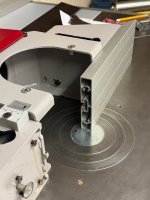
IMG_1107.jpeg
 
If it helps, on that thread you linked to, I eventually went with the ground flat plate. It was expensive but it was my only option at the time before I had a milling machine. It was also an absolute workout to hacksaw the clearance angles on each side of the plates, probably an hour of cutting on each side!

Are you measuring the fence plates on the machine? If those screws aren't properly adjusted behind the fence plates you will end up with probably about that much of an inaccuracy, you could probably adjust the screws to counteract it while it's tightened. I would consider 0.3mm pretty good accuracy for an extrusion on a lower-end machine (high-end hobby machine), unfortunately it's doubled up, which is causing a 0.6mm discrepancy. If you can't adjust the discrepancy out with the screws, I would be very tempted to try and press out the discrepancy from the fence plates with some clamps.

Phenolic sheet (Tufnol) would be hideously expensive in that size, and probably not much more accurate. Machining aluminum wouldn't work unless you had them annodised after machining as it wears terribly without the oxide layer on and leaves black marks on the wood.
 
I’m wondering if you are worrying about nothing? When I had my Hammer I simply tapped a few threads into the aluminium fences and then bolted a piece of thin ply spanning them both. Fire up the spindle moulder and gradually move the whole assembly forwards letting the cutter bite through thus creating that false fence.

I never noticed any problems.
 
Yorkshire workshop on youtube made an adjustable fence for his spindle. Alot of work but works well.
 
I'd agree with Roger and just fix ply to the existing fence and shim it where or if necessary. I did that when I had my Robland / Startrite planer thicknesser.
You could do the same with a length of thinner Tufnol maybe 6mm or 10mm and you can get that from any of the plastics suppliers, look for Amari Plastics who may have a branch near you if you want to buy locally or any of them on line. It isn't cheap and as trevanion said would be very expensive in 24mm thickness.

Put a clothes peg on your nose when drilling or machining as it stinks. :ROFLMAO:
 
Thanks for all the comments thus far.

The problem has come to light because I am making some t-track inserts that will locate in the web of the extruded plates - these will allow the fitting of a sacrificial board inserted flush between the two plates, rather than adding to the depth. (To be fair, I cannot remember the last time I ever maxxed out on cutting depth on my previous spindle moulder, but I am trying to end up with the neatest solution I can.

I will see what Felder have to say - I would be happier if both fences were convex on the front face as the convex one does pull almost straight (at least at the end close to where the fixing bolt is located) when it is properly clamped with the securing bolt from the rear. The concave one does not straighten of course.

I have tried gently (well firmly) straightening the concave one by clamping it to a cast iron machine top and supporting the two proud edges on some shims, but this made no difference so far. I may try being more radical.

I was thinking that Tufnol in 20mm or 25mm should be flat and stable(?) As I mentioned, my Jessem router table top and fence are solid phenolic of some sort (these are faced with what I assume is heavy duty melamine).

Good point about needing to anodise aluminium if I go down that route.

Just for info, what I am trying achieve is similar to the Hammer kit partially illustrated below, but with t-slots which will allow for quicker fitting and removal of the sacrificial insert.


IMG_0471.jpeg

Cheers
 
I still think 'sledgehammer' and 'walnut' but then again I'm Roger the Bodger :) Well, not that bad but I made up load of blank sheets of thin ply, pre-drilled. Ten minutes and I've got a new one in place and the false fence is obviously spot-on. In comparison I don't know how much time you're proposed project will take but I admit it is very elegant.
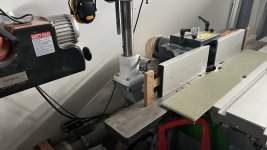
 
I do the same as Rodger, only my fixing is to a tee piece that slots in the fence.
I make a new sacrificial fence for the job, all heights, depths, speeds and any notes are wrote on the fence so next time I set up its super fast and repeatable.
 

Attachments

  • IMG_9757.jpeg
    IMG_9757.jpeg
    126.5 KB · Views: 21
My first spindle moulder had warped extruded fence pieces like that. I put them through the drum sander, convex side up first, then flipped them over. After that, some wooden pieces on top, as they’re easier to screw things to, eg a false fence, or outfeed extensions if the whole face is being machined away.
 
I do the same as Rodger, only my fixing is to a tee piece that slots in the fence.
I make a new sacrificial fence for the job, all heights, depths, speeds and any notes are wrote on the fence so next time I set up its super fast and repeatable.
Oh that is so Brilliant ….👏🏻
 
I can’t even see a third of a mil lol. My Sedgwick fences were a bit short - in my opinion- at the outer ends so I just added a couple bits of Oak to the existing steel ones, there were existing holes to use for the screws!
 
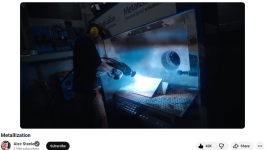
There's a UK company called Metallization, who can seemingly coat anything (i.e. even a credit card)
with anything.
I found the video impressive, to say the least, and I think anyone after seeing it, would be hard pressed to imagine
that this isn't going to become more common.
Although, I haven't seen what they might charge for the likes of this job.
It'd be interesting to read of some ballpark figures, I suppose the car forums might be a good place to look?

Screenshot-2025-12-17 Metallization.png

That said, I'm sure there's a pleasant alternative for peasants, regarding aluminium.

All the best
Tom
 
Last edited:
Back
Top