Hello All
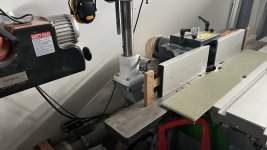
I am pondering the spindle moulding fence set up on my Hammer B3 Saw/Spindle Moulder.
The fence plates consists of two aluminium extruded sections that are secured to the spindle moulding hood by a T-slot in the rear.
I ordered a new set of fence plates from Felder and have been machining some inserts with t-slots to take a replaceable sacrificial centre fence section. This is going fine, but I have just realised that the front faces of the aluminium fence section extrusions are significantly out of true. One is concave by about 0.3mm and the other is convex by about 0.3mm, giving a step in the middle (if the respective top and bottom edges are aligned) of about 0.6mm. This is frustrating and makes my careful milling of the inserts a bit pointless.
I have complained to Felder and I will see what they say.
Anyway, this has caused me to review the whole set up and whether I should just make some replacement fence plates myself.
I googled the problem and came across this thread from a while ago https://www.thewoodhaven2.co.uk/threads/quite-flat-steel.5604/ which was interesting.
The options I have been thinking about are:
- new fence plates from solid phenolic (my Jessem router table has a solid phenolic top and fence and this seems very straight and stable)
- new fence plates from solid surface ground aluminium plate (I think this would be very heavy and expensive)
In both these cases, I could machine some appropriate accommodation for some aluminium t-slot track sections to fix the replaceable sacrificial centre sections.
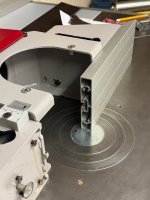
I would be interested to know if anyone has any helpful suggestions to achieve this, in particular any ideas of where I can get suitable phenolic. the existing fence plates are 24mm thick (see picture below).- the Jessem router table top is ¾” thick.
Cheers
I am pondering the spindle moulding fence set up on my Hammer B3 Saw/Spindle Moulder.
The fence plates consists of two aluminium extruded sections that are secured to the spindle moulding hood by a T-slot in the rear.
I ordered a new set of fence plates from Felder and have been machining some inserts with t-slots to take a replaceable sacrificial centre fence section. This is going fine, but I have just realised that the front faces of the aluminium fence section extrusions are significantly out of true. One is concave by about 0.3mm and the other is convex by about 0.3mm, giving a step in the middle (if the respective top and bottom edges are aligned) of about 0.6mm. This is frustrating and makes my careful milling of the inserts a bit pointless.
I have complained to Felder and I will see what they say.
Anyway, this has caused me to review the whole set up and whether I should just make some replacement fence plates myself.
I googled the problem and came across this thread from a while ago https://www.thewoodhaven2.co.uk/threads/quite-flat-steel.5604/ which was interesting.
The options I have been thinking about are:
- new fence plates from solid phenolic (my Jessem router table has a solid phenolic top and fence and this seems very straight and stable)
- new fence plates from solid surface ground aluminium plate (I think this would be very heavy and expensive)
In both these cases, I could machine some appropriate accommodation for some aluminium t-slot track sections to fix the replaceable sacrificial centre sections.
I would be interested to know if anyone has any helpful suggestions to achieve this, in particular any ideas of where I can get suitable phenolic. the existing fence plates are 24mm thick (see picture below).- the Jessem router table top is ¾” thick.
Cheers


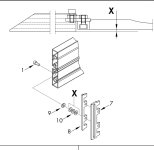
 Well, not that bad but I made up load of blank sheets of thin ply, pre-drilled. Ten minutes and I've got a new one in place and the false fence is obviously spot-on. In comparison I don't know how much time you're proposed project will take but I admit it is very elegant.