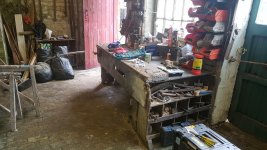
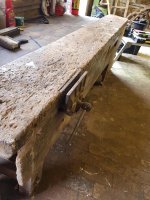
Right, where we we before work interrupted?
Ah yes, I had just patched up an old board to use as a stop parallel to the front edge of the bench. I spent a while umming and ahhing about hole location and spacing, but it all became clear in the middle of a night. I marked everything up on the worktop, and transferred the markings to the stop. Clamping that in place involved a long piece of wood:

I squared up some offcuts to use as a guide, climbed on the bench top, and started drilling:


Using the now-drilled board as a guide ensured that the remainder of the holes were correctly spaced. Some years ago I had bought an old snooker table because I wanted the slate for my hearth. Along with it came a dozen or more snooker cues:

Because of the very gentle taper it was easy to push them in until they fitted, and cut off a section above and below this point to give me the diameter of pegs that I wanted. With an offcut off rubberwood (if that's what it is), I set about making some bench dogs:






I was a bit enthusiastic with the hammer on the first one:

I had a grand tidying session, and thought I'd compare the old bench with the new:


When the glue had set I cleaned up to dogs:

They have to be this sort, rather than the type with a spring and just a round section with a flattened face, because with the big apron and doors it would be a complete pain to retrieve any pegs which got knocked in flush. In addition to work as dogs, they also locate the parallel stop in place. Note the differing distance to the front edge of the bench due to the line of holes being very off-centre:


There are 3 locations for the stop:


The latter will be useful if I ever use the belt sander at the bench, which is very seldom these days.
Right, on to doors. Here are the ones from my old bench:

I was pleased to find they were dry fitted:

I cut all the T&G to length, as well as a 2 ort 3 new pieces saved from the back and sides of the bench. I then planed all the varnish off ono the PT, and re-did the arrises/ grooves with a block plane. Next I found some suitable Douglas Fir to use as ledges. It was absolutely gorgeous close grained and quarter sawn stuff:


There's the planing stops in use already. I've been lost without them for a couple of weeks. After marking and drilling them I used some modern screws as clamps:

This enabled me to take the doors to the saw horses and use a Yankee to drive in the slot headed screws which had held the old doors together:

Rather than trying to hinge directly off the legs, I cut some smaller pieces for the task. Again, note the backstop:

The doors fitted very easily, which is always great. With double doors like this a little twist normally makes things awkward, but there was very little:


I made a little thingamejig to hold the bench dogs:


So that, ladies and gents, is the bench done. It has been fun, but feels very self-indulgent and quite an unproductive time in that I have far more important things to be getting on with. With an hour or two left of the day, I thought I'd tackle this disaster area on the other side of the workshop:

I cleared everything away. Note the position of the right hand leg:

I moved the leg, and re-fitted the hinged router table in an altered location:

I rewired the remotely switched socket which turns the router on and off, and made a little shelf for my battery chargers:


The re-located leg left me a space for the set of shelves which house sanding belts, clamping block thingies, and a whole lot of floating tongues from the days when I used to use such things. The bigger bench had left it homeless:

It might take me a long while to get used to walking into the workshop and seeing a new overly-smart thing where my bench used to stand. In the short time I've been using it, though, I've discovered a couple of things. Firstly, the height is much better. I really enjoy not stooping all the time. Secondly, when you've twice as much space you get lazy and just leave tools lying around in your way. A small bench forces a discipline on you.


 It is proud. Therefore I have a a packer and support for planing long deep pieces which should be self supporting from a dowel. That does not work properly because it does not fit 100% parallel to the apron. I also planned to make a large version from 3x2 say 30” long so that I could clamp work to the apron vertical to work on it in such a way that the weight and stress is taken by the jig and any clamp simply stops the work from moving. That proved impossible.


 )
)
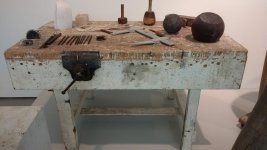

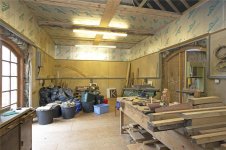
 I think everything on the bench is second hand other than the front two boards of the top, and the apron.