• Hi all and welcome to TheWoodHaven2 brought into the 21st Century, kicking and screaming! We all have Alasdair to thank for the vast bulk of the heavy lifting to get us here, no more so than me because he's taken away a huge burden of responsibility from my shoulders and brought us to this new shiny home, with all your previous content (hopefully) still intact! Please peruse and feed back. There is still plenty to do, like changing the colour scheme, adding the banner graphic, tweaking the odd setting here and there so I have added a new thread in the 'Technical Issues, Bugs and Feature Requests' forum for you to add any issues you find, any missing settings or just anything you'd like to see added/removed from the feature set that Xenforo offers. We will get to everything over the coming weeks so please be patient, but add anything at all to the thread I mention above and we promise to get to them over the next few days/weeks/months. In the meantime, please enjoy!

Mike builds a teardrop (doors, cedar strips, ironmongery)

I share your pain. Template following is fun, until it suddenly isn't.

But honestly it's looking beautiful. I wonder if you'll hesitate to take it out in all but the best weather - I would, after that much careful work...
Thank you, EtV. Without an indoor living space or bathroom, it's very much glorified camping......and not many people willingly go camping in the rain.
 
I am having a tough time finding suitable hinges and door locks. I've already bought some hinges which won't work, so I am trying again. There are a number of complications.......but here is my best hope yet:

IMG_9106.jpg

Stainless steel "H" hinges should be easy, you'd have thought, but they're like hen's teeth. And if that was was difficult, trying to find keyed-alike caravan door latches/ locks is a nightmare. Caravans only have one door, so no-one needs two doors on the same key. No-one except me.....
 
Last edited:
I don't wish to teach Granny to suck eggs, but do our router users know the difference between 'climb' and 'conventional' cuts?

When routing the binding rebates on instruments, I have to follow the curves 'downhill' to avoid what happened to Mike. It happened to me on the first 12 string I made and posted the dame on here.
 
I don't wish to teach Granny to suck eggs, but do our router users know the difference between 'climb' and 'conventional' cuts?

When routing the binding rebates on instruments, I have to follow the curves 'downhill' to avoid what happened to Mike. It happened to me on the first 12 string I made and posted the dame on here.
It's a very fair point Malc! I do think about that when routing, but I still manage to get it wrong sometimes. I think I'm getting better though!
 
..................... trying to find keyed-alike caravan door hinges is a nightmare. Caravans only have one door, so no-one needs two doors on the same key..................

I'm a little surprised at that Mike. I had a caravan, 2017 model new that had the same key for the door and two exterior lockers. It is unusual though and you might find yourself buying two locks and replacing the mechanism on one which won't be cheap.
Would it be so much of a PITA to have different keys? In practice you could open one door and reach over to unlock the other from the inside handle. If the keys had identity marks it wouldn't bother me.

Yeah, I expect a few conversations with strangers!

Understatement of the year so far :unsure: I guarantee you'll attract a crowd of curious admirers if on site.
 
I don't wish to teach Granny to suck eggs, but do our router users know the difference between 'climb' and 'conventional' cuts?

When routing the binding rebates on instruments, I have to follow the curves 'downhill' to avoid what happened to Mike. It happened to me on the first 12 string I made and posted the dame on here.
When routing I thought climb cutting was the action of reversing the cutter into the path of the material ?
Mike looks like he was cutting conventionally but going against the grain.
Cheers, Andy
 
I don't wish to teach Granny to suck eggs, but do our router users know the difference between 'climb' and 'conventional' cuts?

When routing the binding rebates on instruments, I have to follow the curves 'downhill' to avoid what happened to Mike. It happened to me on the first 12 string I made and posted the dame on here.
Yep, but if you look at the corner in question there is no gap at all between the two completely opposite grains, and therefore cut directions. I just went 5mm too far.
 
When routing I thought climb cutting was the action of reversing the cutter into the path of the material ?
Mike looks like he was cutting conventionally but going against the grain.
Cheers, Andy
My understanding of climb vs conventional cutting (as the terms are used in a milling machine context) is to do with whether the rotation of the cutter is trying to pull the router forward and make it cut further or whether you're fighting it and it's always trying to push back to where it has always been. If the cutter rotation is trying to pull the router along then it's climb cutting (and risky), if it's resisting the movement of the router it's conventional cutting.

With a clockwise rotating cutter (as viewed from above) and going around the outside of a shape, anticlockwise movement of the router is conventional; clockwise movement around the shape is climb cutting.

1770824929263.png
 
That would be a good illustration @Dr.Al but the main headings above are contradicted by the words underneath lol
I’m not a Routerer by the way, think I understand but then also, the pic on the right looks as though it could run away with you and the pic on the left would tear out the grain?
 
Last edited:
I am having a tough time finding suitable hinges and door locks. I've already bought some hinges which won't work, so I am trying again. There are a number of complications.......but here is my best hope yet:

View attachment 39205

Stainless steel "H" hinges should be easy, you'd have thought, but they're like hen's teeth. And if that was was difficult, trying to find keyed-alike caravan door latches/ locks is a nightmare. Caravans only have one door, so no-one needs two doors on the same key. No-one except me.....

Are these hinges any good? Or do you want them not to lift off? They do have some other unusual patterns available.

N-76397.jpg


And for locks, I expect you will already know Niche Locks, who seem to have a bewildering variety of the sort of thing you'd see on a caravan:

 
Last edited:
I've found and ordered some hinges already, Andy. Just a bigger version of what you've found (and in stainless steel). A huge thanks for looking, though. I'm off to look at Niche Locks now.
 
My understanding of climb vs conventional cutting.....

Obviously the cutter enters the wood in the same way no matter which way one pushes the router, and thus any dangers of tearing out remain despite the change in feed direction. However, my (untaught) experience is that shallow scallop cuts coming from the "wrong" direction mean that if the cutter bites at any point, it only tears out a short amount of material.
 
When I do template routing, I try to always cut in the right direction (ie not climb) but flip the work piece and template over (using top or bottom bearing as appropriate) when the grain changes direction. I still find it tricky dealing with the transition point though.
 
That would be a good illustration @Dr.Al but the main headings above are contradicted by the words underneath lol

Ha, yes good point. That was the first one I found that looked promising when I did a web search for a reference image.

I’m not a Routerer by the way, think I understand but then also, the pic on the right looks as though it could run away with you and the pic on the left would tear out the grain?

Tearing out the grain depends on the grain direction and how hard you're pushing it I think. The one on the right has a high risk of taking a much heavier cut as a result of pulling the machine along the workpiece. Of course the best answer is to put the router back away and use something quieter!

I'm not a routerer either: I hate the things. On a milling machine the conventional cut (left-hand edge) is a much safer thing to do, but the climb cut typically leaves a better finish. Using a climb cut is likely to do a lot of damage unless you have a very rigid machine with stiff slideways or you're taking a light cut. I'll often rough stuff down to a fraction of a millimetre oversize using conventional cuts and then do a very last light pass using a climb cut.
 
When using a straight cutter if the grain is nasty one option would be to plunge cut the worst out leaving a small amount to attach in a conventional manner….. I know many on this forum tend to dislike the use of routers but in a professional environment they are a necessity and with experience you would look at the grain and automatically see a right to left cut.
 
When using a straight cutter...
But you don't have to these days!

I have a brilliant spiral template cutter from Wealden, which has both top and bottom bearings. It's a beast (might be over 1/2" diameter - can't remember), but it cuts ridiculously cleanly. Having the two beaings makes it easy to change direction, also.

You might, with considerable caution, use it handheld, but it's really too big for me to do that. I'm fairly certain Wealden sell smaller ones with single bearings, that could be used handheld.

The big one wins, in part because it's a paring cut. You can't beat that. I only have a few spiral cutters, but all of them leave a far better finish than the simpler flat-cutter designs. The same is true for helical planer blocks, for the same reasons.

By the way, I have quite a few moulding cutters, for things like picture frames, etc. I don't ever attempt one pass, but creep up on the finished size, with a final climb cut of around 1mm (or even less), so that the grain is pushed into the surface. It makes a huge difference.
 
Not tried the spiral router cutter I have them for the spindle….. If the need comes up will definitely try them, sounds like a handy cutter with top and bottom bearing, thanks for the recommendation.
 
I'm getting jobs out of the way which lead to being able to start doing the external cladding. The first of these is the insulation. However, before I could do that, I had to infill the gaps between the ends of the roof timbers. These bits of wood serve no structural purpose, but will take the end pin holding the cedar strips in place on the side. Therefore, they were cut from scraps of Douglas fir of any old thickness, then just cut on the bandsaw to fit the ply roofline:

IMG_9111.jpg

I screwed and glued them in place on both sides of the roof:

IMG_9112.jpg

That enabled me to start on the insulation. I have a 50mm gap between the roof ply and the underside of the cedar strips, and 40mm Celotex. That difference is to allow for fitting segmented bits of straight/ flat stuff onto a curved surface, and the gap will be filled with spray foam as I do the cedar cladding. To make the Celotex follow the curve more closely, I cut most of the way through the boards with a circular saw:

IMG_9113.jpg

That was a filthy horrible job! But it worked nicely:

IMG_9114.jpg

Remember, all of the external skin is glued, to make the construction, in effect, a torsion box. Therefore, the tedious part of the job was squeezing copious amounts of PU adhesive onto the back of the Celotex, and then clamping/ wedging it in place as the glue dried:

IMG_9115.jpg

The astute will have noticed a new piece of sapele at the lower edge of the roof. This is because this edge will be visible when the kitchen lid/ hatch/ door thingy is open. It is also there to add a lot of beef to the roof at that point, because the hinge will exert a load, and more importantly, the gas struts will be trying to push the roof up and off its frame when the hatch is shut.

I need to make the hatch. However, at the moment I don't know the line of the bottom edge of it, nor the top. So, I have to do the trim on the kitchen wall sides, which define the under-edge (it's slightly more complex than that, as you'll see in the next week or so). Before I did the trim I offered up the original template to mark the true line:

IMG_9116.jpg

I had left everything at the bottom of that curve slightly proud and unfinished because there is a great deal of complexity there, with bits of timber and steel meeting all over the place:

IMG_9117.jpg

I could then make a quick router guide:

IMG_9118.jpg

IMG_9119.jpg

I'm still not completely sure how all that resolves itself neatly (but it will!).

I could then take a pattern:

IMG_9124.jpg

On this pattern (which I'd probably do differently next time) I made a whole lot of clamping blocks, and hot glued, then screwed them in place:

IMG_9125.jpg

IMG_9126.jpg

If you look closely, you might see I have eased the blocks in a few mm at each end to allow for spring-back. It was to turn out that this wasn't far enough.

I went to my bog oak store, and found a suitable piece of wood:

IMG_9121.jpg

This isn't wood for a beginner! It's all over the place, and has lots of faults (particularly twists and shakes). This piece was was good enough, and I ripped off a section which was then cleaned up:

IMG_9122.jpg

I made this four-square, and then ripped it into 6mm strips on the bandsaw, planing between each cut, and then thicknessing the final strips in my P/T:

IMG_9123.jpg

The tops of the piece that these lamination will make are the bearing surface for the hatch seals, and I wanted a "gutter" between the two lines of seals. I ran this in quickly on the router table:

IMG_9127.jpg

I could then glue up the first piece, and that went really easily and well:

IMG_9128.jpg

Whilst that was drying, I de-clamped the insulation on the teardrop, and I prepared a whole lot of Douglas fir for laminations of the curves of the hatch/ lid. I was using my very last piece of Douglas fir, and needed it to make the maximum possible number of laminations. Therefore, instead of using the planer between each cut, I planed it at the bench to take off the very minimum:

IMG_9129.jpg

I don't have a photo of the finished pile, but you'll see enough of them next time.

In due course, I de-clamped the first lamination, which sprang back about 40mm at the end. That's fine for this piece, which is being fixed into place, but is an important lesson for the hatch, which has to be precisely the right curve. I'm going to steam bend those pieces first, and then glue with epoxy, rather than with PVA. If I can get the steaming right the I shouldn't need to guess too much with the lamination former. Anyway, I cleaned the first piece up:

IMG_9130.jpg

......and then offered it into place:

IMG_9131.jpg

The other laminated piece was glued up and left in clamps overnight.

Lots of very important lessons learned!
 
Last edited:
I rolled it out of the garage this evening to enable me to get access to the roof, to do the last of the foam spraying. Not very exciting, except this is the first time it's been out, and I rather like the photos:


IMG_9139.jpg

IMG_9141.jpg
 
Nice.
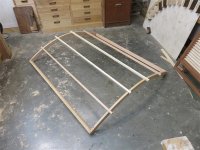
Will make a good guest room :)
It's not impossible that it might be used like that one day. As our grandchildren count grows, and our circle of overseas family extends, when they all descend on us at once in the summer holidays we might foreseeably be trying to sleep 12 or 13 people in a 4 bed house. A bit of overflow accommodation might be useful.
 
It's not impossible that it might be used like that one day. As our grandchildren count grows, and our circle of overseas family extends, when they all descend on us at once in the summer holidays we might foreseeably be trying to sleep 12 or 13 people in a 4 bed house. A bit of overflow accommodation might be useful.
Just as long as you draw the line at camp beds in the workshop. :)
 
Ooh that big oak trim is looking very nice! Seeing it out like that makes we wonder are the swoopy wheel arches from the initial sketch going to be a masterpiece in bent lamination or metal?
 
.......... are the swoopy wheel arches from the initial sketch going to be a masterpiece in bent lamination or metal?

I'm thinking I might try making them of fibreglass.
 
I'm thinking I might try making them of fibreglass.
Interesting, as I pondered what you said I was thinking that that would be an opportunity to do something sleek and aerodynamic, but then I realised that would probably entail two matching left and right moulds so twice the work.
When I was at school the woodwork teacher was making a canoe from a mould that he asked a few of us to help make, quite a complex procedure involving shaped ribs filled in with plaster, scraped to a smooth fair line, then a two part mould was made on that plug then finally a canoe was produced.
Are you sure you want all that work Mike? But on the other hand it might look a bit of a cheap cop out with bought ones.
Laminated wood?
 
Interesting, as I pondered what you said I was thinking that that would be an opportunity to do something sleek and aerodynamic, but then I realised that would probably entail two matching left and right moulds so twice the work.
When I was at school the woodwork teacher was making a canoe from a mould that he asked a few of us to help make, quite a complex procedure involving shaped ribs filled in with plaster, scraped to a smooth fair line, then a two part mould was made on that plug then finally a canoe was produced.
Are you sure you want all that work Mike? But on the other hand it might look a bit of a cheap cop out with bought ones.
Laminated wood?
I'm open to laminated wood, but I'd probably paint them, or fibreglass them such that they were a contrast to the wood of the body. I think it possible to have TOO much wood! I don't have to make an immediate decision. I have a pair of plastic half-round things which will get me through the IVA (the testing procedure). As for the amount of work...........well, that's sort of the point of this whole thing. I seem to be taking the longer option for any part I make. I'm having fun just playing, and there's no deadline for completion.
 
Summer is just around the corner, camping time.
Very true. I should be OK to use it by early April, but I need some dry weather over 16 degrees to do the fibreglass and the 2 part varnish. That can happen in March, but some years it doesn't happen until May or even June.
 
Remember right at the beginning of this build that I talked about doing this instead of building a boat? Well, we're at the point of the build which is most boat-like. Time for some more steaming and laminating: in other words, more curved bits of wood. I set up a steam box again:

IMG_09142.jpg

There were two tasks for it. One was to pre-bend the strips of wood which will be laminated into the rear hatch (boot lid). Here they are on the former:

IMG_09143.jpg

The other was to make a strip which surrounds each door. These were to be in ash, 8.5mm thick, and bent around a very tight radius. I made 6 pieces, leaving me with a couple of spares if any broke. They soaked in the pond for a couple of days, then went in the steamer, and then got bent around the door (rather than a former). The very first one broke:

IMG_9144.jpg

I graded them in the steamer from best to worst, and that was my best piece. I didn't have high hopes after that. However, that was the last of the major issues, thankfully. Here's the first door with the 2 bent pieces cooling:

IMG_9145.jpg

Note the few fibres in the near corner which broke. I had allowed quite a lot of additional width, so these can be ripped off the edge. Here's a good corner:

IMG_9146.jpg

As someone who has worked with straight pieces of wood my whole life, I am still struggling to get used to the idea of a piece of wood being able to do that. The second door went even better:

IMG_9147.jpg

Once they had cooled I cut them to length and glued them in place with PU glue:

IMG_0003.jpg

The one corner which wasn't perfect wasn't as bad as I thought:

IMG_0002.jpg

A day or two later I revisited the strips for the hatch lamination. They simply hadn't bent enough, and had sprund back too much, so I steamed them around a tighter bend:

IMG_9148.jpg

I needed the former for the next batch, but found a conveniently spaced pair of studs in my garage wall so that they could continue cooliong with the right bend radius:

IMG_9149.jpg

I cleaned up the door edge trims, which was quite a delicate job planing down to a very soft ply:

IMG_0005.jpg

Having learnt from laminating the bog oak last week, I decided that I needed epoxy this next batch of laminations, I couldn't afford any (well, much) springback this time. I went to my local yacht chandlers and invested in some West System's epoxy, with a fast hardener, and some thickener. I have never used epoxy before, so I spent quite a long time on their technical help line, and can't recommend them high enough. I put the phone down fairly confident that I knew what I was doing. Anyway, here's the set-up for epoxy-ing my first laminations:

IMG_0006.jpg

The fast hardener, which I had to use because of the temperature, gives you 10 to 15 minutes of pot life, so you really do have to get your ducks in a row. Anyway, the mixing/ spreading/ clamping process went really well:

IMG_0007.jpg

Given the springback on my bog oak laminations, I tightened up the curve of the former, assuming that despite the epoxy being a much harder/ stiffer glue when dry than PVA that there would still be a bit of springback. There wasn't:

IMG_0008.jpg

That meant that this lamination was too tight a curve.

I corrected the former for the next one, and that went well. That left me with one piece which need correction.

I marked up a template, using a compass, nails, and a batten to offset from the know curve:

IMG_0009.jpg

IMG_0010.jpg

I ruined one of the edges, but it wasn't important. You can see from the template that I needed some extra laminations, both internally and externally. I found some off-cuts and glued them on (using PU):

IMG_0011.jpg

When that dried, I cut and cleaned both ribs until they were the right shape, and identical. This involved much spokeshaving and planing:

IMG_0012.jpg

IMG_0013.jpg

More in a minute....
 
It took some time, and lots of checking for squareness:

IMG_0014.jpg

As I was shaping them, I realised that I needed some way of returning them to their exact position to enable me to safely mark up for the joinery with accuracy. I decided to cut the half laps of the external cross-ribs:

IMG_0015.jpg

Once I had done that, I could always insert a piece of scrap, and it would pull everything into proper alignment. That enabled me to rip each rib in two, to form the 4 I needed:

IMG_0016.jpg

The bottom two, with the laminations running out, will be the two central ribs, which don't take anywhere near the same load as the outer ones.

Cutting the joinery wasn't straightforward. I started with the easy bit: the tails of the dovetailed corner joins. Here is the entirety of my marking out:

IMG_0017.jpg

IMG_0018.jpg

IMG_0019.jpg

When I say awkward, think about how you would offer up a curved 1.4m long tailed piece onto the end of a 1.5m straight piece, to mark out for the sockets. I didn't have enough hands to manage that and take a photo at the same time, as you can imagine.

The next issue is sawing for sockets on the end of a 1.5m long piece of 2x1. Normally you try to saw fairly vertically:

IMG_0021.jpg

Once a couple of joints were done, it got easier to do the marking out:

IMG_0022.jpg

Eventually, all 4 corners were done and I could do a dry fit (with the cross-ribs in place):

IMG_0023.jpg

That was close of play for the day, and as I was tidying up I realised that I had got the frame fundamentally wrong.


--------


The geometry of a curved lid with a straight bottom edge meeting a stepped-and-curved edge with seals, and that meeting a straight edge with seals, isn't straightforward, and when I had set the length of the lid I hadn't got the geometry right. Luckily, the fix was pretty easy. I had to lose an inch or two off the ribs:

IMG_0024.jpg

Unfortunately, this left me needing to use the pins to layout the tails, and as someone who has spent a lifetime doing it the other way (I nearly said "the right way" :) ), I found this very awkward. I checked a few times before I picked up a saw:

IMG_0020.jpg

The middle 2 curved ribs are going to meet the top and bottom of the frame in a sliding dovetail, so they're be a different length from the two end ones which have through dovetails. I lined everything back up using the half-lap joints, and transfered the shoulders:

IMG_0025.jpg

Then it was just 4 simple dovetail grooves, (tenon saw, chisel and router plane):

IMG_0027.jpg

........and a bit of hand-chiseling:

IMG_0026.jpg

I pointed the camera and pressed the button at one of the completed joints, but unfortunately it was set in "movie" mode, so there is no image. They all 4 worked well, though:

IMG_0028.jpg

I carefully cut the other sides of the half laps, in the cross-ribs, making absolutely sure that everything was square and true. A world of pain would await if I managed to make this lid out of square or true:

IMG_0029.jpg

I then pushed everything together in a dry fit, and went and offered it in place:

IMG_0030.jpg

IMG_0031.jpg

It fits! Phew......

The observant will have seen that the inside of the teardrop is now stripped of all cabinetry, and is grey. It's the same inside the bedroom, and on the inside of the doors (which is why I needed to bend the edging strip around them). This is the first of 3 coats of a marine primer, which will be followed by 3 coats of a bilge paint. No matter what the final finish is, this waterproof (and oil-proof) paint is designed to keep moisture out of the walls.
 
Last edited:
Back
Top