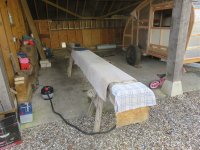
I'm getting jobs out of the way which lead to being able to start doing the external cladding. The first of these is the insulation. However, before I could do that, I had to infill the gaps between the ends of the roof timbers. These bits of wood serve no structural purpose, but will take the end pin holding the cedar strips in place on the side. Therefore, they were cut from scraps of Douglas fir of any old thickness, then just cut on the bandsaw to fit the ply roofline:

I screwed and glued them in place on both sides of the roof:

That enabled me to start on the insulation. I have a 50mm gap between the roof ply and the underside of the cedar strips, and 40mm Celotex. That difference is to allow for fitting segmented bits of straight/ flat stuff onto a curved surface, and the gap will be filled with spray foam as I do the cedar cladding. To make the Celotex follow the curve more closely, I cut most of the way through the boards with a circular saw:

That was a filthy horrible job! But it worked nicely:

Remember, all of the external skin is glued, to make the construction, in effect, a torsion box. Therefore, the tedious part of the job was squeezing copious amounts of PU adhesive onto the back of the Celotex, and then clamping/ wedging it in place as the glue dried:

The astute will have noticed a new piece of sapele at the lower edge of the roof. This is because this edge will be visible when the kitchen lid/ hatch/ door thingy is open. It is also there to add a lot of beef to the roof at that point, because the hinge will exert a load, and more importantly, the gas struts will be trying to push the roof up and off its frame when the hatch is shut.
I need to make the hatch. However, at the moment I don't know the line of the bottom edge of it, nor the top. So, I have to do the trim on the kitchen wall sides, which define the under-edge (it's slightly more complex than that, as you'll see in the next week or so). Before I did the trim I offered up the original template to mark the true line:

I had left everything at the bottom of that curve slightly proud and unfinished because there is a great deal of complexity there, with bits of timber and steel meeting all over the place:

I could then make a quick router guide:


I'm still not completely sure how all that resolves itself neatly (but it will!).
I could then take a pattern:

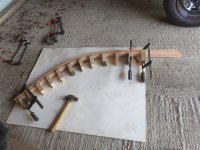
On this pattern (which I'd probably do differently next time) I made a whole lot of clamping blocks, and hot glued, then screwed them in place:


If you look closely, you might see I have eased the blocks in a few mm at each end to allow for spring-back. It was to turn out that this wasn't far enough.
I went to my bog oak store, and found a suitable piece of wood:

This isn't wood for a beginner! It's all over the place, and has lots of faults (particularly twists and shakes). This piece was was good enough, and I ripped off a section which was then cleaned up:

I made this four-square, and then ripped it into 6mm strips on the bandsaw, planing between each cut, and then thicknessing the final strips in my P/T:

The tops of the piece that these lamination will make are the bearing surface for the hatch seals, and I wanted a "gutter" between the two lines of seals. I ran this in quickly on the router table:

I could then glue up the first piece, and that went really easily and well:

Whilst that was drying, I de-clamped the insulation on the teardrop, and I prepared a whole lot of Douglas fir for laminations of the curves of the hatch/ lid. I was using my very last piece of Douglas fir, and needed it to make the maximum possible number of laminations. Therefore, instead of using the planer between each cut, I planed it at the bench to take off the very minimum:

I don't have a photo of the finished pile, but you'll see enough of them next time.
In due course, I de-clamped the first lamination, which sprang back about 40mm at the end. That's fine for this piece, which is being fixed into place, but is an important lesson for the hatch, which has to be precisely the right curve. I'm going to steam bend those pieces first, and then glue with epoxy, rather than with PVA. If I can get the steaming right the I shouldn't need to guess too much with the lamination former. Anyway, I cleaned the first piece up:

......and then offered it into place:

The other laminated piece was glued up and left in clamps overnight.
Lots of very important lessons learned!


 I guarantee you'll attract a crowd of curious admirers if on site.